From Zero to Cited, Part 1: Does SEO Still Matter When Everyone Asks ChatGPT?
Does SEO still matter when everyone asks ChatGPT? Part 1 of our free SEO course breaks down AI search visibility and how citations work in 2026.

Dana Willow
Senior Marketer sharing 15 years of marketing wisdom through an AI lens.
Published on September 21, 2026
Updated on September 22, 2026
SEO still matters, even with ChatGPT. It's exactly where this free 10-part SEO course starts. This is Part 1, and I'm giving you a straight answer.
By the end of this course, you'll know how to research keywords for the business you already run, plan content at scale without hiring a content team, write with AI without sounding like a template, and get cited by ChatGPT instead of watching your competitor get quoted in your place.
What This 10-Part SEO Course Actually Covers
Here's the roadmap so you know what's coming. Skip ahead if you need to.
Part 2: keyword research fundamentals. The actual mechanics of finding what people type and ask before they land on your site.
Part 3: finding opportunities inside the business you already run. Your existing services, products, and the questions you already answer every week, not some hypothetical business from a textbook.
Part 4: planning content at scale, because one blog post a month was never going to move the needle.
Part 5: free tools and how to structure content pages that actually earn a place in results.
Part 6: writing articles with AI the right way, so they sound like your business and not a template someone else already used.
Part 7: getting cited by AI search. This is probably why you clicked. What separates a source that gets quoted from one that gets skipped.
Part 8: competitor intel and distribution. Good content doesn't just sit there waiting to get discovered.
Part 9: holding onto your rankings once you've earned them. Keeping a spot takes a different set of moves than winning it.
Part 10: the minimal effective dose. The smallest amount of steady SEO work that keeps a small team or a one-person shop visible without wearing anyone out.
Ten parts, one thread: get found by people who are already looking for what you do, whether they're typing into a search bar or just asking a model to point them somewhere.
Does SEO Still Matter When Everyone's Asking ChatGPT?
Yes. And the reason is simpler than most explanations make it sound.
AI answers don't come from nowhere. ChatGPT, Perplexity, and Google's AI Overviews are built on the same web pages that already rank in regular search results. They lean hardest on pages other sites already cite, link to, and treat as reliable.
Google's own Search Central documentation says AI Overviews are grounded in the same ranking systems and quality signals used for classic search results, not a separate system with its own rules (Google Search Central). If a page isn't strong enough to earn a spot on page one, it's rarely strong enough to get pulled into an AI answer either.
SEO in the Age of AI Still Runs on the Same Signals
The shift changes where your customer's attention lands. It doesn't change what it takes to earn it. SEO in the age of AI still runs on clear writing, real expertise, structured pages, and other sites willing to reference you, the same four things that mattered back in 2015. What changed is the scoreboard: instead of counting clicks alone, you're also counting how often a model decides you're worth quoting.
So when someone asks me if SEO still matters, here's what I tell them: somewhere in your market, an AI model is already answering your customer's question about your industry, whether or not it's ever heard of you. Some businesses get named as the answer. Some get skipped. That split gets decided with the same signals search engines have used for years: clear structure, real answers, and other credible sites pointing back to you.
Check Where You Already Stand on AI Search Visibility
Before you plan anything, you need to know your starting point. This is the one hands-on step in Part 1, so let's do it now.
Open PostKing, go to Search Performance, then AI Visibility. That page shows you which AI engines already mention your business, what they say when they do, and who's getting cited in your place when they don't.
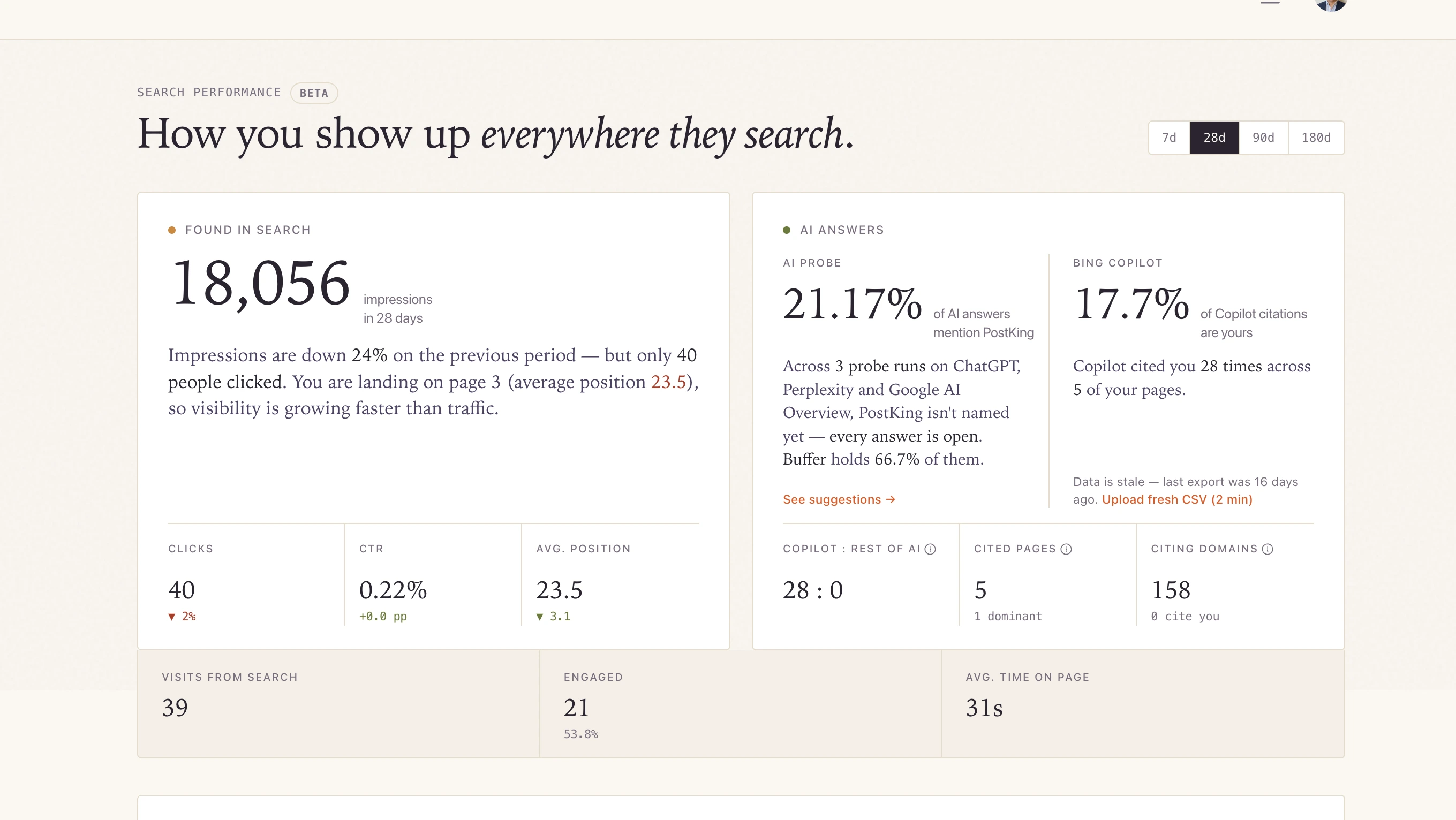
Here's what to do:
- Run it for your own business name.
- Run it for your main service.
- Run it for one or two questions your customers actually ask a chatbot before they ever call you. A dental practice might check "best way to fix a chipped tooth." A cybersecurity vendor might check "how to stop phishing attacks at a small company."
You're looking for three things: whether you're mentioned at all, whether what's said is accurate, and which competitor keeps showing up in your seat instead of you. That last one usually stings the first time you see it.
Honestly, this single check does more for your AI search visibility than any article you'd write this week. It tells you whether you're dealing with a visibility problem or a trust problem, and those get fixed in different ways. AI search visibility means showing up when the answer engine speaks, whether or not anyone ever scrolls through a page of blue links to find you.
Want it from Google directly? This one's worth the half hour.
Do's and Don'ts for Getting Cited by ChatGPT
This applies whether you run a clinic, a law firm, a cybersecurity vendor, or a plumbing company with three trucks. And it works without a dedicated content team.
What Works
Answer the exact question your customer is typing or asking out loud. Plain language, near the top of the page, before any backstory or company history.
Use real specifics: your city, your certifications, your actual process, a price range if you can share one.
Keep pages structured with real headings so both people and models can find the part that answers the question.
Update pages that already rank instead of only publishing new ones. A page a model already trusts is worth more polish than a blank one.
What to Avoid
A few habits quietly undo everything else in this section.
Burying the real answer under three paragraphs of company history is the most common one.
Thin pages that repeat a keyword phrase without adding anything new rarely earn a second look from a model deciding who to quote.
Citations aren't permanent, either. These systems re-check sources constantly, and a competitor with a sharper, more current page can take your spot within a few weeks.
The businesses getting cited by ChatGPT right now are mostly the ones with strong pages built before anyone thought to ask an AI these questions at all. The best time to fix a weak page was months ago. The second best time is today.
Does SEO Still Matter? Yes. Here's What's Next.
Does SEO still matter when everyone's asking chatbots instead of typing into a search bar? Yes. AI search runs on the same foundation rankings always did: clear answers, real expertise, and other sites willing to link back to you.
The businesses getting cited right now aren't pulling off some secret trick. They're just doing SEO well, on pages built for a human reader and a model deciding who's worth quoting.
Check your AI visibility today if you haven't already. Then come back for Part 2, where we cover keyword research: the actual questions your customers type and speak out loud, and how to find every one of them.
From Zero to Cited · Part 1 of 10 · Course overview
About Dana Willow
Author
Senior Marketer sharing 15 years of marketing wisdom through an AI lens. Teaching founders to automate smarter.