

From Zero to Cited, Part 3: Finding Keyword Opportunities for a Business You Already Run
Your competitors already mapped the keywords worth chasing. Here's how to run competitor keyword research in PostKing and put their work to use.

Dana Willow
Senior Marketer sharing 15 years of marketing wisdom through an AI lens.
Published on September 21, 2026
Updated on September 22, 2026
Here's the thing about where you're sitting right now: you're not starting from zero. You've got a business, a website, maybe a solid Tuesday and a weird slow Thursday, and rankings that already exist for some keywords and just don't for others. This is Part 3 of the From Zero to Cited series, and unlike Part 1, we're not doing the "find your niche" meditation again. You already have a niche. It sends invoices. What you need is more keywords that actually turn into customers, and you need them faster than staring at a blank spreadsheet will ever get you there.
The fastest route in is competitor keyword research: look at whoever's already outranking you and figure out why, calmly, the way you'd study someone else's garden before you plant your own. I used to do this the hard way, one search at a time, incognito tab after incognito tab, trying to guess what some content team was thinking six months ago. It works, sort of, the way digging a trench with a soup spoon works: slow, technically possible, not something you'd recommend to a friend. Google's own SEO Starter Guide says basically the same thing in drier language: looking at what already ranks for a query is one of the fastest ways to understand what that query is actually asking for.
Start With Whoever's Already Winning: Your Free Research Department
Somewhere in your search results right now, there's a page beating you for a keyword you'd like to own. Could be a direct competitor. Could be some content site or marketplace that just happens to speak your buyer's language fluently. Doesn't matter which. That page is a research report somebody else already paid to produce, and you get to read it for free.
Here's the hands-on part. Open PostKing and add that competitor by domain. It runs a profiling pass (sometimes called a probe) that pulls the domain's ranking keywords, its estimated traffic split, and the pages doing the actual heavy lifting. Give it a minute. Then read the overview screen slowly instead of skimming it like a horoscope. This is where you catch the stuff no rival would ever put in a slide deck: they're ranking for a comparison term you never thought to write, or half their organic traffic is quietly funneling through one pricing page.
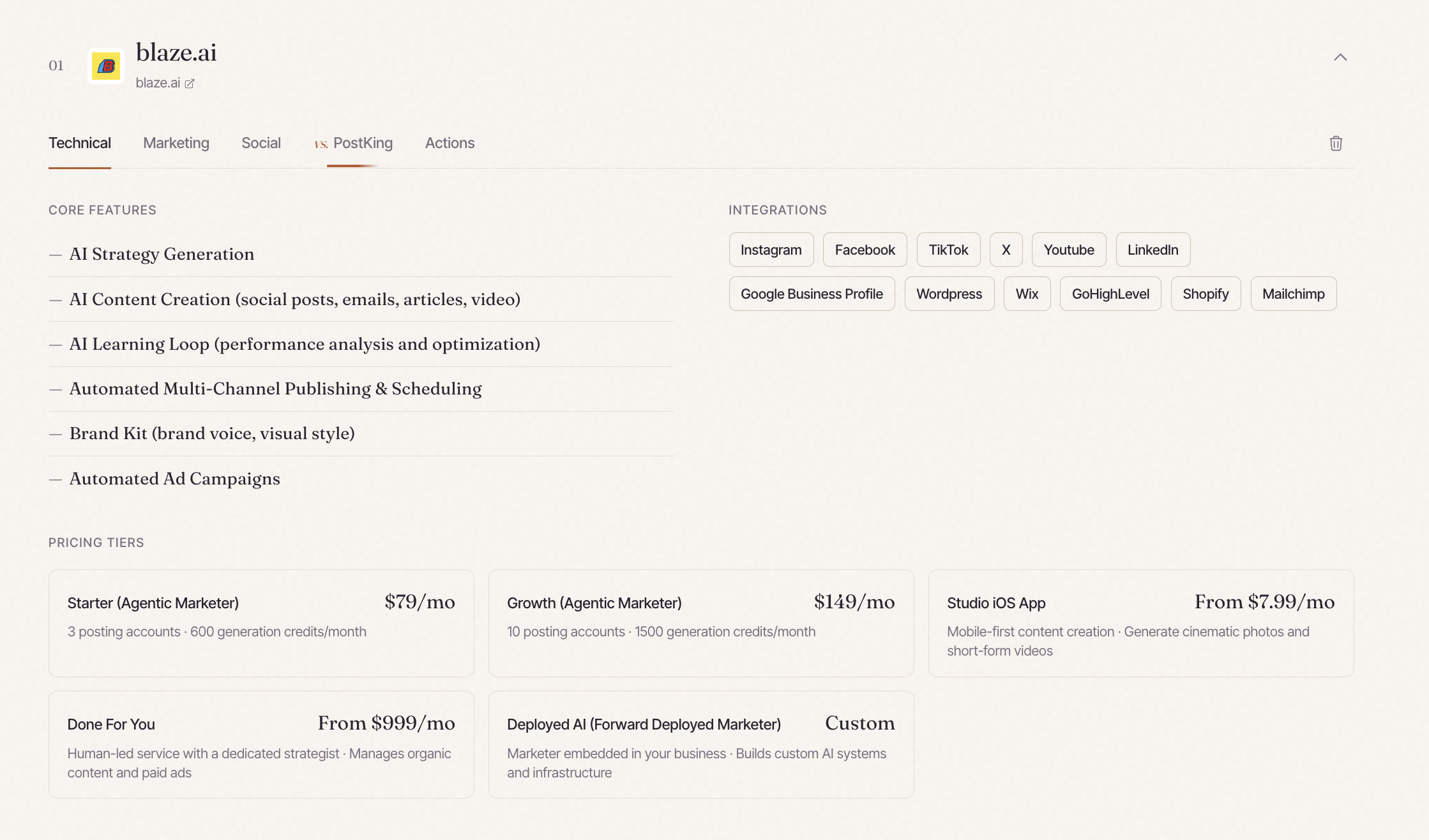
I'd add one competitor at a time here, not five. It's tempting to profile every business that looks vaguely like yours in a single sitting, but the overview only earns its keep when you're reading closely enough to ask "why does this page rank and mine doesn't." That question gets slippery fast once you've got five dashboards open and a lukewarm mug of tea.
Content Gap Analysis: The Keywords They Rank For and You Don't
Once you've profiled a competitor, run a content gap analysis. Basically: what are they showing up for that you aren't. PostKing's keyword gap report lays your keyword list next to theirs and shows the difference. This is usually where the good surprises live, because the gap almost never matches what you assumed the competitor was "known for."
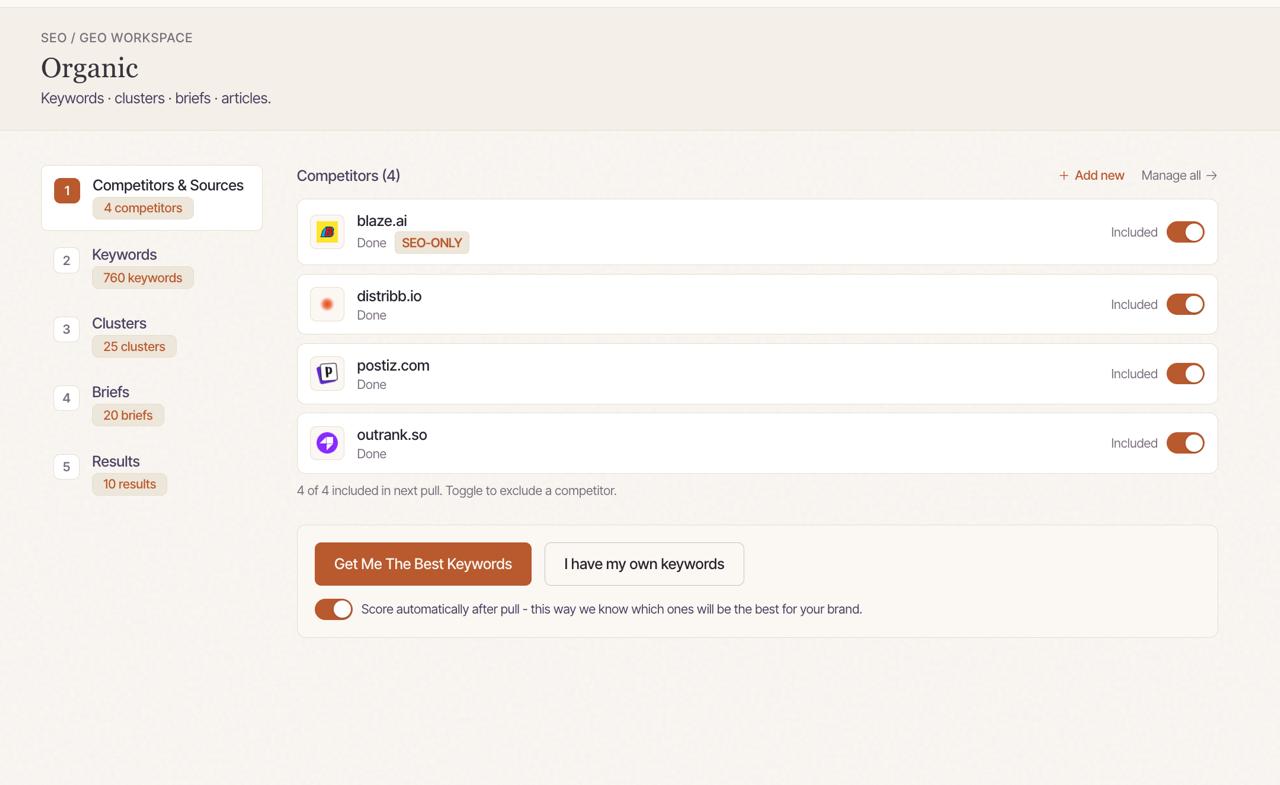
Don't export the whole list and dump it into your content calendar. A raw content gap report comes stuffed with branded terms, long-tail junk, and difficulty scores that assume a domain with a decade of backlinks behind it. Filter before committing to anything. Look for where low difficulty overlaps with decent search volume: that's the zone where a newer or mid-sized site actually has a shot at ranking in a normal timeframe, not a theoretical one. Moz has argued for years that keyword difficulty matters more than raw volume, and it holds up. A 10,000-search term you'll never crack isn't worth as much as a 400-search term you can own by next quarter.
Pull the filtered keywords straight into your keyword list from the report screen. That's the whole point of using a gap tool instead of a spreadsheet: it turns an overwhelming wall of data into a short list you can act on this afternoon, no research assistant required.
What a Content Gap Analysis Actually Tells You
It's not just a list of missing words. A content gap analysis usually reveals a missing content type, not just a missing term, and that distinction matters when you're deciding what to build next. Sometimes you're missing a comparison page. Sometimes it's a glossary entry. Sometimes it's a whole category of "how to" content you assumed your customers would never search for, because surely they'd just ask you directly. They won't. They'll Google it first and email you second, if you're lucky enough to get the email at all.
Following the Trail: Related Terms, Expansion, and the Keyword Gap Tool
The keywords a competitor ranks for rarely tell the whole story. Most keyword gap tools show an "also ranks for" layer, related terms and near-synonyms their pages pick up almost by accident, and that's where a lot of the real volume hides. If a competitor's page ranks for "employee scheduling software," it's probably also picking up "shift planning tool" and "staff rota app" without anyone on their team ever targeting those phrases on purpose.
Expand the surfaced terms in PostKing and you'll usually turn up three or four related phrases for every keyword you started with. Some are near-duplicates, not worth a separate page. Others reflect a genuinely different way a chunk of your audience searches, and that's worth sitting with for a minute, especially if you sell into more than one market.
Here's where a lot of teams trip up, say, running the US and Czechia at once, or any two markets with different search habits: the same product gets called something else depending on who's typing. A US buyer searches "project management software." A Czech buyer might search "software pro řízení projektů," or just default to the English term, depending on the industry and how techy the local vocabulary already runs. Geo-tag every expanded term by market as you add it, so your keyword list doesn't quietly assume everyone visiting your site searches in your home market's language and phrasing. Small habit. It saves you from writing a beautiful page optimized for a phrase nobody in that market ever types.
Want the reality check on those competitor metrics, straight from Google? This one's worth the listen.
Do's and Don'ts When You Find Keywords Competitors Rank For
Quick gut check before you dump everything into your content calendar. Once you see how much volume is sitting there, it's easy to get greedy.
Don't chase their branded terms. A competitor ranking for their own company name is a trademark with a search bar attached. You won't outrank it, and trying just burns a content slot you could've spent on something winnable. Skip anything built around a rival's product name or tagline, unless you're writing an honest, above-board comparison piece.
Don't add keywords you have no page for yet. A keyword sitting alone in a spreadsheet with no content behind it is a wish, and wishes don't rank. If a term from the gap analysis doesn't map to an existing page, or a realistic one you'll actually build soon, either commit to writing it or drop it from the active list. Half-finished intentions just clutter your reporting and make your coverage look better than it is.
Do prioritize by difficulty and relevance together, not volume alone. The keyword with the biggest number attached isn't automatically the one worth chasing first. Low-difficulty and squarely matched to something you actually sell usually wins out, quietly, every time.
Do revisit competitor profiles periodically. Rankings shift. Competitors publish new pages while you're not looking. A gap report from six months ago is a snapshot, not a permanent map.
Where This Leaves You
Competitor keyword research is a shortcut to demand you'd have taken months to find on your own, then building something better for it than they did. Profile a competitor. Run the content gap analysis. Filter it down to what's actually winnable. Follow the related terms and regional variants a little deeper. Skip the branded noise. That's the whole loop, and you can repeat it with a fresh competitor any time your content calendar looks thin. Give it a clearer map and it'll do the rest.
Part 4 picks up right here: what to actually do with a keyword list once it's full, and how to turn it into pages instead of a list you check once and forget.
From Zero to Cited · Part 3 of 10 · Course overview
About Dana Willow
Author
Senior Marketer sharing 15 years of marketing wisdom through an AI lens. Teaching founders to automate smarter.