

From Zero to Cited, Part 4: From Keyword Clusters to a Content Roadmap
Skip thin programmatic pages. Build a content roadmap for SEO from clustered keywords, then generate briefs that turn each cluster into one strong page.

Dana Willow
Senior Marketer sharing 15 years of marketing wisdom through an AI lens.
Published on September 21, 2026
Updated on September 22, 2026
For a long time, scaling content was simple: more pages, full stop. Ten thousand city-plus-service pages, swap a variable, hit publish, move on. That's classic programmatic SEO. It worked, right up until Google got a lot better at telling a page built for a crawler apart from a page built for a person.
This is Part 4 of 10 in the From Zero to Cited series. If you're planning content at scale in 2026, the honest starting point is a content roadmap built out of keyword clusters, not a spreadsheet of thin templates.
Here's the thing I keep seeing: someone spends weeks building a beautiful keyword list, four hundred terms, color-coded, the whole bit, then stalls out. Turning four hundred rows into pages that don't read like they came out of a spinning machine is genuinely hard, and that's what this part is for.
Two Audiences, One Rule
Every page you publish has two audiences: the person reading it, and the systems deciding whether to show it to anyone. Most people treat those as separate jobs, one for "content," one for "SEO." They're the same job wearing two hats.
Google's own guidance on helpful, reliable content puts it plainly: would you be comfortable recommending this page to a friend as genuinely useful (source: Google Search Central, developers.google.com)? At this point, that's close to a literal ranking signal.
So here's the rule, and it's blunt on purpose: match and exceed what's already out there. Look at what's currently ranking for a keyword. Notice what it covers, what it skips, what it fumbles. Then build something that covers the same ground and keeps walking, a sharper example, a clearer answer, some small tool the other pages never bothered with.
If your draft can't beat the top three results on substance, it's not ready. One quiet gut check, whether a reader walks away satisfied, tells you almost everything about whether Google bothers showing it to anyone else.
Matching Content Type to Search Intent
Here's a mistake I see over and over. Someone writes a careful two-thousand-word article for a keyword where every top result is a pricing page. The writing's genuinely good. It never had a chance, because it answered a question nobody asked.
Intent decides the format before you write a single sentence. An informational query, something like "how does email deliverability work," wants an article: clear, thorough, no pitch buried in paragraph three. A comparison query, "PostKing vs. Jasper," wants a comparison page with an honest table and real tradeoffs named out loud, not a puff piece wearing objectivity as a costume. A transactional query, "free content calendar template," wants a landing page or a free tool, something the visitor can grab in the next sixty seconds. A navigational query, someone typing your brand name straight into the box, doesn't need a new page at all. Leave it alone. Spend the effort where it earns something back.
Get the intent wrong and you can write a genuinely strong page that still goes nowhere, because you solved a problem nobody searching that phrase actually has. I've done this myself: poured care into an explainer for a term that turned out to be mostly commercial intent underneath. Rewrote it as a landing page, and the rankings moved within weeks.
What Replaces Classic Programmatic SEO: A Scalable Content Strategy
Old-school programmatic SEO worked like a mail merge. Take a template, drop in "[City] + [Service]," spit out five thousand pages overnight, and hope volume carries the day. It worked for a while, honestly. Then Google's helpful content systems got good at spotting the pattern, and sites built that way didn't get gentle little corrections page by page. They got steep, sitewide drops (source: Search Engine Land's coverage of Google's helpful content update).
Scaling still works, but you need to change what gets scaled. Instead of templating thousands of near-identical pages, you group your keywords through keyword clustering, gathering every term that shares the same underlying intent so "invoice template," "free invoice generator," and "how to invoice a client" don't turn into three thin pages competing with each other. They become one page substantial enough to earn all three.
That's the whole shift: one well-built page per cluster, not one thin page per keyword. The scaling happens at the research and planning stage, where a machine is fast, while the actual writing stays focused on fewer, stronger pages. You end up publishing less and ranking for more. Sounds backwards until you've watched it happen on a real site.
Hands-On: From Seed Keywords to Keyword Clustering in PostKing
Here's how this actually runs inside PostKing.
Start with seeds. Drop in your core topics. Run a bike repair shop? Your seeds might be "bike tune-up," "flat tire repair," "e-bike servicing." You don't need a finished list, just the handful of terms that describe what you do all day.
Generate. PostKing expands those seeds into a full keyword set and clusters them by shared intent, not shared words. "How to fix a flat on the go" and "flat tire won't hold air" land in the same cluster even though they barely share a word, because they're answering the same question.
Review. This step matters more than people expect. The clusters are a strong first pass, not a finished decision. Skim for anything that got lumped in wrong, a comparison term sitting inside an informational cluster, that sort of thing.
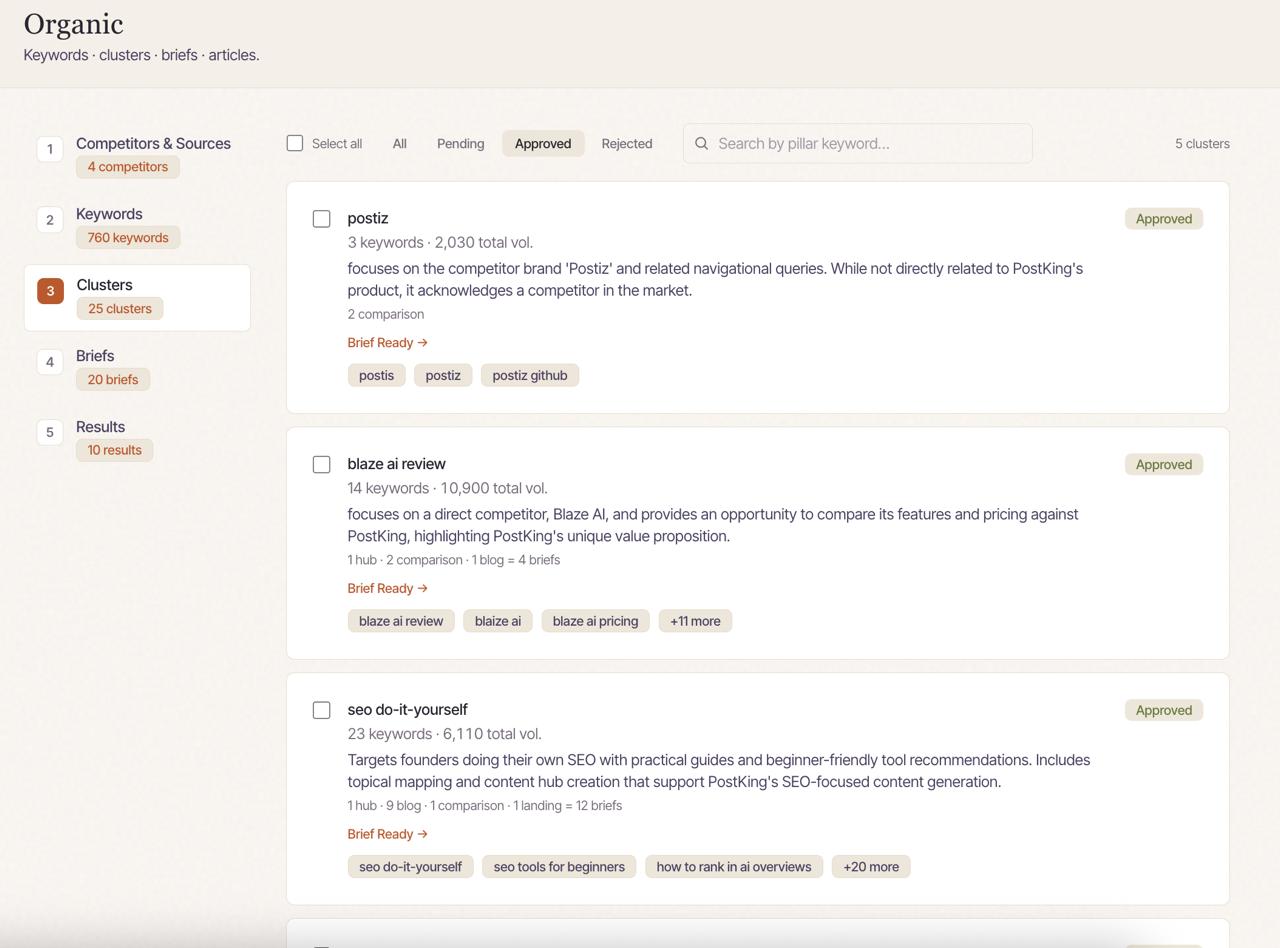
Merge and approve. Combine clusters that are really the same page wearing two different names. Split the ones trying to cover too much ground. Then approve what's left. That approved set becomes the raw material for everything downstream, so a sloppy pass here shows up later as a sloppy roadmap.
Hands-On: Clusters to a Prioritized Content Roadmap for SEO
Once your clusters are approved, the next step turns them into a plan you can hand to a writer, or sit down and write from yourself.
Generate the roadmap. PostKing takes your approved clusters and ranks them by a mix of opportunity and difficulty, so you're not just guessing which one to tackle Monday morning.
Review the briefs. Each cluster turns into a brief: an outline, the intent it's aimed at (informational, comparison, transactional), and the supporting keywords it should naturally fold in. This is where content brief generation quietly does the work that used to eat an entire Tuesday afternoon, turning a pile of related keywords into something a writer can open and use.
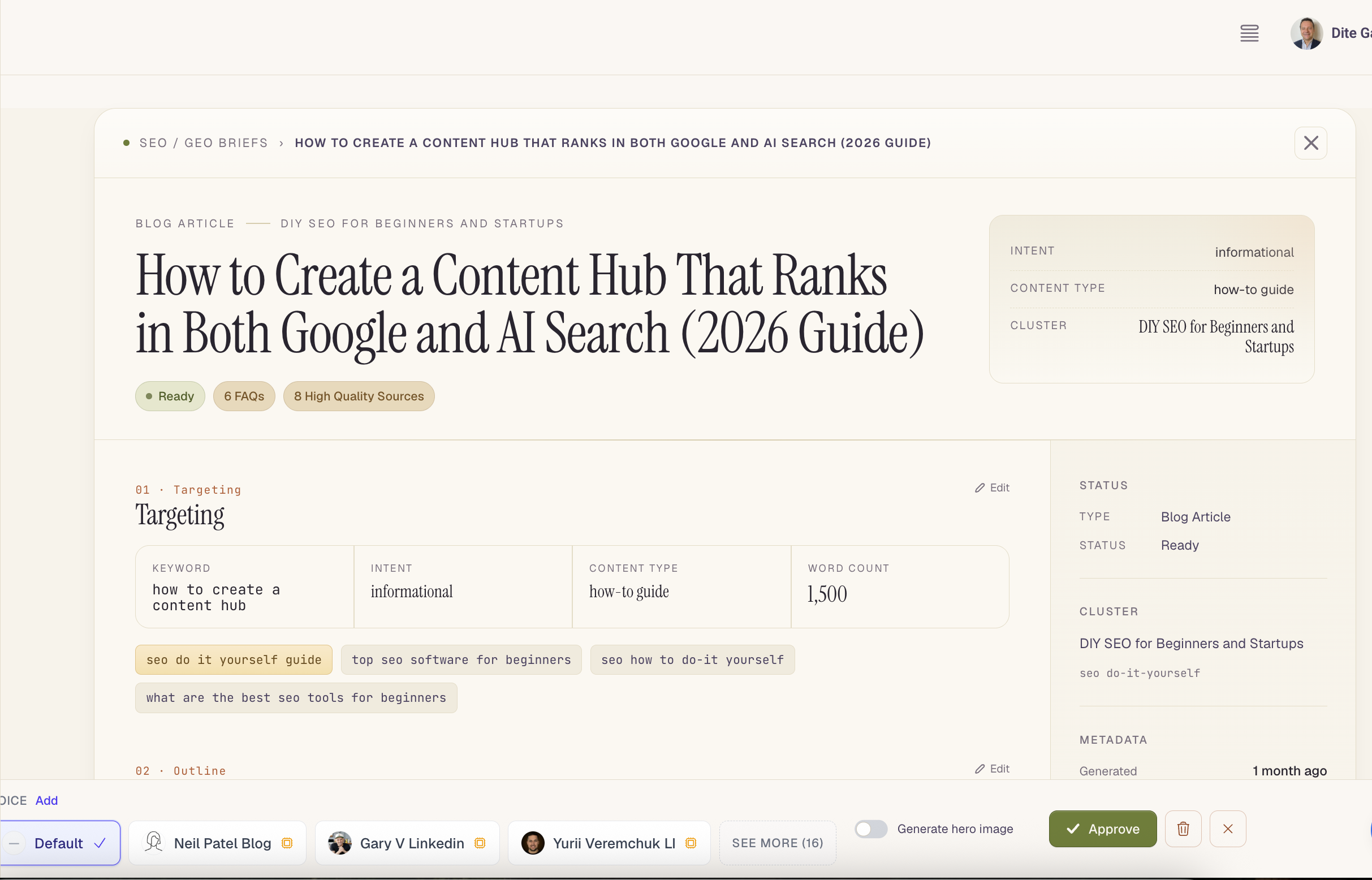
Edit. A brief is a starting point, not gospel. If the outline misses an angle your business genuinely nails, add it. If the intent call looks off, fix it before anyone builds a page on that assumption.
Approve. Once a brief looks like something you'd actually want published, approve it and send it into your queue. Fast enough to plan a whole quarter of content in an afternoon, careful enough that nothing thin sneaks through.
Want the cautionary version of this straight from Google? Worth the twenty minutes before you scale anything.
Do's and Don'ts for a Scalable Content Strategy
A few things I've learned the hard way, or watched someone else learn the hard way.
Don't approve fifty briefs in one sitting. It feels productive in the moment. Usually it just means you stopped reading closely around brief twelve, and the back half of your roadmap gets the same rubber stamp as the front half.
Do sequence by difficulty. Start with clusters you can realistically win: lower competition, a clean intent match. Save the harder, high-volume clusters for once you've built some track record on the domain.
Do keep it to one page per keyword. Two pages fighting over the same term don't double your odds. They split your own authority and leave Google guessing which one to show. That's the exact problem keyword clustering is supposed to solve, so don't undo it downstream by writing overlapping pages anyway.
Don't treat the roadmap as carved in stone. Rankings shift. A competitor publishes something sharper. Your business adds a service or a feature. Revisit the roadmap every quarter and re-prioritize, rather than grinding through it in the exact order it got generated eight months back.
Where This Leaves You
A content roadmap for SEO is just the plan that makes sure every page you publish has a reason to exist: an intent it's matched to, a cluster of real search demand behind it. Keyword clustering handles the grouping, content brief generation handles the translating, and what you're left with is fewer pages, but stronger ones.
Next up in the series: what actually goes into a brief that makes a writer's job easier instead of harder, and where AI drafting tools fit without flattening your brand's voice. For now, take your approved clusters, generate the roadmap, and read the first five briefs slowly before you go near the other forty-five.
From Zero to Cited · Part 4 of 10 · Course overview
About Dana Willow
Author
Senior Marketer sharing 15 years of marketing wisdom through an AI lens. Teaching founders to automate smarter.