
AI Marketing Tools: How to Build a Stack That Actually Pays for Itself
Cut content and campaign busywork with AI marketing tools that fit a lean team. See the categories, costs, and ROI checks before you buy the next seat.

Dana Willow
Senior Marketer sharing 15 years of marketing wisdom through an AI lens.
Published on September 7, 2026
Updated on October 10, 2026

How to pick AI marketing tools that earn their keep, with a practical framework for building a stack that pays for itself
Key Takeaways
- AI adoption in marketing is near-universal, so the edge is no longer having tools, it is picking few and wiring them together.
- Sort tools by the job (research, content, creative, email, social, analytics, ops), not by hype category.
- Score every tool on promised vs. delivered value: time saved per week, output you would actually publish, and integration cost.
- Data quality and integration break more AI rollouts than model quality does.
- Free tiers are fine for exploration; specialized paid tools earn their keep only when a repeatable weekly workflow depends on them.
- Brand voice is the failure point most tool lists ignore, generic output costs you more than the subscription saves.
What Counts as an AI Marketing Tool in 2026
A chat box does not make software intelligent. Every marketing platform now claims an "AI-powered" badge, but the label covers everything from a genuine machine-learning model to a rebranded autocomplete field bolted onto a decade-old CRM. That gap matters because buyers are choosing based on outcomes, not vocabulary, and vague claims waste evaluation cycles. Trust is part of the calculation too: Salesforce found that 68% of customers say AI advances make it more important for companies to be trustworthy, which means a tool's actual mechanism, not its marketing copy, is what teams need to interrogate before adoption. The real problem buyers face isn't a shortage of AI tools; it's the opposite. Hundreds of vendors, near-identical pitches, and no shared criteria for telling a category-defining product from a repackaged feature set. Before comparing vendors, it helps to sort tools by what they actually do:
- Generative tools that produce net-new assets, including copy, images, video, and audio.
- Predictive tools: they score, forecast, or segment audiences using your existing data.
- Agentic tools execute multi-step workflows with minimal human supervision at each step.
- Assistive layers: AI features bolted onto existing CRM, email, or ad platforms.
Generative vs. predictive vs. agentic
These three modes solve different problems and rarely overlap in one product. Generative tools create; predictive tools rank and forecast; agentic tools act on your behalf across a workflow. One eesel case study showed a generative AI blog writer helped grow daily impressions from 700 to 750,000 within three months by publishing over 1,000 optimized posts, a generative outcome, not a predictive or agentic one.
The "AI feature" vs. "AI product" test
Ask whether removing the AI component breaks the product's core value.
If the software still functions fine without it, you're looking at a feature, not a product.
The Eight Categories of AI Marketing Tools, Mapped to Real Jobs
Category first, tool name second, always. Every AI marketing purchase should start with a job to be done, not a product name someone mentioned in a Slack channel. There are eight categories that cover nearly every marketing workflow: research and SEO/GEO, content generation, visual and creative, social scheduling, email and lifecycle, ads and bidding, analytics and attribution, and workflow automation. Sorting spend by category before evaluating tools prevents the most common budget leak, paying for three tools that all claim to do the same job. Sprout Social notes that 98% of leaders agree companies need a better grasp of AI and machine learning for long-term success, and that starts with knowing what each category actually replaces. The table below lists the job each category displaces, what a strong tool looks like in that slot, and typical entry pricing.
| Category | Job it replaces | What "good" looks like | Typical entry price |
|---|---|---|---|
| Research & SEO/GEO | Manual keyword and SERP analysis | Tracks prompts and keywords, not just rankings | $0, $150/mo |
| Content generation | Freelance writer, first drafts | Matches your voice without heavy editing | $0, $99/mo |
| Visual & creative | Designer for social and ad assets | On-brand templates, batch export | $0, $60/mo |
| Social scheduling | Manual cross-posting | Platform-native formatting, not copy-paste | $15, $99/mo |
| Email & lifecycle | Segment building, subject line testing | Predictive send timing with real lift data | $20, $200/mo |
| Ads & bidding | Manual budget reallocation | Transparent attribution, exportable data | % of spend |
| Analytics & attribution | Spreadsheet reporting | Clean joins across sources | $0, $300/mo |
| Workflow automation | Copy-paste between apps | Reliable triggers, visible error logs | $0, $100/mo |
Where the categories overlap (and where you are paying twice)
Content generation and research/SEO often overlap, as many drafting tools now include keyword suggestions. Social scheduling and analytics also overlap; a scheduler with weak reporting still forces you into a separate dashboard tool. Ads platforms frequently duplicate attribution features that a dedicated analytics tool already handles better. Before adding another subscription, check whether an existing tool in another category already does most of the job. Zapier's roundup of AI marketing tools shows how much category bleed already exists among leading platforms.
The three categories a solo founder should staff first
- Content generation covers the highest-volume, most time-consuming task most solo operators face.
- Research and SEO/GEO tools prevent content from being written for the wrong queries entirely.
- Workflow automation connects the other tools so data does not require manual re-entry.
- Everything else can run manually until revenue justifies the added subscription cost.
- HubSpot's research found AI tools help marketers cut manual work and focus on higher-value tasks, which is exactly the effect solo founders need most.
The Evaluation Framework: Promised Value vs. Delivered Value
Score trials on output you would actually ship. Most tool reviews compare feature lists, not results, which is why buyers end up with subscriptions nobody opens after month two. A useful evaluation happens during the trial window itself, on your own content, against your own past output. The framework below breaks that trial into six measurable checkpoints, each with a concrete test and a pass threshold. None of them require trusting a vendor's demo or a marketing page's claims. They require logging your own time, reading your own drafts, and doing arithmetic on your own invoice. Treat the 14-day trial as a lab, not a sales call, and the numbers will tell you more than any comparison chart, including this one behindrankings.com put together after testing over 20 tools directly.
The publishable-rate test most reviews skip
Publishable rate is the single most honest metric in this table, and almost no review site measures it. Count how many drafts ship with light edits only, versus how many need a full rewrite.
A tool that saves typing time but doubles editing time is not actually saving anything.
Voice match matters just as much, and it's the criterion most tools quietly fail. Blind-read five outputs against your best existing post and see if your team can pick the AI one.
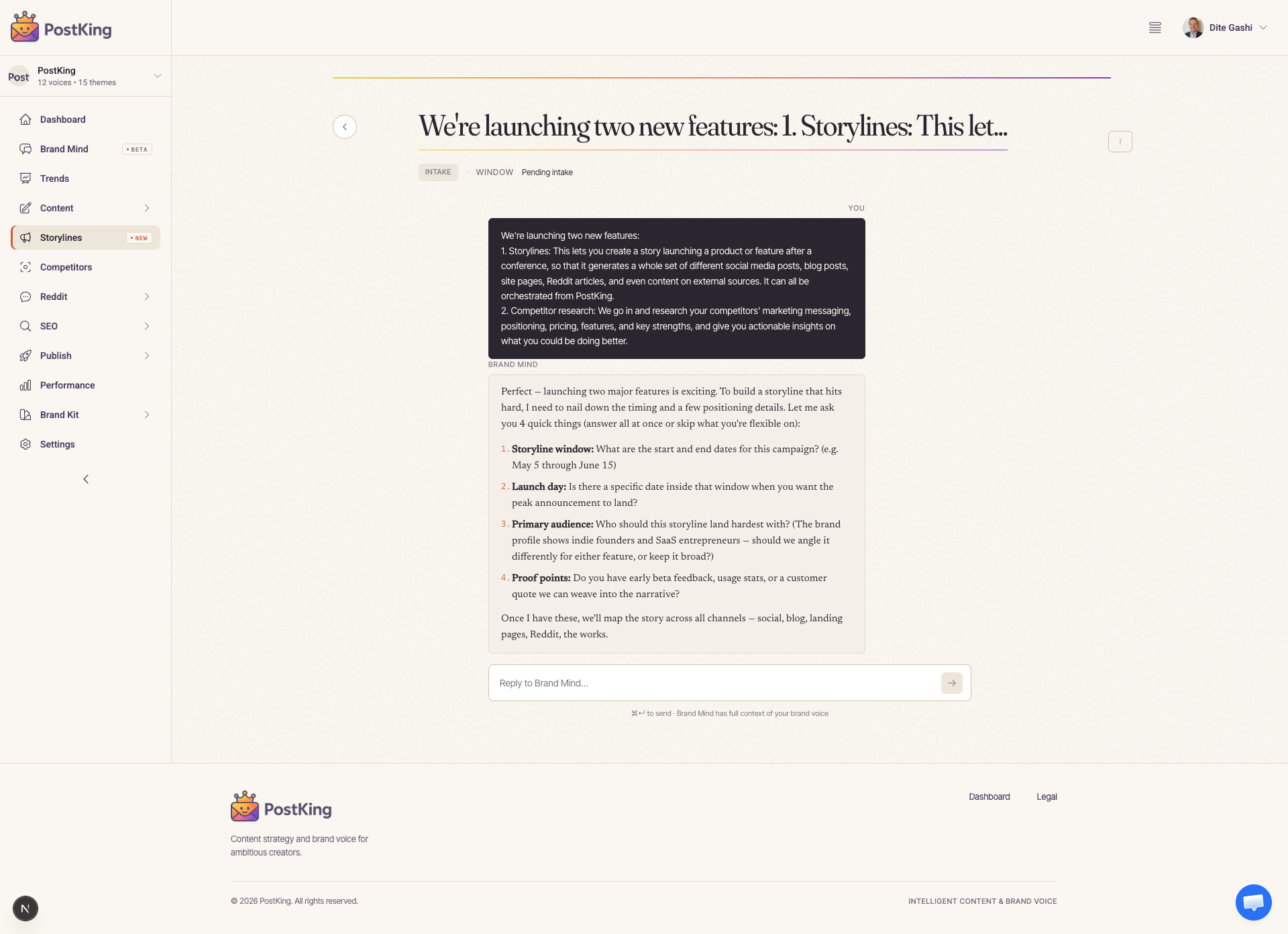
In practice, tools like PostKing build specific per-brand voice models so that test comes back inconclusive, rather than producing generic copy that reads like every other AI draft.
Credits, seats, and the pricing math vendors bury
Start cost and exit cost rarely appear in pricing pages, but they decide whether a tool survives a renewal. Ask how long it takes to connect your actual data sources, then ask what happens if you leave.
True monthly cost is where vendors hope you stop counting. Seats, credits, and overage fees at real usage volume tell a different story than the advertised entry price.
| Criterion | How to test it in 14 days | Pass threshold |
|---|---|---|
| Time saved per week | Log minutes on the same task, tool vs. no tool | 90+ minutes/week |
| Publishable rate | Count drafts shipped with light edits only | 60%+ |
| Voice match | Blind-read 5 outputs against your best existing post | Team cannot reliably pick the AI one |
| Integration cost | Time to connect your data sources end to end | Under one working day |
| Exit cost | Can you export content, assets, and data? | Full export, no lock-in |
| True monthly cost | Seats + credits + overage at real volume | Under 1% of monthly revenue |
Free vs. Paid AI Marketing Tools: When to Actually Spend
Pay only when a weekly workflow depends on it. Free tiers earn their keep for one-off tasks: a single blog outline, a quick image resize, a competitor scan you'll never repeat. When a tool becomes load-bearing infrastructure for recurring output, its free version starts costing more in stalled work than a subscription ever would. Resource-constrained teams often miss this distinction, and this section clarifies it.
The hidden cost of free tiers: rate limits and rework
Free plans cap usage precisely where teams need consistency most: daily generations, export resolution, or API calls during a launch week. eesel.ai notes that free AI marketing tools work well for testing but throttle hard once real production volume hits.
A paid plan removes the ceiling entirely.
A free-tier draft that needs 30 minutes of editing per asset imposes a hidden labor tax.
A spend trigger you can defend to your co-founder
Use frequency and risk, not budget mood, to decide. canva.com frames the best AI marketing tools as ones matched to a specific recurring job, not a generic feature list.
- Stay free: one-off research, occasional image edits, exploratory drafting.
- Go paid: anything on a fixed weekly publishing schedule.
- Go paid: anything touching customer data that needs an audit trail.
- Go specialized when a general tool's output needs more than 20 minutes of rework per asset.
If none of those triggers apply yet, stay free. The upgrade decision should follow the workflow, not the other way around.
Building an Integrated AI Stack Without Creating a Data Mess
Model failures cost more than model quality. A brilliant writing tool that pulls stale product claims from an unmonitored spreadsheet still produces content that gets your brand in trouble. Data quality and integration are the biggest AI challenges for nearly 60% of marketing leaders, not the intelligence of any single model (industry surveys). That number tracks with what happens on small teams: someone adds a fourth AI tool, nobody updates the brand guidelines it reads from, and within weeks three tools are quietly contradicting each other in tone, pricing, and claims. The solution is a clear map of what reads data, what writes it, and who owns the source of truth. Get that wrong and every new subscription multiplies the mess instead of the output.
The system-of-record rule
Every stack needs one place that holds brand voice, approved claims, and asset files, nothing else. Every other tool either reads from it or proposes edits to it, never both silently.
- Name one system of record for brand assets, voice guidelines, and approved claims.
- Map every tool as a reader or writer of that record, never both without review.
- Standardize inputs, brand site, past posts, product docs, before adding tools.
- Add one tool per month and measure before the next.
- Kill any tool that has not changed a weekly metric in 60 days.
This sequencing matters more than any individual tool choice. Teams that skip step three end up training five separate AI systems on five slightly different versions of "who we are."
Consolidation vs. best-of-breed for teams under 50
Best-of-breed wins when a team has a dedicated ops person to manage handoffs.
Consolidation wins when marketing is two or three people wearing multiple hats. In practice, platforms like PostKing address this by covering blog, social, scheduling, and landing pages from one system, so brand voice and asset libraries never fork across tools. This approach reduces the work surface entirely rather than managing it. For teams under 50, fewer seams usually beats more features.
What ROI From AI Marketing Tools Actually Looks Like
Measure output volume, cycle time, and pipeline separately. Blending them into one "AI saved us X hours" figure hides which gains actually reach revenue. Volume tells you how much content shipped, cycle time tells you how fast it moved, and pipeline tells you whether any of it influenced a deal. Most vendor case studies report only the first metric, because it is the easiest one to inflate. A tool can double blog output while doing nothing for demo requests or closed revenue. Treating these three numbers as one blended "efficiency win" is how marketing teams end up unable to explain a flat pipeline despite a busier content calendar. Separating them from the start makes it possible to see, quarter over quarter, which layer of the funnel the tooling is genuinely moving versus which layer just looks busier.
Three metrics worth tracking from day one
Output volume counts finished assets per week or month, nothing more. Cycle time tracks days from brief to published. Pipeline influence ties specific assets to opportunities in the CRM, which is the metric most teams skip because it takes longer to set up.
- Log every asset's publish date against its brief date to get a real cycle-time baseline.
- Attribution tagging: assign a UTM or CRM source field to AI-assisted content before it goes live, not after.
- Review the three metrics separately in monthly reporting rather than folding them into one productivity score.
- Cost per hour saved: weigh against editing time added downstream, since drafts still need human review.
A worked example: cost per published asset
Say a team spent $400 a month on tools and produced 40 assets instead of 20, a real doubling. Cost per asset dropped from roughly $0 in tool spend to $10
editing hours per asset barely changed because drafts still needed fact-checking and voice edits. Harvard Business Review frames this as a strategy problem, not a tools problem: AI adoption without a defined measurement plan tends to account for activity rather than outcomes.
Why volume gains do not automatically become revenue
More published assets only help if buyers are actually finding and reading them.
A glut of similar-sounding posts can dilute rankings instead of building them. Teams comparing options, as catalogued by insiderone.com and eesel.ai, still need a distribution and differentiation plan behind the output.
Where AI Marketing Tools Fail: Data, Staleness, and Sameness
Most failures are input problems, not model problems. Marketers rarely fail because the model is weak; instead, they fail because the inputs feeding it are messy, outdated, or unsupervised. Adoption is already near-universal, with 93% of marketers using AI tools and predictive analytics as the top use case (Salesforce State of Marketing report). That scale means the failure modes below aren't edge cases anymore.
They're routine operational risk hitting brand pages, customer emails, and paid ad copy every week. Teams treat AI output as finished work rather than a draft that needs grounding in real data and a human check. The gap between "the tool ran" and "the output is correct" is where most of the damage happens, quietly, until a customer or a compliance team catches it.
The data quality tax
Every AI system inherits the mess underneath it. Siloed CRM records and duplicate contact fields produce segments that look confident but are simply wrong.
A model trained on stale product data will happily generate content about features you deprecated last quarter.
Cleanup is an ongoing tax on every campaign the tool touches.
Why 'AI slop' is a business risk, not a style complaint
Generic-sounding copy erodes the differentiation that made a brand recognizable in the first place, and it compounds across months of output.
In practice, tools like PostKing address this by generating content sourced from a brand's own site and past posts, rather than relying purely on general model knowledge that goes stale after training cutoff. Grounding output in real, current source material is a direct countermeasure to both drift and generic sameness.
- Dirty or siloed data produces confidently wrong customer segments that skew targeting decisions.
- Training cutoffs: models return outdated facts, pricing, and dead links without warning.
- Generic output erodes brand distinctiveness gradually, often unnoticed until engagement drops.
- Missing review step: no human checks claims, numbers, or customer-facing promises before publish.
Ethics, Privacy, and Responsible AI Use for Small Teams
Trust is now a competitive input, not overhead. With AI adoption among marketers reaching 71% (Canva, 2024), most small teams are already piping customer data, drafts, and campaign context through third-party tools. Few have written down what's off-limits. That gap is where legal exposure and audience distrust quietly accumulate.
A two-person marketing team doesn't need a compliance department to close it, just a short, enforced set of rules that live where work actually happens. Salesforce frames responsible AI marketing as a matter of transparency and data stewardship, not just output quality. Statista's tracking of AI use in marketing shows the practice scaling faster than most teams' internal policies.
GDPR realities for teams operating in Czechia and the EU
Czech and EU-based teams inherit GDPR obligations the moment customer data enters a prompt. Free-tier chat tools often retain inputs for model training by default.
That single setting can turn a quick copy-paste into a data-processing violation. Check your vendor's data processing agreement before connecting any CRM, email list, or support log.
A one-page AI use policy template outline
You don't need forty pages. One page, five rules, reviewed quarterly, beats a policy nobody reads.
- Never paste customer PII into general-purpose chat tools.
- Vendor terms: check training and retention policies before connecting any account.
- A human approver signs off on every published claim and statistic.
- Disclosure: label AI-assisted content wherever your audience or market expects it.
- Log which tool produced which asset so audits and corrections stay traceable.
Upskilling a Two-Person Marketing Team on AI
Proficiency compounds faster than tool count does. A two-person team that spends four focused weeks building shared prompts, reviewing drafts, and documenting edits will outperform a team that buys five subscriptions and never trains on any of them. Most roundups rank tools by feature lists and skip the harder question: who actually gets good at using them, and how. Sprout Social frames this as workflow design, not software selection
the tool matters less than the repeatable process wrapped around it. Small teams rarely have a dedicated AI lead, so skill-building has to be scheduled deliberately or it never happens. Treat the first month like onboarding a new hire, except the hire is a shared capability. The payoff shows up in editing time, not headline speed claims.
Prompt libraries beat prompt tricks
Clever one-off prompts don't scale across a two-person team. A shared library of tested prompts and briefs does, because it turns tribal knowledge into a reusable asset either person can pull from.
Store prompts by content type, not by the person who wrote them. That single habit prevents the "only Maria knows how to get good output" bottleneck.
Who owns AI quality when nobody has the title
Someone still has to catch a hallucinated stat or an off-brand tone before it publishes. Without a formal AI editor role, quality ownership defaults to whoever proofreads last
which means it often defaults to nobody. Insider One notes that teams relying on AI tools still need a human review layer built into the process, not bolted on after.
- Week 1: build a shared prompt and brief library covering your five most common content types.
- Week 2: run blind quality reviews comparing AI drafts against human drafts to calibrate standards.
- Week 3: document the edit patterns your team repeats most, turning fixes into prompt updates.
- Week 4: automate the single workflow with the highest repetition, using what weeks 1–3 revealed.
A 30-Day Rollout Plan for Your First AI Marketing Stack
One tool per week, measured before the next. A 30-day rollout beats a big-bang launch because it forces proof at every stage instead of blind faith in a vendor demo. Most teams fail not by choosing bad tools but by adopting three at once and never learning which one earned its keep. Spreading adoption across four weeks gives each layer, audit, voice, testing, measurement, room to surface problems before the next layer compounds them. This table converts the whole guide into a sequence you can start Monday morning. Each row has one focus, one deliverable, and one success signal, so there's no ambiguity about what "done" looks like. The Zapier field on AI marketing tools makes the same point: stacks that stick are assembled deliberately, not bolted together overnight. Treat Week 4 as a hard checkpoint, not a suggestion, since that's where sunk-cost thinking usually wins if you let it.
| Week | Focus | Deliverable | Success signal |
|---|---|---|---|
| Week 1 | Audit and baseline | Current time-per-asset and monthly output count | Honest baseline numbers written down |
| Week 2 | Voice and asset setup | Brand voice inputs, approved claims, visual library | Outputs pass a blind-read test |
| Week 3 | Content and social cadence | Four weeks of scheduled posts and two articles | Cadence holds without manual scrambling |
| Week 4 | Measure and prune | Cost per published asset, tool keep/kill decisions | At least one subscription cancelled |
Week 1 is the least glamorous step and the most skipped one.
Skip it and you'll have no way to prove the stack worked. Week 2 is where most output quality problems get caught early, before bad habits calibrate into your workflow.
By Week 4, monitoring tools matter as much as generation tools. A platform like Semrush One tracking 50 prompts and 500 keywords per day across five domains gives a two-person team enough visibility to make the keep-or-kill call with data instead of gut feel. Cancel what didn't earn its line item, then repeat the cycle with the next tool.
Three Stack Shapes and How Each One Fails
Every AI marketing stack ends up in one of three shapes, and each one breaks in its own way. Know which shape you're running before you add or cancel anything.
- Point solutions with no integrations: 9 to 14 tools and a lot of manual copy-paste. The typical failure is that nobody knows which dashboard is the source of truth.
- A hub plus two specialists: 3 to 5 tools and one export step. You'll hit specialist gaps at the edges.
- An all-in-one platform: 1 to 2 tools and minimal handoffs. You'll get weaker depth in one category.
Consolidation pays off wherever a handoff is manual today. If exporting from tool A and importing into tool B eats an hour a week, close that seam first. But don't fold everything into the hub. Keep a dedicated analytics tool and a dedicated design tool separate, because depth there beats convenience.
Two questions to ask during any trial, since vendors rarely answer them upfront: what data does the trial exclude, and does output quality change after the free tier ends? And write your kill criteria down on day one, before excitement clouds your judgment.
FAQs about ai marketing tools
What are the best AI marketing tools for a solo founder?
Start with one tool that handles content creation and scheduling together, rather than stitching together five specialized apps. A solo founder's biggest constraint is time spent switching contexts, so focus on that, not the quality ceiling of any single tool. Get a consistent publishing schedule going for four to six weeks first, then layer in an analytics tool once you have enough output to actually measure. Adding measurement before you have a rhythm just means you're analyzing noise.
How much should a small business spend on AI marketing tools?
A reasonable ceiling is under 1% of monthly revenue until the stack proves itself. But the more useful trigger is your workflow, not a budget line. Upgrade or add a paid tool when a weekly task is bottlenecked by a free-tier limit (rate caps, export restrictions, seat limits), not on a calendar schedule. Spend should follow demonstrated friction, not projected need.
Can AI marketing tools match my brand voice?
Only as well as what you feed them. Voice consistency depends almost entirely on the grounding inputs, style guides, sample copy, past campaigns, and explicit dos and don'ts, rather than on the model itself. A simple way to check: run a blind-read test where you mix AI-drafted and human-written pieces and see if a teammate can tell them apart. If they can, your inputs need more specificity, not a different tool.
Do AI marketing tools replace marketers?
No, they shift where marketers spend their time. Routine drafting, variation testing, and first-pass research move to the tools, while strategy, positioning calls, and quality review stay with a person. Every claim, statistic, or promise that goes out under your brand still needs human approval before publishing. Skipping that step is where AI marketing mistakes end up public.
What is the biggest reason AI marketing rollouts fail?
Poor data quality and weak communication between tools are the biggest reasons AI marketing rollouts fail, not a lack of AI capability. If your CRM, analytics, and content tools don't talk to each other cleanly, the AI layer just automates the mess faster. The second most common failure is organizational: no one is explicitly responsible for reviewing and owning output quality, so errors and off-brand content slip through unnoticed.
Are free AI marketing tools good enough?
For exploration, one-off assets, and testing whether a workflow is worth building, yes, free tiers are genuinely sufficient. The problem shows up once you hit a real wall: rate limits interrupt work mid-week, and formatting or export restrictions create rework that costs more time than the tool saves. Treat free tools as a proving ground, then upgrade the specific step that keeps breaking.
How do I measure ROI from AI marketing tools?
Track cost per published asset first, total tool spend divided by pieces actually shipped, not drafted. Then layer in cycle time (how long from brief to publish) and pipeline attribution (how much of that output influences leads or revenue). A tool that lowers cost per asset but doesn't speed up cycle time or move pipeline numbers isn't paying for itself, regardless of how cheap it looks on paper.
Six Mistakes That Turn an AI Marketing Stack Into Expensive Clutter
- Teams often buy tools before defining the job: they sign up for whatever ranked first in a roundup, then reverse-engineer a use case. Instead, pick the repetitive weekly job first, then shortlist only tools built for that job.
- Stacking seven subscriptions that never talk to each other: Every disconnected tool adds a manual copy-paste step, which quietly erases the time the tool was supposed to save. Count manual steps before counting features.
- Skipping the voice setup step: Default model output reads like every other brand's output. If you never feed the tool your site, past posts, and approved claims, you are publishing your competitors' tone with your logo on it.
- Publishing unverified stats and claims: Models produce confident numbers from stale training data. Any figure, price, or product claim needs a human check against a live source before it ships.
- Measuring output volume instead of outcomes: Ten posts a week is not a result. Track cost per published asset, cycle time, and downstream pipeline, or you will not know which tool to cancel.
- Never pruning the stack: Trials become renewals nobody reviews. Set a 60-day rule: if a tool has not moved a weekly metric, it goes.
Sources
- Salesforce State of Marketing report
- 29 best AI marketing tools for smarter workflows
- The 17 Best AI Marketing Tools, Zapier
- What is AI Marketing?
- How to Design an AI Marketing Strategy
- What are the best AI marketing tools?
- Best AI Marketing Tools Marketers Rely On
- 20+ Best AI Marketing Tools I Tested for Marketers
- Free AI Marketing Tools
- AI use in marketing
About Dana Willow
Author
Senior Marketer sharing 15 years of marketing wisdom through an AI lens. Teaching founders to automate smarter.