
AI-Powered Marketing Platform: A Practical Buyer's Guide for Small Teams
Compare AI-powered marketing platform options, stack integrations, and ROI checks. See which tools fit your goals and start shipping on-brand content.

Joshua Krindle
SEO Expert, turning what I know about traditional SEO into programmable agentic insights.
Published on September 8, 2026
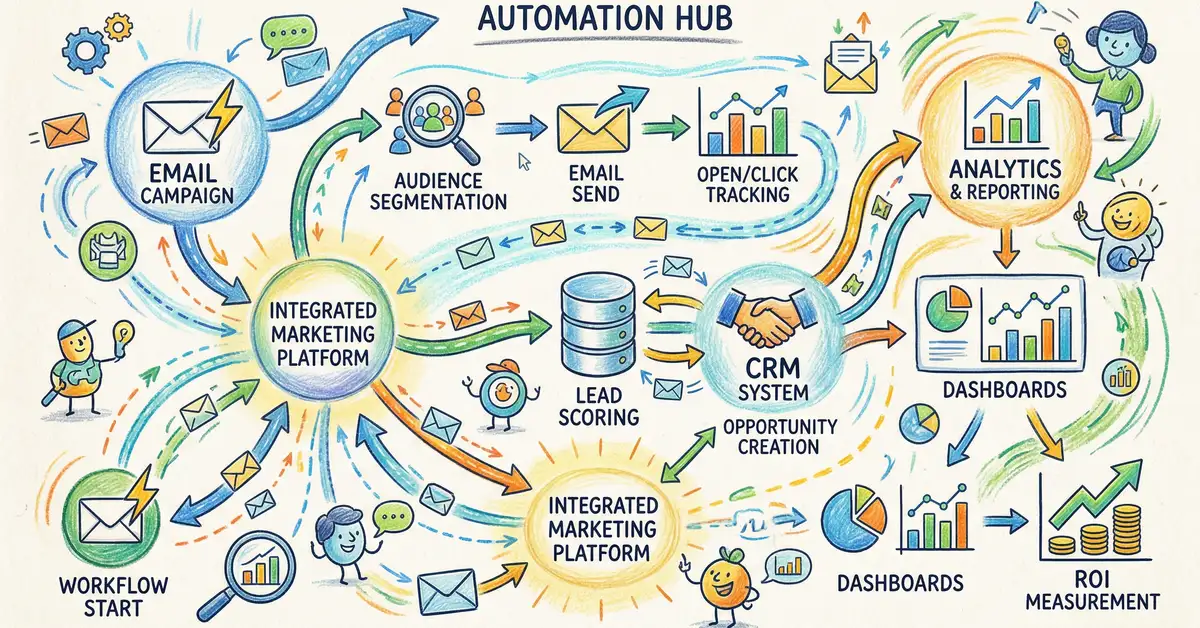
AI marketing platforms automate tasks like content generation, audience segmentation, and campaign optimization, freeing up your team for strategy.
Key Takeaways
- A platform is only worth it if it replaces three or more point tools you already pay for.
- Voice fidelity beats output volume - generic content costs more attention than it earns.
- Judge platforms by the specific marketing goal (SEO, ads, social, email), not by feature count.
- Instrument ROI before you migrate: baseline output, cycle time, and pipeline per channel.
- Human review stays mandatory for claims, data handling, and anything with your name on it.
What an AI-Powered Marketing Platform Actually Does
Category confusion costs more than subscription fees. Teams sign contracts expecting a single system to write, schedule, and optimize campaigns, then discover they bought a content generator wearing a platform's marketing. Only 12% of marketers rate themselves highly effective, having exceeded goals over the last 12 months (CMI's B2B Content and Marketing Trends report, 2026), and a mismatched tool is often the quiet cause. An AI-powered marketing platform, when clearly defined, combines generation, orchestration, personalization, asset handling, and measurement into one connected loop rather than five separate features bundled under one login. A significant majority of organizations already use AI for copywriting and campaign planning (BuzzHive Marketing, 2025), which makes distinguishing genuine platforms from dressed-up point tools an urgent, practical skill for any team about to sign a contract, rather than an academic exercise reserved for analysts.
Generation vs. orchestration vs. analytics
Vendors love to show off generation because it demos well.
A real platform proves itself in the layers most tools skip.
- Generation: blog posts, social variants, landing page copy, and campaign plans
- Orchestration: calendars, scheduling, and cross-channel publishing
- Personalization: audience segments and platform-aware formatting
- Asset handling: automatic visual generation and image-to-copy matching
- Measurement: performance feedback that reshapes the next cycle
The three questions that expose a thin "platform"
Ask what happens after content publishes, not just how it gets written.
Does output route to a calendar automatically, or does someone still copy-paste it? Does the system learn from last week's results before generating next week's assets? Can it match visuals to copy without a designer stepping in?
Point Tools vs. Platforms: Which One Fits Your Team
Tool sprawl is the real hidden marketing cost. Every extra login, prompt template, and disconnected calendar adds coordination tax that founders rarely track until publishing stalls. Nearly half of marketers already report stuck or struggling effectiveness (CMI, 2026), and mismatched tooling is a quiet driver of that plateau.
The fix isn't buying more software - it's matching setup to team size and channel count. A solo founder running five stitched apps burns hours on copy-paste workflows a single writer tool could handle. A 20-person team running one lightweight AI writer, meanwhile, under-tools itself into inconsistent output and missed deadlines. The table below gives a fast decision rule: find your team size and channel count, then read across for the setup, cost band, and failure mode to watch. Use it before your next renewal cycle, not after a budget review flags the overspend.
The three-tool consolidation rule
| Setup | Best for | Typical monthly cost | Main failure mode |
|---|---|---|---|
| Single AI writer + manual posting | Solo founder, 1-2 channels | Low | Publishing stalls when the founder is busy |
| 3-5 stitched point tools | 2-5 person team, 3+ channels | Medium | Voice drifts between tools; no single calendar |
| End-to-end AI marketing platform | Lean teams covering blog, social, site, email | Medium to high | Overpaying for modules you never turn on |
| Enterprise suite + agency retainer | Teams of 50+ with dedicated ops | High | Slow cycles, heavy onboarding, low founder control |
Match the Platform to the Marketing Goal
Feature lists mislead; goal fit predicts renewal. Most comparison articles rank platforms by feature count, pricing tier, or user reviews. That ignores the one variable that predicts whether a tool survives past the trial: does it match your goal. A platform built for consistent social posting will frustrate a team chasing organic growth, even if both call themselves "AI marketing platforms."
The reverse holds too - a GEO-focused research tool won't help you launch a paid acquisition campaign next week. Semrush One, for instance, tracks up to 500 keywords per day across five domains (Behind Rankings, 2026) - a fit for organic search, not creative testing. Buyers who skip this step pay for capability they never touch, then blame the software at renewal. The table below sorts by goal first and features second, because that's how renewal decisions actually get made.
Why "best overall" rankings rarely match your situation
"Best overall" lists average scores across use cases nobody actually has. A platform can win the aggregate ranking while failing the one goal you care about.
Match your primary goal to the table below before comparing star ratings.
| Marketing goal | What to look for | Pro | Con |
|---|---|---|---|
| Organic search and GEO | Keyword research, brief generation, prompt monitoring | Compounding traffic without ad spend | Slow feedback loop; needs 90+ days |
| Consistent social presence | Platform-aware variations, scheduler, auto visuals | One input, many native outputs | Generic voice if the model isn't tuned to you |
| Campaign launches | Plan generation, landing pages, asset matching | Ships a full campaign in days, not weeks | Weak on offline or partner channels |
| Paid acquisition | Creative variation and budget optimization | Fast creative testing at volume | Optimizes spend, not positioning |
| Multi-brand or client work | Brand switching, role-based access | One account, separate voices | Governance overhead if roles aren't set early |
Pick the row that matches this quarter's priority, not next year's roadmap.
Teams that revisit this mapping when the goal shifts avoid paying twice for the same job.
Where AI Helps - and Where Humans Still Decide
Automation scales output; judgment protects the brand. AI tools now draft, repurpose, and schedule content faster than any team could manage manually, and a significant majority of marketing organizations already lean on them for copywriting and content planning tasks (BuzzHive Marketing, 2025). But speed without oversight is exactly how brands end up sounding like everyone else. Online mentions of the word "slop" jumped over 200% in 2025 (Creative Ghost, 2025), a signal that audiences notice when content feels mass-produced. Meanwhile, the people running these tools aren't fine: burnout jumped 11 points in a single year among tech workers leaning hardest on AI workflows (Annual AI sentiment survey, 2026). The solution involves clearer boundaries around what a model touches and what a person must.
The slop test: read it aloud before you publish
If a paragraph sounds robotic out loud, it will read that way too. Before publishing, read every AI-assisted draft aloud and cut anything that doesn't sound like a person talking.
Voice replication vs. tone sliders
Generic tone settings produce generic writing.
Real voice replication trains on your actual customer conversations, founder quotes, and past wins - the difference buyers should test before buying any platform.
- Delegate: first drafts, repurposing, scheduling, variant generation, asset pairing
- Review: claims, statistics, customer quotes, pricing, legal and compliance language
- Own outright: positioning, pricing narrative, crisis response, founder point of view
Building a Stack That Doesn't Fight Itself
Stack order determines whether adoption sticks. Most five-person teams don't fail at AI adoption because the tools are weak
they fail because nobody sequenced the rollout. Bolting analytics onto ungoverned generation, or inviting a contractor before roles exist, creates rework instead of speed. A significant majority of organizations already use AI for copywriting and content planning (Creative-Ghost Marketing, 2025), yet still only 12% of marketers call their content programs highly effective (CMI's B2B Content and Marketing Trends: Insights for 2026 report, 2026). The gap sits in stack architecture, not model quality. A working reference stack starts with a single source of truth, then layers generation, distribution, permissions, and cleanup in a fixed order. Skip a step and the next one inherits the mess. Below is the sequence a five-person team can follow without a dedicated ops hire.
A reference stack for a five-person team
- Fix your source of truth: brand site, past posts, and a written voice guide
- Consolidate generation and scheduling in one place before adding analytics
- Connect channels one at a time and confirm formatting per platform
- Set roles and brand permissions before inviting contractors
- Retire the point tools you replaced
otherwise you pay twice
Proving ROI Before the Annual Contract
Baselines beat testimonials when evaluating AI platforms. A vendor case study proves a tool worked somewhere else, for someone else, under conditions you can't audit. What actually protects a budget is a 90-day measurement plan built before the contract renews, tracking output, engagement, and pipeline against numbers you captured on day one. Most teams never get past reporting what happened last week; descriptive analytics dominates even mature categories like CPG, leaving the harder question - why a metric moved - unanswered. Content teams fall into the same trap, citing volume gains without connecting them to pipeline. The fix is explanatory, not just descriptive: track the edit-ratio, the share of AI output requiring substantial human rewrite, since a shrinking ratio is the earliest honest signal that a platform is learning your voice rather than just generating faster. Pair that with the 30/60/90 table below so output, engagement, and revenue attribution each get their own checkpoint instead of one end-of-quarter guess.
The edit-ratio metric most teams skip
| Window | Metric to track | Healthy signal |
|---|---|---|
| Days 1-30 | Published pieces per week, hours per piece | Output up, edit time trending down |
| Days 31-60 | Impressions, saves, replies, branded search | Engagement holds as volume rises |
| Days 61-90 | Signups, demos, or inquiries attributed to content | Cost per qualified lead below your prior baseline |
Ethics, Data Privacy, and Brand Safety Guardrails
Trust erodes quietly, then all at once. A team publishes one unverified stat, one AI-voiced post nobody disclosed, one client's data pasted into a shared prompt window - and none of it looks fatal in the moment. Readers rarely announce they've stopped believing a brand; they just stop clicking, stop subscribing, stop replying. The same content boom that rewarded speed has made audiences warier of anything that smells synthetic
online mentions of "slop" jumped over 200% in 2025 (Creative Ghost, 2025), a signal that skepticism is now the default reader posture, not the exception. Guardrails fix this before it becomes a pattern. None of the checks below require a legal team or a compliance platform - they need one accountable person and a habit of asking uncomfortable questions before content ships, not after a client or reader asks them first.
- Data residency: Ask where your brand data is stored and whether it trains shared models.
- Sourced claims: Require source links on every statistic before publishing.
- Disclosure: Disclose AI assistance where your audience or platform expects it.
- Bias audits: Audit outputs quarterly for bias, stereotyping, and unsupported claims.
- Named ownership: Keep a human named owner for every published channel.
Upskilling Your Team in 30 Days
Skill gaps, not software gaps, require rollouts. Teams buy the best AI writing tools, distribute logins, and expect fluency by Friday. It doesn't work that way. Nearly half of marketers report being stuck in neutral or struggling with effectiveness, and only 12% call themselves highly effective (CMI's B2B Content and Marketing Trends: Insights for 2026 report, 2026). The issue is usually judgment: knowing when output is on-voice, accurate, and actually useful. A 30-day rollout closes that gap without pausing production. Each week builds a specific muscle, not a vague "get comfortable with AI" mandate.
- Week 1: Write the voice guide together and load real brand examples so the standard isn't abstract.
- Week 2: Each person ships one piece end to end, unedited by anyone else.
- Week 3: Run a swap review - score outputs for voice, accuracy, and usefulness.
- Week 4: Lock the weekly plan and assign channel owners.
By day 30, the team is producing work that meets the RuleBook standard, on schedule, without a single bottleneck editor, rather than just prompting.
FAQs about ai powered marketing platform
What is an AI-powered marketing platform?
An AI-powered marketing platform is a system that combines content generation with campaign orchestration-planning, scheduling, distribution, and performance tracking-inside one connected workflow. That's the key distinction from a simple chatbot wrapper: a wrapper only produces text on request, while a true platform understands your calendar, your channels, your brand assets, and how a piece of content should move from draft to published to measured. For a small team, this means one login and one source of truth instead of stitching together a writing tool, a scheduler, and a separate analytics dashboard.
How is it different from a standalone AI writing tool?
A standalone writing tool stops once it hands you a draft. A marketing platform keeps going: it schedules the post, publishes across multiple channels, matches the copy to the right images or video assets, and logs everything on a single shared calendar. It also applies one shared voice profile across every channel, so a social caption, an email subject line, and a blog intro all sound like they came from the same brand-not from three disconnected prompts. For small teams without a dedicated ops person, that automation is often the bigger time saver than the writing itself.
Can AI marketing tools match my brand voice?
It depends heavily on how the platform handles voice. Some tools rely on fine-tuning against your existing content, which tends to produce a closer match over time, while others use prompt-based presets (tone sliders, style descriptors) that are faster to set up but less precise. Before committing, test any platform with your own past posts, product descriptions, and site copy as reference inputs, then compare the output against what your team would actually publish. If the gap is large after a few rounds of feedback, that's a signal the tool's voice-matching approach isn't a fit for your brand.
How much should a small team budget?
Rather than pricing the platform in isolation, compare its cost to what you're currently spending across separate point tools-a writing assistant, a scheduler, a design app, an analytics add-on. Consolidating those into one platform often costs less overall even if the sticker price looks higher at first glance. Most vendors also offer free credits or a trial tier; use that window to run a real campaign end-to-end before signing an annual contract, so you're validating the platform against your actual workflow rather than a demo environment.
How long before I see results?
Expect two different timelines. Output gains-faster drafting, quicker scheduling, fewer manual handoffs-typically show up within the first few weeks as your team adjusts to the new workflow. Pipeline signal, meaning actual traffic, leads, or revenue attributable to the platform's content, generally takes 60 to 90 days to become visible, since that's how long it takes for published content to get indexed, distributed, and acted on by an audience. Judge the platform on both timelines, not just the early productivity boost.
Does AI-generated content hurt SEO?
Search engines don't penalize content for being AI-assisted; they penalize content that fails quality and originality thresholds, regardless of how it was produced. The risk with AI tools is thin, generic output that reads like everyone else's-so the safeguard is a human review pass, claims backed by real sources or data, and a genuine unique angle rather than a rehashed version of existing top-ranking pages. Platforms that build these checks into the workflow, rather than leaving them to chance, are meaningfully safer bets for a small team's search visibility.
Five Mistakes Teams Make When Buying an AI Marketing Platform
- Buying on feature count instead of goal fit: A platform with forty modules you never activate costs more than a focused tool that covers your three real channels. Shortlist against the goal you're actually behind on.
- Skipping the voice test during the trial: Most teams evaluate speed and forget fidelity. Feed the tool your existing posts and site copy, then check whether the output sounds like you or like every other brand in your feed.
- Never retiring the tools you replaced: Consolidation only saves money if the old subscriptions get cancelled. Audit your billing 30 days after migration and cut what's now redundant.
- Publishing unsourced AI statistics: One fabricated number undoes months of credibility. Require an inline source link on every claim before anything goes live.
- Treating the platform as a strategy: Automation multiplies whatever direction you give it. Without positioning, an ICP, and a weekly plan, you just produce more of the wrong content faster.
Sources
- CMI’s B2B Content and Marketing Trends: Insights for 2026 report
- 20+ Best AI Marketing Tools I Tested for Marketers
- Report on AI adoption in marketing statistics
- Marketing Trends for Small Business
- ABI Research - Global AI Market Size
- Statista Market Insights - Artificial Intelligence Worldwide
- DataReportal - Global Digital Insights
- AI Market Size Statistics
- Best CPG Category Management Software - Platforms Category Teams Shortlist
- Lenny's Podcast - Annual AI Sentiment Survey (Noam Segal)
About Joshua Krindle
Author
SEO Expert, turning what I know about traditional SEO into programmable agentic insights.


