
We're Multilingual From Today! Deutsch, Français, Español, Português, Čeština - Our Algorithms Speak Them All
PostKing now researches and writes native-language SEO content in German, French, Spanish, and Portuguese, live today across 32 search markets.

Dite Gashi
10 years of full stack development experience.
Published on August 17, 2026
Updated on October 9, 2026

PostKing now writes in German, French, Spanish, Portuguese and Czech.
Starting today, PostKing writes multilingual SEO content the way it should have worked from day one. Written natively.
For years, that meant shipping an English draft through a translation tool and hoping the keywords still made sense in German, or paying someone to rewrite your Spanish copy by hand because the machine version read stiff. That workflow is gone as of today.
PostKing now researches keywords and writes content directly in German, French, Spanish, Brazilian Portuguese, and Czech, alongside English. Six authoring languages, live now. This is native-language SEO. The research happens in the target language, the writing happens in the target language, and nothing gets lost in a translation pass.
What Native-Language SEO Actually Means
Here's the distinction, and it matters more than it sounds. Translated content takes an English article and converts it word for word into another language, and while it can read fine, it usually ranks poorly, since the keyword research was never done in that language to begin with.
Native-language SEO skips that step. PostKing researches search terms the way a native speaker in Berlin, São Paulo, or Prague actually types them, then writes the article, headings, and calls to action in that language starting with the first draft. That's multilingual content generation done right. Researched and written in-language, not patched together after the fact.
I've watched founders spend a weekend feeding their homepage into a translation tool, then spend the next explaining to a native-speaking colleague why the German version reads like a legal disclaimer. That's the gap this closes.
Every surface gets localized: body copy, subheads, bullet points, calls to action, image alt text, meta descriptions, page titles, even the URL slug. Your brand name and product terms stay exactly as you spelled them. Some things shouldn't translate.
That preference for native language isn't just intuition. CSA Research surveyed thousands of online shoppers across dozens of countries in 2020 and found the large majority preferred buying from a site written in their own language, with a meaningful share saying they'd never buy from a site that wasn't. That's the friction native-language SEO is built to remove.
Six Languages, 32 Markets, and the Rules for Multilingual Content Generation
Here's the map. PostKing covers 32 country-and-language search markets across 27 countries, and now writes in six authoring languages: English, German, French, Spanish, Brazilian Portuguese, and Czech. We'd rather do six well than twenty badly.
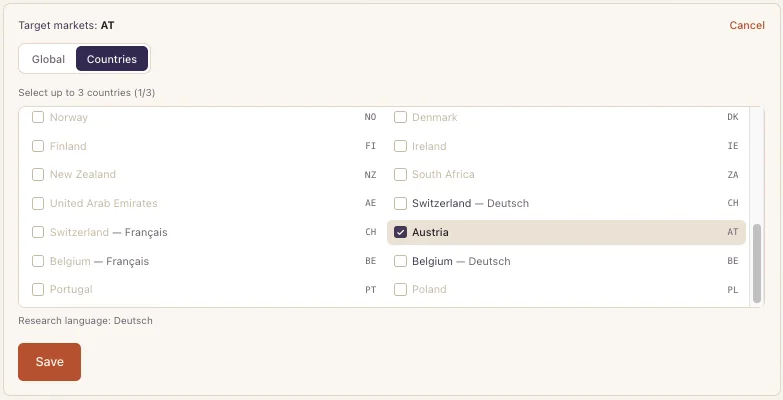
Multilingual content generation only works at scale if the targeting logic underneath it is sane, so here's the rule PostKing enforces automatically: a brand can target up to three countries at once, as long as they all share one research language.
Germany, Austria, and Switzerland together works. They're all German-language markets. Germany and the United States together doesn't. Different languages, different rulebook.
Set your brand's content language once, and PostKing pre-selects the matching default countries for you. Pick German, and Germany, Austria, and Switzerland populate automatically. Adjust from there if you need to, but the defaults save you the setup guesswork.
What Multilingual SEO Content Looks Like in Practice
Say you run a SaaS product and you're expanding into Iberia. Set your content language to Spanish, and PostKing starts researching keywords the way someone searching from Madrid or Bogotá actually phrases them, not a direct port of your English target list.
The article comes out written in Spanish from the first word: headline, subheads, the bullet list under your pricing section, the call-to-action button copy, the meta description, the alt text on your hero image, the URL slug. All of it, in Spanish, all at once.
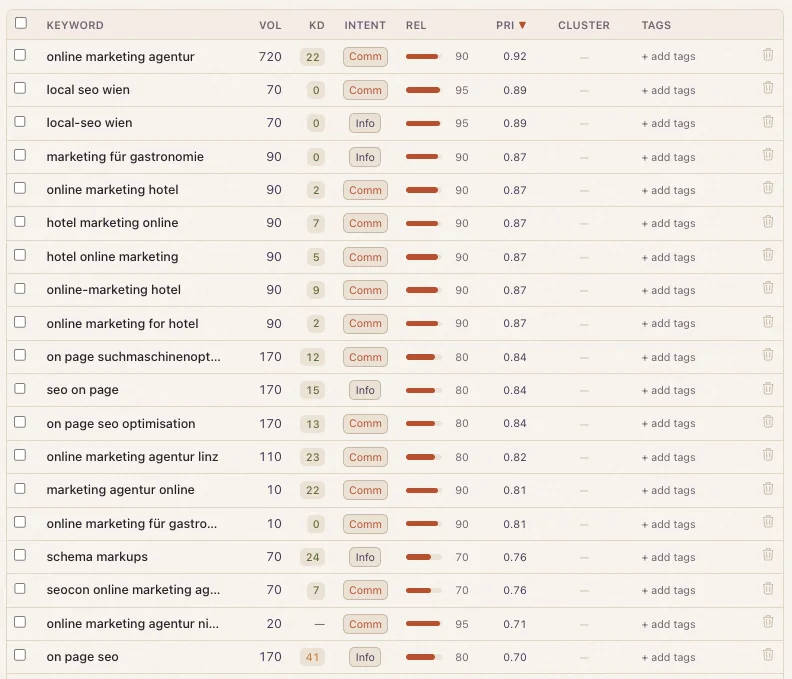
See your own market's keywords, not a translated guess.
Set a target country and language, and watch real local search terms populate, the same way the Austrian data above did.
Run a keyword search →One honest caveat, because overselling this would be easy: the underlying research still draws on English-language source material, and PostKing applies it through a native-language lens when it writes each market's content. Statistics render in the article's language for readability, but the source, URL, and publication year stay exactly as published, so you can check every claim yourself.
Best Practices for International Content Marketing
A few things worth knowing before you flip the switch.
Existing content doesn't retroactively change. If you've been publishing in English and you switch your brand language to French today, your old English posts stay exactly as published. Only new content going forward gets written in French.
If you run an agency juggling clients across Germany, France, and Brazil, three languages, three sets of search behavior, three sets of client expectations, this is where multilingual SEO content and international content marketing genuinely meet: one dashboard, three brand-language settings, three sets of natively-written content, instead of three separate translation workflows and a proofreader catching what the machine got wrong.
And if you're expanding into DACH, France, Iberia, LATAM, Brazil, or Czechia for the first time, start with the country grouping that actually matches your audience. Don't force a three-country combo just because the option exists. Pick the markets you can genuinely serve.
What's Next for Multilingual SEO Content
Your competitors translated their content, but you never had to, not from today onward.
If you've been writing in English because that's what the tool supported, or cleaning up machine-translated drafts before letting them near your site, that constraint is gone. Set your brand language, and PostKing researches and writes there natively.
That's what native-language writing should feel like. You publish. PostKing already wrote it in-language.
Go to your brand settings, pick German, French, Spanish, Brazilian Portuguese, or Czech, confirm your countries, and publish your first native-language SEO piece today. Six languages, one dashboard, live now.
About Dite Gashi
Author
10 years of full stack development experience. Had trouble finding distribution - founded PostKing.app in the process.