

From Zero to Cited, Part 2: Keyword Research Fundamentals
Learn how to do keyword research using intent, related terms, and real metrics, then turn seed keywords into a shortlist inside PostKing.

Dana Willow
Senior Marketer sharing 15 years of marketing wisdom through an AI lens.
Published on September 21, 2026
Updated on September 22, 2026
Here's the thing about keyword research: everybody treats it like a box to check before the "real" writing starts. It's actually the whole ballgame. This is Part 2 of From Zero to Cited, our free SEO course, and today we're slowing way down on keywords, because rushing this step is where most of the trouble starts.
Here's a mistake worth sitting with. You pick a keyword because the volume number looked big and shiny. You write a solid post around it. You hit publish. Then nothing happens, for months.
Turns out that keyword was carrying three intents at once: people learning, people comparing, people ready to buy. One blog post can't be all three things to all three people. Google didn't rank it because it never answered the question underneath the search. That's the whole lesson this guide is built on.
Short-Tail vs. Long-Tail Keywords: Volume Isn't the Whole Story
Short-tail keywords are the two or three word terms with huge search volume and even bigger competition. Think "yoga classes" or "bike repair." Big audience, sure, but you're fighting page one against sites that have been at it for a decade with content teams ten times your size. For a small business or a lean team, that's not a fight worth picking on day one.
Long-tail keywords run four, five, six words or more. Less traffic per term, a lot more intent per searcher. "Beginner yoga classes for people with bad knees" pulls fewer searches than "yoga classes," but whoever types it knows exactly what they need and is a lot closer to booking a class. Stack enough long-tail terms together and the traffic adds up, no years of built-up authority required.
So start there. Build your early content on long-tail terms you can actually rank for, let the relevance and trust from those pages do the work, then go after the short-tail term once you've got something to stand on. Chasing short-tail keywords first is a rough move for a new or lean team.
Related Keywords SEO: Building the Vocabulary Google Expects
Old-school SEO called this LSI keywords, short for latent semantic indexing. The term got thrown around way more than it was ever actually understood, but it pointed at something real: search engines expect a page about a topic to contain the vocabulary that topic uses in real life. These days most people just call it related keywords SEO, or semantic coverage. Same idea, less jargon.
Say your seed keyword is "keyword research." A page that repeats that exact phrase over and over reads thin, almost robotic, like it's trying too hard. A page that naturally works in terms like search volume, keyword difficulty, search intent, SERP, long-tail, and content gap reads like someone who actually knows the topic wrote it. Because they did.
You don't need a fancy separate tool for this. Scroll to the "People also ask" box. Check the related searches at the bottom of the results page. Skim the subheadings on whatever's already ranking. That's related keywords SEO in its rawest form: Google handing you, for free, the vocabulary it already associates with your topic.
The Four Search Intent Types (And Why They Decide Your Content)
There are four search intent types, and mixing them up is the fastest way to write something that ranks fine and converts nobody.
Informational is someone learning. "What is keyword difficulty" or "how does search intent work." They want an answer, not a pitch. A guide, a glossary entry, a plain how-to post gets it done.
Commercial, sometimes called comparison intent, is someone weighing options. "Best keyword research tools" or "Ahrefs vs Semrush." Close to deciding, not quite there. Comparison posts and "X vs Y" pages win here.
Transactional is someone ready to act. "Book bike repair near me" or "PostKing pricing." This is where product pages, pricing pages, and sign-up forms belong, not another 2,000-word explainer nobody asked for.
Navigational is someone hunting for a specific brand or page they already know exists, like "PostKing login." You're not writing new content for this one. You're just making sure your own site shows up first for your own name.
Once you can spot which of the four intent types is sitting behind a keyword, the format nearly picks itself: informational gets a guide, commercial gets a comparison, transactional gets a page built to convert. Write the wrong format for the intent and you end up with content that's technically fine and never earns a click, let alone a customer.
Match-and-Exceed: How to Do Keyword Research by Studying Who's Already Winning
Most guides skip this step: before you write anything, go Google the keyword yourself and actually read what's already sitting there.
Open an incognito tab. Search your keyword. Study the top three results side by side. What format are they using, listicle, guide, comparison table, video? Roughly how long are they? What subtopics do all three touch on that you hadn't considered? What questions do they leave hanging, or answer badly?
That's the match half. Copying the structure confirms you understand what intent Google has already decided this keyword serves. If three ranking pages are all product comparisons, a personal essay isn't going to out-rank them no matter how beautifully it's written.
The exceed half is where you actually earn the spot instead of just chasing it: cover the subtopic none of them touched, answer the question their comments section is full of, use a real example instead of a vague one, make the page load faster and read easier. Match the format, then beat the substance. That combination is how a smaller site with less history climbs past competitors who've had a head start for years.
Keyword Difficulty Explained, Plus Volume and CPC
Keyword difficulty is a tool's guess at how hard it'll be to outrank whatever's currently sitting on page one, usually based on how much authority those pages have already built up over time. It's a forecast, not a law, and different tools score the same keyword differently. Treat it as a compass, not gospel.
Search volume tells you how many people search a term in a given market each month. A big number feels good. Volume with no intent match is just traffic that bounces.
CPC, cost-per-click, is what advertisers pay for that keyword in paid search. You don't need to run ads to care about it: it's a proxy for commercial value. If businesses are paying real money for clicks on a term, real money tends to follow the organic ranking too.
The actual skill is reading all three together. Decent volume, moderate difficulty, healthy CPC: that's usually worth the effort. Huge volume, brutal difficulty, near-zero CPC: that's often just curiosity traffic with nobody behind it ready to do anything. Google's own Search Central documentation says it plainly: content should be built to satisfy the person searching, not to game a single metric. That's the filter worth running every keyword through before writing a word.
Hands-On: How to Do Keyword Research Inside PostKing
Theory's fine, but here's what it actually looks like. It's built into PostKing, so nobody needs five browser tabs and a spreadsheet open at once.
Start with seed keywords. Two or three broad terms tied to what the business actually does: a clinic, a bike shop, a small cybersecurity outfit, whatever. Don't overthink it, the tool expands from there.
Generate keyword research. PostKing pulls live search data for each seed and returns volume, keyword difficulty, CPC, and search intent for a full set of related terms, not just the exact match. This used to eat a paid tool subscription and an entire afternoon.
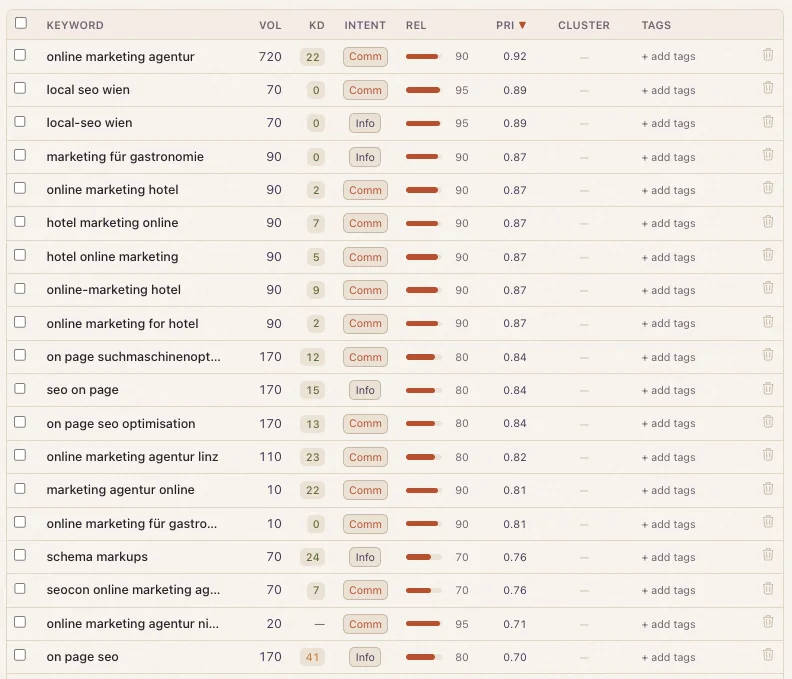
Categorize by intent. Intent's already tagged per keyword, so sorting the list into informational, commercial, transactional, and navigational buckets takes minutes instead of guessing from phrasing.
Set market and language. Publishing for a US audience and a Czech one? Set that per project. Volume and CPC shift by market, and a term that's crowded in the US might be wide open in Czechia, or the reverse.
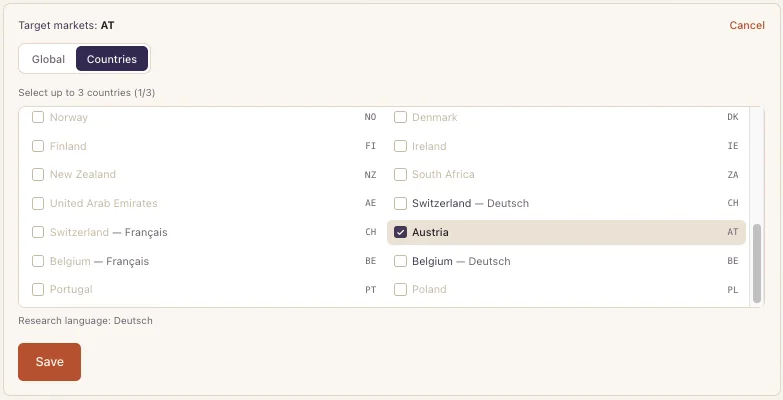
Shortlist. Pull the keywords where volume, difficulty, and CPC line up with what's realistic to produce and rank for right now. Save that shortlist as the content plan for the weeks ahead.
That's the whole loop. Seed to shortlist, backed by real data instead of a hunch.
Want to see where this data actually shows up once a post is live? Three minutes, straight from Google.
Do's and Don'ts for Keyword Research
Do
- Start with long-tail terms you can realistically rank for before chasing short-tail volume.
- Check the top three ranking pages before you write a single sentence.
- Match content format to intent: guide for informational, comparison for commercial, product page for transactional.
- Read volume, difficulty, and CPC together, never one in isolation.
- Set market and language per project if you're publishing across more than one region.
Don't
- Pick a keyword purely on volume while ignoring what the searcher actually wants.
- Cram related terms in awkwardly. Work them in where they'd naturally show up.
- Write a transactional-intent keyword as a 2,000-word essay, or the reverse.
- Treat keyword difficulty scores as fixed. They shift as the SERP shifts.
- Skip the shortlist step and try to write everything the tool surfaces at once.
Where This Leaves You
Keyword research isn't a task you finish once and file away. Search intent shifts. Competitors publish. The vocabulary Google expects on a page keeps changing right along with it.
But once the habit's in place, seed keywords in, categorized shortlist out, it stops being the intimidating part of content and turns into maybe the fastest ten minutes of your week.
Part 3 picks up right where this leaves off, turning that shortlist into briefs actual content can be built from. For now, open PostKing, drop in a few seed keywords, and see what the data says about what you thought you already knew.
From Zero to Cited · Part 2 of 10 · Course overview
About Dana Willow
Author
Senior Marketer sharing 15 years of marketing wisdom through an AI lens. Teaching founders to automate smarter.