

From Zero to Cited, Part 9: Maintaining Your Rankings
How long does SEO take to work when you're maintaining rankings, not chasing them? Here's what to track, and what to leave alone.

Dana Willow
Senior Marketer sharing 15 years of marketing wisdom through an AI lens.
Published on September 21, 2026
Updated on September 22, 2026
This is part nine of ten, and we've hit the least glamorous stretch of the whole series. Here's the thing about maintenance: you've spent eight installments getting keywords found, pages written, tools built, competitors sized up. Some of it worked. A few keywords cracked page one, some pages started pulling real traffic, other sites began citing your stuff because it was actually useful. Now comes the part nobody puts on a highlight reel: staying there. If you're asking how long SEO takes to work at this stage, the honest answer is different from the one you got back in Part 1. Maintenance runs on its own clock, and it's slower and weirder than the climb up.
The difference between those two outcomes comes down to knowing what to watch, and when to actually act.
The Waiting Period Nobody Warns You About
Google doesn't rank a new or updated page and then leave it alone. It tests. Your page might sit at position 14 for a few days, jump to 7, drop to 22, then eventually settle somewhere that reflects how real people respond to it: dwell time, click-through, bounce patterns, the whole messy soup of signals. Google is figuring out where you belong. It's determining the right place for your content.
Google's own Search Central documentation says ranking signals get reprocessed continuously as the index refreshes, and that position volatility in the weeks after a change is expected behavior, not an error state (Google Search Central, developers.google.com/search). So if you're asking how long SEO takes to work for a freshly published or refreshed page, plan on 8 to 16 weeks before the position settles into something you can trust. Anything faster is luck. Anything you judge before that window closes, you're judging noise, not signal.
This is the part that gets people. Checking rankings every day during the test phase feels like watching a stock ticker on opening bell: pure chaos, no real signal in it. Set a calendar reminder for six weeks out. Don't look before then unless traffic falls off a cliff.
What "Settling" Actually Looks Like
A settled ranking still wobbles day to day, by a spot or two. What you're actually watching is the trend line over a rolling 30-day window, not the daily jitter. Flat or climbing? Leave it alone. Sliding for three straight weeks? That's your cue to act, not the one bad day.
Google Core Updates Will Move Your Rankings, and It's Not Personal
Google rolls out a core update a handful of times a year, and it can shuffle rankings across whole categories in ways that feel completely arbitrary if you're the one losing spots. Google's own documentation says core updates reassess how content gets evaluated overall: pages that show real expertise and usefulness get rewarded, pages optimized for search engines instead of readers lose visibility (Google Search Central, Search Status Dashboard).
Here's what actually helps: content built for a real reader tends to survive these updates. Thin pages stuffed with keyword synonyms and no actual point of view are the ones that get flushed. If your content answers what someone actually typed, explains it clearly, and doesn't waste their time, a core update is just weather, not a threat.
So when a core update lands, don't rewrite your whole library in a panic. Google says rollouts can take two to three weeks to fully complete. Wait it out, then check which specific pages actually moved and why. Usually it's a handful, not everything.
Intent Shifts Under Your Feet: When to Refresh Instead of Rewrite
Keywords aren't fixed targets sitting still while you climb toward them. "Best scheduling software for a small clinic" meant something different in 2022 than it does now, when people expect automation built into the tool, not bolted on after the fact. The keyword didn't change. What people mean by it did.
When intent shifts and your page doesn't, you slip. The content is answering last year's question. The fix is almost never a new URL. Update the examples, adjust the framing, add the section that answers what people are actually asking now, and let the page keep its history and backlinks right where they are.
Watching for Shifts in PostKing Search Performance
This is where most of the guesswork disappears. Connect Google Search Console and Bing inside PostKing Search Performance, and you get clicks, impressions, and average position per page in one view, instead of toggling between two dashboards that never quite agree with each other.
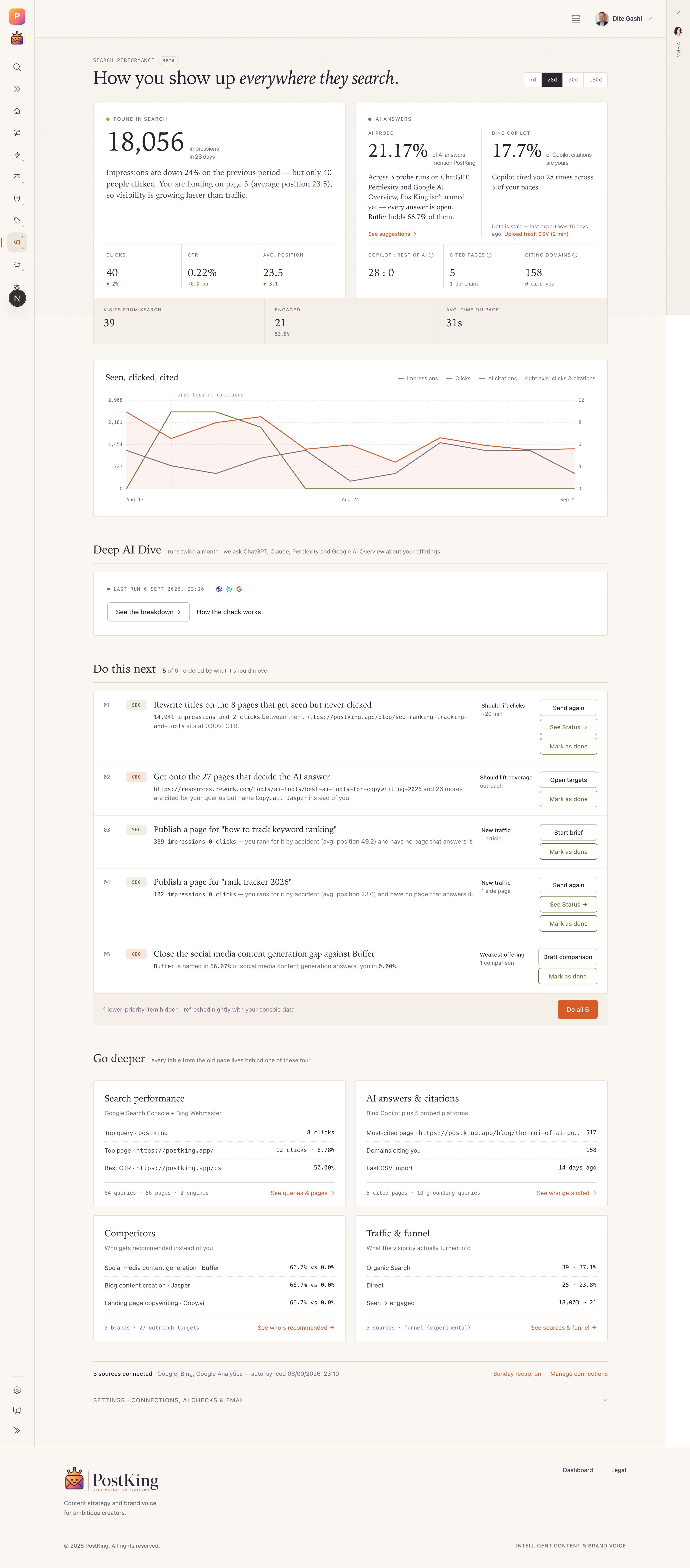
The worklist PostKing builds from those numbers is the useful part: pages where position dropped but impressions held steady (people are still searching, they're just not clicking your result anymore, a strong intent-shift signal), and pages where both are sliding together (more likely a competitive hit or a core update).
Say a yoga studio's "beginner class" article held position 4 for six months, then slipped to position 11 over three weeks while impressions stayed flat. That's your refresh candidate. Pull it from the worklist, check what's outranking you now, update the page to match what those top results actually deliver, and republish under the same URL. It's faster than starting over, and it works better too, which makes it a core piece of any seo maintenance checklist worth following.
Measure Actions, Not Just Results
Rankings lag. Measure only the outcomes (traffic, position, leads) and you're always staring at decisions you made weeks ago. Fix it with a lead-indicator dashboard, checked weekly: pages published, briefs approved, refreshes completed, competitor pages reviewed. These are things you control today.
Weekly, you track activity. Monthly, you check whether that activity is actually moving the needle: are refreshed pages recovering, are new pages climbing through the test phase on schedule. Quarterly, you pull back and look at rank tracking data and traffic trends across the whole site, the view where you actually judge whether the work paid off.
That's the honest answer to how long SEO takes to work: weekly effort, monthly signal, quarterly proof. Rank tracking tools (PostKing's included, alongside GSC and Bing) give you the position data, but the weekly action log tells you whether you're doing enough of the right things before results show up.
Want it straight from Google? Here's how to mark those actions on the chart where you'll actually see them pay off.
Do's and Don'ts for Maintaining Rankings
Wait 8 to 16 weeks before judging a new or refreshed page. Refresh slipping pages instead of publishing a near-duplicate next to them. Check your worklist weekly and tackle impression-steady, position-dropping pages first. Keep a simple SEO maintenance checklist running: crawl errors, broken links, outdated stats, refreshed metadata, updated internal links.
Don't rewrite your whole site after every Google core update. Don't chase daily rank tracking swings; they're mostly noise until a trend holds for weeks. Don't assume a dropped page is dead; check impressions before writing it off. And don't skip the monthly review just because weekly numbers look fine, slow bleeds hide inside monthly aggregates and they'll find you eventually.
What Comes Next
Maintaining rankings is a lot less dramatic than winning them, and that's kind of the point. It's quiet work: watching a worklist, refreshing a page here, holding steady through a core update there. If you've made it through nine parts of this series, you already know SEO is a rhythm you keep, week after week, with PostKing's Search Performance dashboard doing the watching so you can spend your time writing.
From Zero to Cited · Part 9 of 10 · Course overview
About Dana Willow
Author
Senior Marketer sharing 15 years of marketing wisdom through an AI lens. Teaching founders to automate smarter.