
Free Blog Post Generator AI: How to Get Publishable Drafts Without Paying (or Sounding Generic)
Get publishable drafts from a free blog post generator AI without the generic voice. See the limits, the workflow, and how to scale output. Start free.

Dana Willow
Senior Marketer sharing 15 years of marketing wisdom through an AI lens.
Published on July 28, 2026
Updated on October 8, 2026

Discover how to leverage free AI tools to create high-quality blog content that stands out, without breaking the bank.
Key Takeaways
- Free blog post generators are drafting engines. They solve the blank page, but don't capture your brand voice.
- The real cost of free tools is editing time: most founders spend more hours rewriting generic output than they would writing a structured brief.
- Voice replication beats prompt engineering. Tools trained on your existing content produce drafts that need light edits instead of full rewrites.
- Disclosure matters - 69% of consumers feel manipulated when brands use AI without saying so (BCG).
- Free tiers are best used to test whether AI drafting fits your workflow before committing budget to a full content stack.
What a Free Blog Post Generator AI Actually Gives You
Free generators solve blank pages, not brand voice. They excel at giving you a starting point - a headline, an outline, or a rough draft you still need to shape into something worth publishing. Most tools marketed as "free blog post generators" actually span four distinct categories, each solving a different problem at a different stage of content production. Confusing them is the single biggest reason writers try a free tool, get an underwhelming result, and conclude AI drafting doesn't work for their niche. An idea generator was never meant to write a post, and a full-draft tool was never meant to replace your editorial voice. Knowing which category you're testing before you sign up saves time and sets realistic expectations for output quality. The free tier almost always exists to get you into a paid funnel, so limits are deliberately tight - daily caps, word ceilings, or credit systems that throttle usage after a few posts. None of that makes free tools useless; it just means you should match the tool to the job. Use the table below to identify which category solves your actual bottleneck.
Idea generators vs. draft generators
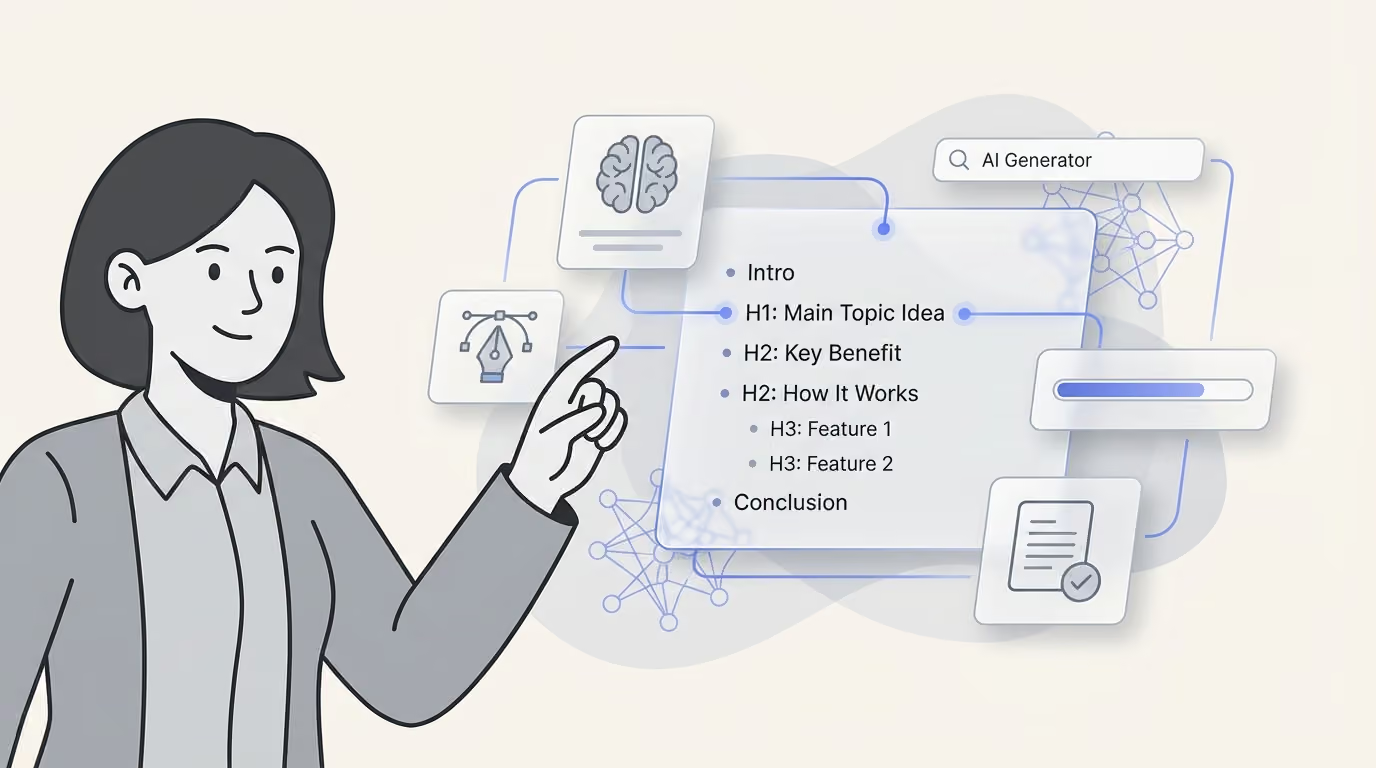
Idea and outline generators produce structure - headlines, angles, H2/H3 skeletons - without writing prose.
Full-draft generators attempt complete paragraphs, usually 600-1,200 words, ready for editing rather than ideation.
What "free" usually means in practice
Free almost never means unlimited. It means a capped number of outputs, a word ceiling, or a credit allowance designed to demonstrate value before upgrading.
| Tool category | What it outputs | Typical free limit | Best used for |
|---|---|---|---|
| Topic/idea generators | Headline and angle suggestions | Unlimited, gated by email | Filling a content calendar |
| Outline generators | H2/H3 structure only | 3-5 outlines per day | Structuring a post you'll write yourself |
| Full-draft generators | 600-1,200 word first drafts | 1-3 posts per month or word-capped | Testing whether AI drafting fits your workflow |
| Brand-trained platforms | Voice-matched drafts plus assets | Credit-based free tier | Recurring publishing at volume |
The Hidden Cost of Free: Where Generic Drafts Break Down
Editing time is the real price of free. A no-cost generator produces a draft in seconds, but the hours spent rewriting voice, checking claims, and reformatting for each channel are the actual bill, and that bill often exceeds what a paid tool would have cost. This gap matters more now than ever: the AI software market itself was valued at US$122 billion in 2024, meaning every team is competing against a flood of similarly-generated content. When output looks interchangeable with every competitor's blog, the "free" draft stops saving time and starts creating it, one rewrite at a time. Marketers who skip disclosure also risk audience trust: 69% of consumers feel manipulated when brands use undisclosed AI. The pattern is often called "AI slop" - technically correct sentences that carry no distinct point of view. It reads clean, passes a grammar check, and still fails to sound like anyone in particular. Teams end up rewriting line by line instead of publishing as-is because this failure isn't cosmetic.
The 'AI slop' problem in plain terms
AI slop is content that technically answers the prompt but says nothing memorable. Sentences are grammatically sound, structurally predictable, and stylistically flat.
It reads like a summary of a summary, without the personal investment of someone with a stake in the topic.
Why free output reads the same everywhere
Free tools default to the same training patterns, so every user gets a similar shape and tone. There's no brand memory, no source-checking layer, no channel-specific formatting built in.
- Voice drift: output reads like every other SaaS blog, forcing a line-by-line rewrite
- Shallow research: claims without sources, which you must verify or delete
- Structural sameness: identical intro-body-footer shape across every post
- No asset pairing: you still hunt for images and format for each channel manually
- Trust risk: undisclosed AI content erodes the audience relationship you're trying to build
Free vs. Freemium vs. Paid: A Working Comparison
Publishing volume decides which tier makes sense. A founder posting twice a month has nothing in common with a five-person team shipping content across four channels, yet both groups often start on the same free tool. The right tier match saves money early and saves rework later. Free tools work best for testing whether AI drafting fits your process at all - no login, no credits, no risk. Freemium credit systems suit occasional publishers who need consistency without a contract. Paid, brand-trained platforms earn their cost once volume and voice consistency both matter, especially across an SEO cluster where internal linking and topical authority compound. Beyond a certain team size, the constraint shifts entirely: editing, approvals, and scheduling overhead cost more time than any subscription fee. Matching tier to actual publishing volume - not aspirational cadence - avoids both overpaying for unused capacity and hitting credit walls mid-campaign.
| Your situation | Posts per month | Right choice | Why |
|---|---|---|---|
| Testing AI drafting for the first time | 1-2 | No-login free tool | Zero commitment, fast signal on output quality |
| Solo founder publishing occasionally | 2-4 | Freemium with credits | Enough volume to build a habit without a contract |
| Building an SEO cluster | 6-12 | Brand-trained platform | Voice consistency and internal linking matter more than per-post cost |
| Team of 5-50 across channels | 12+ | Multi-brand automation with scheduling | Editing and coordination overhead outweighs tool cost |
What credit-based free tiers really cover
Most freemium plans ration by credits, not by feature access.
That means the drafting engine is often identical to the paid version, just capped in volume. Credits typically cover a handful of full drafts monthly, enough for solo founders who publish sporadically rather than on a fixed schedule.
Signals that you've outgrown the free tier
Running out of credits before the month ends is the clearest sign. Rewriting drafts to match brand voice every time is another. If editing takes longer than writing from scratch would, the free tier is now costing more than a subscription.
The 6-Step Workflow That Turns a Free Draft Into a Publishable Post
Structured input beats better prompts every time. A free generator produces its best output when the workflow around it does the thinking the tool cannot: defining intent, supplying real brand language, and checking facts before publishing. Most teams skip straight from prompt to publish, which is exactly why so much AI-drafted content reads the same. About 70% of technical work in comparable software delivery pipelines is glue and wiring rather than the creative core, according to Forrester's research on application development, and content production runs on the same logic (Forrester). The generator handles a fraction of the job. Everything else - briefing, sourcing, editing, formatting - is where a publishable post actually gets made. Treat the six steps below as a checklist, not a suggestion, and run every draft through all of them before it goes live.
- Brief before you generate: keyword, intent, audience pain, and the one sentence the post must deliver.
- Feed the generator real inputs - your site copy, past posts, customer language.
- Generate structure first, prose second, so the argument holds before the wording does.
- Fact-check every number and attach an inline source or cut the claim.
- Rewrite the opener and closer manually - these carry the most voice signal.
- Pair visuals and repurpose into channel-native variants before publishing.
Writing the brief the generator needs
Vague prompts produce vague drafts. A usable brief names the target keyword, the searcher's intent, their specific pain point, and the single message the post must deliver.
The two paragraphs you should always write yourself
Generators flatten voice fastest in openers and closers.
Write those two paragraphs yourself, then let the tool fill the middle.
How to Make Any Generator Match Your Brand Voice
Voice comes from training data, not adjectives. Typing "sound casual but professional" into a prompt box produces generic marketing filler, because the model has nothing specific to imitate. Real voice calibration means feeding a generator your actual writing, your actual customers' words, and a clear list of what to avoid.
Think of it like onboarding a new freelancer: you wouldn't hand them one sentence of instructions and expect them to write like your brand.
You'd give them samples, context, and edits. Generators need the same inputs, structured deliberately, before they can produce copy that doesn't sound synthetic. Skip this step and every draft will need a rewrite. Do it once and each new post gets closer to your actual voice without extra correction. This is the difference between a tool you fight and one you trust with a first draft.
Banned-phrase lists that kill hype language
Most AI drafts lean on the same crutch words: "unlock," "supercharge," "game-changing," "in today's busy world." A banned-phrase list strips these out before they ever reach your editor.
Build the list once, reuse it in every prompt or fine-tune job. Fifteen minutes of effort removes hours of manual find-and-replace later.
Why fine-tuned models beat prompt engineering
Prompt engineering asks a general-purpose model to guess your voice from a paragraph of instructions.
Fine-tuning shows the model dozens of real examples and lets it learn rhythm, vocabulary, and pacing directly. The result holds up across hundreds of posts instead of drifting after the third one.
| Voice input | What it fixes | Effort |
|---|---|---|
| 10-20 of your best past posts | Sentence rhythm and vocabulary | One-time upload |
| Your website and product copy | Positioning and terminology | One-time crawl |
| A banned-phrase list | Corporate filler and hype language | 15 minutes |
| Customer support transcripts | How your audience actually phrases problems | Ongoing |
Governance: Disclosure, Fact-Checking, and What You Should Never Automate
Undisclosed AI content costs more than it saves. Trust, once lost, rarely comes back at the same price it left. When readers discover a post was machine-written and passed off as fully human, they don't just distrust that page - they discount everything else you've published. Building governance around AI tools is the solution, before a mistake forces the issue. A lightweight policy costs a team almost nothing to write and almost everything to skip.
A three-line AI content policy for small teams
Keep it short enough to fit on a sticky note. Line one: disclose where readers expect transparency. Line two: name a human owner for every published piece.
Line three: no statistic goes live without a checked source. That's the whole policy - enforceable in a five-minute review, not a compliance meeting.
Claims that always need a human check
- Disclosure: Disclose AI assistance where your audience expects transparency
- Off-limits: Never automate original research, customer stories, or pricing claims
- Sourcing: Require an inline source for every statistic that reaches publication
- Ownership: Assign one human owner per post - accountability, not just approval
- Traceability: Log which model and which inputs produced each draft
When to Graduate From Free Tools to an Automated Content System
Coordination overhead, not writing, becomes the bottleneck. Free AI writing tools solve the blank-page problem, but they don't solve scheduling, formatting, image sourcing, or keeping five channels consistent. Once you're publishing weekly across a blog, social, and landing pages, the real cost shifts from generating drafts to stitching everything together by hand. That stitching work rarely shows up in a tool comparison, yet it eats the hours a free tool was supposed to save. When your workflow needs orchestration, a patchwork of free apps stops scaling and starts costing you launches.
The editing-time threshold to watch
Track minutes spent editing per 1,000 words. Under 15 minutes, a free tool is still doing its job.
Past 30 minutes, you're paying in time what you saved in subscription fees; that trade stops making sense once volume increases.
Cost per published post, not cost per tool
Compare total hours across drafting, editing, image selection, and scheduling against your actual output. A "free" tool that takes three hours per post costs more than a paid system finishing in forty minutes.
- Editing time: You're editing more than 30 minutes per 1,000 words
- Fragmented workflows: You maintain separate workflows for blog, social, and landing pages
- Asset overhead: Image selection and scheduling eat more time than drafting
- Multi-brand load: You manage more than one brand or client
- Inconsistent output: Publishing slips whenever your week gets busy
Common Mistakes Founders Make With Free AI Blog Generators
Most failures trace back to thin inputs. A free tool cannot compensate for a vague prompt, and founders often blame the software when the real gap is a missing brief, no target reader, and no examples of tone. The fix is rarely a better generator; it's a sharper input. Before publishing anything, run the draft against a short checklist covering accuracy, originality, and whether it still matches the offer you sell. Skipping that step is what turns AI drafting into a liability instead of a shortcut, and it's the fastest way to lose trust in the workflow entirely after one bad post goes live.
- Publishing first drafts untouched: AI output needs a human edit pass for facts, tone, and specificity before it goes live.
- Chasing tool count instead of fixing the brief: Switching platforms won't fix a prompt that lacks audience, angle, or proof points.
- Ignoring the free tier's word or credit ceiling: Founders hit limits mid-project and lose momentum or unfinished drafts.
- Treating the blog post as the finished asset: The post is a source asset for emails, social, and sales pages, not the endpoint.
Quick self-audit before you hit publish
Read the draft aloud once; if it sounds generic, it needs another pass. Check that every claim ties back to your product or data, not filler. Confirm the piece still serves the reader's original question before it goes anywhere near your CMS.
FAQs about free blog post generator ai
Is a free blog post generator AI good enough to publish directly?
It's good enough to get you a solid first draft, not a finished post. A free blog post generator AI is fast at structuring an outline and filling in paragraphs, but it doesn't know your latest data, your brand's actual opinions, or what happened last week in your niche. Before publishing, always rewrite the opener so it doesn't sound like every other AI intro, fact-check any statistics or claims it generated, and rewrite the closer so it ends with a real point instead of a generic one. Treat the output as a skeleton, not a finished article.
What are the usual limits on free AI blog post generators?
Free tiers are built to get you hooked, not to run your content calendar. Expect a monthly word count or credit cap that runs out after a handful of articles, no ability to train the tool on your own voice or past posts, and no scheduling or publishing integration - you'll be copying and pasting into your CMS manually. Some tools also cap word count per article or strip out longer-form structures like FAQs and comparison tables unless you upgrade. Know these limits going in so you're not caught mid-article.
Will Google penalize AI-generated blog posts?
No - Google has been clear that it ranks content based on helpfulness and quality, not on whether a human or an AI typed it. There's no blanket penalty for using a free blog post generator AI. The real risk is publishing thin, unedited, generic output that doesn't add anything a reader couldn't get from ten other AI-written pages. That kind of content struggles on its own merits, not because of an "AI detection" flag. Edit for accuracy, specificity, and usefulness, and authorship isn't the issue.
How do I stop AI drafts from sounding generic?
Give the tool something to imitate and something to avoid. Feed it a few of your best past posts so it can pick up your sentence rhythm and tone instead of defaulting to generic AI phrasing. Keep a running banned-phrase list - things like "in today's quick world" or "unlock the power of" - and strip them out every time. Then write the opening paragraph yourself, or heavily rewrite the AI's version, since the first few lines are what readers and editors judge fastest.
Do I need to disclose that AI helped write a post?
You're not legally required to in most contexts, but hiding it entirely is a trust risk if readers or clients find out later - it can undercut credibility more than the disclosure itself would have. A short byline note like "Drafted with AI assistance, edited and fact-checked by [name]" is usually enough. It's transparent without turning into a disclaimer that distracts from the content, and it sets honest expectations about how the piece was made.
How many free posts per month is realistic?
For most free blog post generator AI tools, expect enough credits or word allowance for about one to three full-length drafts a month before you hit a wall. That's fine for occasional publishing, but not for a consistent content calendar. Many tools offer low-cost credit tiers that stretch this further without jumping straight to a full paid plan, so if you need more volume, check whether a small top-up gets you there before assuming you need the top-tier subscription.
Five Mistakes That Make Free AI Blog Generators Useless
- Prompting instead of briefing: A one-line prompt produces a one-size-fits-all draft. Give the generator the keyword, the audience pain, the angle, the single takeaway, and the editing load drops by more than any prompt trick delivers.
- Publishing the first draft untouched: Free output is structurally competent and voice-neutral. Readers notice the neutrality before they notice the structure, and the post quietly damages the brand you were trying to build.
- Skipping fact verification: Generators fabricate confident-sounding numbers. Every statistic that survives to publication needs an inline source, or it needs to be cut - there is no third option.
- Hiding AI involvement: Non-disclosure reads as deception once discovered, and 69% of consumers already report feeling manipulated by undisclosed AI content. A single-line note at the end of the post costs nothing and preserves trust.
- Collecting tools instead of building a system: Stacking four free generators plus a scheduler plus a stock image site creates more coordination work than it removes. The bottleneck is workflow, not word count.
Sources
About Dana Willow
Author
Senior Marketer sharing 15 years of marketing wisdom through an AI lens. Teaching founders to automate smarter.