AI Tools for Marketing Campaigns: What Actually Works in 2026
Run better campaigns with less headcount. See which AI tools for marketing campaigns earn their spot, how to stack them, and where humans still win.

Joshua Krindle
SEO Expert, turning what I know about traditional SEO into programmable agentic insights.
Published on September 14, 2026
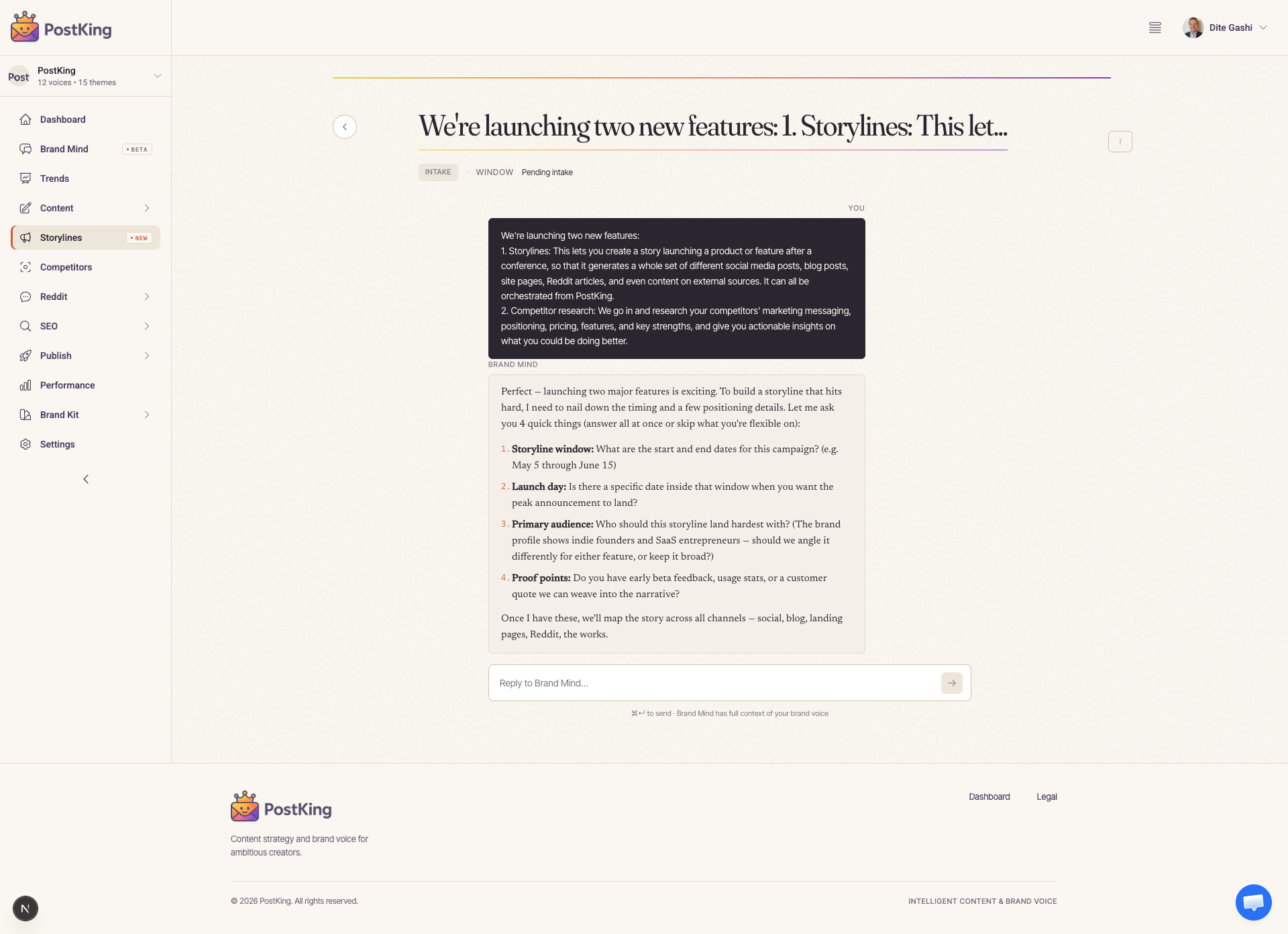
A clear campaign storyline helps you map out each stage, from initial goal setting to final optimization.
Key Takeaways
- AI compresses campaign production time, but strategy and offer quality still decide results.
- Stack coherence beats tool count - three connected tools outperform nine disconnected ones.
- Voice-matched output is the differentiator now that generic AI copy is everywhere.
- Measure AI tools against campaign outcomes, not seats saved or words generated.
- Budget for human review on every customer-facing asset, no exceptions.
Why Most AI Campaign Stacks Underperform
More tools rarely fixes a weak campaign. Teams keep buying platforms hoping automation will paper over a shaky strategy, and the results rarely change. Nearly half of marketers are stuck in neutral or struggling with their effectiveness, while just 12% call themselves highly effective (CMI's B2B Content and Marketing Trends: Insights for 2026 report, 2026). This gap indicates a strategy problem wearing a tooling disguise. Meanwhile, the humans running these stacks are fraying: burnout has jumped an alarming 11 points in a single year (Annual AI sentiment survey (Noam Segal), 2026). Adding another dashboard, another generator, another tool only adds more surface area to manage. It doesn't add clarity about what the campaign is actually supposed to do.
The effectiveness gap nobody talks about
Marketers assume more inputs produce better outputs, but effectiveness and effort keep diverging.
Most teams optimize the wrong layer.
They tune prompts and workflows instead of fixing weak positioning or unclear offers.
Tool sprawl as a symptom
Tool sprawl looks like ambition. It's usually avoidance.
Each new subscription promises the missing piece.
None of them replace a clear decision about what the campaign is for.
The Five Jobs AI Actually Does in a Campaign
Match tools to jobs, not to hype cycles. Every AI platform on the market claims to do everything at once, but a real campaign only needs five distinct functions performed well: research and positioning, drafting, visual production, distribution, and performance analysis, each of which calls for a different kind of model, prompt structure, and human review step rather than one universal assistant that tries to cover all five badly. Buyers who evaluate platforms by the job at hand see stronger returns than those who chase whatever tool trends this quarter, and that discipline matters more now that a significant majority of organizations already lean on AI for tasks like copywriting and marketing planning (BuzzHive Marketing, 2025), even as most teams still stitch tools together without ever mapping a single capability to a specific need in the funnel.
- Research and positioning: clustering keywords, mining audience pain points, and tearing down competitor messaging to find an angle worth writing toward.
- Drafting: producing campaign copy, landing pages, email sequences, and social variants fast enough to test more than one idea per cycle.
- Visuals: generating on-brand assets and pairing them automatically with the written content they're meant to support.
- Distribution: adapting one core message into platform-aware variations and scheduling them without manual re-formatting.
- Analysis: turning raw performance data into readouts, attribution hypotheses, and concrete inputs for the next cycle.
Few teams stack all five well.
Most lean hard on drafting and quietly neglect analysis, which is where compounding advantage actually lives.
AI Tools for Marketing Campaigns, Compared by Goal
Every category has a real cost and ceiling: SEO suites scale keyword tracking, content platforms scale voice, ad tools scale variants, email tools scale drafts, and analytics copilots scale explanation speed, but none replace judgment. Picking a tool by category, not by brand name, is the fastest way to avoid buyer's remorse. A CPG-style research finding still holds across marketing teams broadly: most brands can report what happened last week but struggle to explain why it happened LatentView. That gap shows up in every row below. Research suites like Semrush One can track prompts and keywords at real scale, monitoring up to 500 keywords daily across five domains Behind Rankings. Content automation platforms need strong source material before they sound like your brand. Ad and email tools speed up drafts
they don't fix weak offers or bad segmentation.
| Campaign goal | Tool category | Best for | Where it breaks down |
|---|---|---|---|
| Organic search growth | SEO/GEO research and optimization suites | Keyword and prompt monitoring at scale | Outputs read templated without editorial judgment |
| Full-funnel content output | Multi-brand content automation platforms | Blog, social, landing pages from one brand voice model | Needs quality source material to learn voice from |
| Paid ad creative | Ad copy and creative generators | Fast variant testing across placements | Weak on offer strategy and audience insight |
| Email lifecycle | Sequence and subject-line assistants | Draft speed for nurture flows | Deliverability and segmentation stay manual |
| Reporting and insight | Analytics copilots | Explaining last week's numbers quickly | Descriptive, not causal - rarely tells you why |
Building a Cohesive Stack Instead of a Tool Pile
Integration decides whether your stack saves time. Buying five AI tools rarely equals five times the output - connected tools compound; disconnected ones just multiply login screens. A significant majority of organizations already use AI for copywriting and content planning, but adoption alone isn't the differentiator (BuzzHive Marketing, 2025). What separates teams that ship faster from teams stuck in dashboards is whether outputs from one tool feed cleanly into the next. A brand-voice model that can't pass its guidelines to a production tool forces manual re-entry every time. A production tool that can't push finished assets to distribution creates a copy-paste bottleneck right before deadline. Think of the stack as plumbing, not a toolbox - value moves through connections, not through individual tools sitting in isolation. That's the real reason so many marketers report stalled results despite heavy tool spend, with only 12% calling their content efforts highly effective (CMI, 2026). The fix isn't more tools - it's fewer seams.
The three-layer stack: brand, production, distribution
Structure your stack in three layers.
Brand layer holds voice, guidelines, and approved messaging. Production layer turns that input into drafts, images, and variants. Distribution layer schedules, personalizes, and publishes across channels. Each layer should export in a format the next layer can ingest without manual reformatting.
Where handoffs leak hours
Most wasted time hides in handoffs, not in the tools themselves.
Watch for exports that require reformatting, approvals that live outside the tool, and channels that need re-tagging on arrival. Audit each handoff quarterly and cut any step a human retypes by hand.
Avoiding AI Slop in Campaign Copy
Generic output now actively damages brand trust. Online mentions of the word "slop" jumped over 200% in 2025 as audiences grew sharper at spotting robotic, templated marketing copy (Creative Ghost). A significant majority of organizations already use AI for copywriting and content planning, which means bland output is no longer rare - it's the default competitors are shipping (Buzzhive Marketing). Voice-matched generation is the actual differentiator now, not AI adoption itself. The brands that win train their tools on their own writing
the ones that lose accept whatever the model defaults to. This section is a practical checklist for keeping campaign copy recognizably yours.
- Feed it your archive first: Load existing posts and site copy into the tool before any campaign draft.
- Ban the tells: Prohibit filler openers, superlatives, and em-dash-heavy corporate language in prompt rules.
- Keep a human gate: One editor must approve every customer-facing asset before it ships.
- Test against your own writing: Compare drafts to a held-out sample of past posts for voice drift.
- Run the blind read: If a teammate can't identify an asset as yours, kill it.
Measuring ROI From Your AI Marketing Tools
Seats saved is not a marketing metric. Teams that adopt AI tools often report headcount efficiency and stop there, but that number tells you nothing about pipeline, revenue, or whether campaigns actually got better. Real ROI tracking ties tool spend to output volume, speed, cost per lead, and how much a human still has to fix. This matters because only 12% of marketers call themselves highly effective right now, despite a significant majority already using AI for copywriting and planning. Adoption clearly isn't the bottleneck anymore.
Measurement is. The table below gives four baseline metrics worth tracking before you credit any tool with saving your quarter. Each one answers a different question: did output actually increase, did cycles get faster, did cheaper content convert, and is the AI voice good enough that editors aren't rewriting half of it. Pull these numbers before your next renewal conversation.
| Metric | How to baseline | Signal it gives you |
|---|---|---|
| Assets shipped per campaign cycle | Count 90 days pre-adoption | Whether output bottleneck actually cleared |
| Cycle time from brief to publish | Median days across last 10 campaigns | Where the stack removed friction |
| Cost per qualified lead | Blended pre-AI average | Whether faster output converts |
| Edit ratio on AI drafts | Percent of words rewritten | How well voice matching is working |
Ethics, Privacy, and Disclosure You Can't Skip
Small teams carry the same compliance risk. A five-person shop that mishandles customer data faces the same fines, breach disclosures, and reputational fallout as a large enterprise, without the legal bench to absorb it. Nearly half of marketers already describe their AI-assisted output as merely adequate rather than exceptional, and unchecked prompts are part of that gap. Only 12% of marketers report highly effective results from their broader content programs CMI, and sloppy data handling erodes trust further, not less. Treat every prompt as a public document, because logs, training pipelines, and third-party plugins can all retain what you paste.
Customer data you should never paste into a prompt
Never paste names, emails, purchase history, or support tickets into a general AI tool.
Use synthetic examples or aggregated summaries instead.
Bias and claim-checking before publish
Review every AI draft for skewed assumptions, unverifiable claims, and missing disclosure of AI involvement. A human editor should confirm facts against source data before anything ships.
Upskilling a Small Team to Run AI Campaigns
Skill gaps show up as burnout, not complaints. Teams rarely file a ticket saying "we don't know how to prompt this tool." Instead, someone quietly starts working nights to fix AI drafts nobody trained them to fix, and the exhaustion spreads before leadership notices. Burnout has jumped an alarming 11 points in a single year (Annual AI sentiment survey, 2026), and small marketing teams absorb that spike hardest because there's no backup shift. A four-week ramp fixes the root cause instead of the symptom, building capability in order rather than dumping every tool on the team at once.
- Week one: document brand voice rules the tools can ingest
- Week two: run one campaign end-to-end with human review at every stage
- Week three: automate only the steps that survived review unchanged
- Ongoing: one owner per tool, one shared prompt library, monthly output audit
This sequence matters more than the tools themselves.
Automating an undocumented process just scales the confusion faster.
How to Pick Your First Three Tools
Start with your worst bottleneck, not the leaderboard. Tool review sites reward the platform that paid to be tested, not the one that fixes your specific drag on output. Before shortlisting anything, name the single stage where campaigns fail - research, drafting, or reporting - and buy against that gap only. Most teams overspend on a flashy all-in-one suite while the real leak is a two-hour manual reporting task nobody automated. Commercial-intent searches like "best AI marketing tool" convert better when narrowed to a job: rank tracking, brief generation, or prompt monitoring. A platform like Semrush One, which tracks up to 500 keywords per day across five domains, only earns its seat if keyword sprawl is the actual constraint. Run each shortlisted tool on one live project for two weeks. Measure time saved against the manual baseline, not feature counts. Keep the tool that moves the metric; drop the rest before renewal.
FAQs about ai tools for marketing campaigns
What are the best AI tools for marketing campaigns in 2026?
The best choice depends on your goal rather than a single "top tool." For copy and campaign drafting, look for platforms with strong brand-voice training; for ad creative and video, prioritize tools with fast iteration and multi-format export; for analytics and audience targeting, choose tools that integrate directly with your existing ad platforms. Start by shortlisting one tool per category - content, creative, and analytics - rather than chasing an all-in-one solution. Platforms that let you train on your own brand voice and past campaigns consistently outperform generic generators for anything customer-facing, so weigh voice-matching capability heavily before comparing price or feature count.
Can AI run a full marketing campaign on its own?
Not reliably, and treating it that way is where most campaigns go wrong. AI is genuinely strong at the execution layer - drafting copy variations, scheduling posts, resizing creative for different channels, and A/B testing subject lines at a speed no human team can match. What it still can't do well is set strategy: deciding the offer, positioning against competitors, reading market timing, or knowing which trade-offs your brand should make. In practice, the winning setup in 2026 is a human-defined strategy and offer, with AI handling the high-volume drafting and scheduling work underneath it.
How much should a small team spend on AI marketing tools?
Cap it at three tools maximum - one each for content, creative, and analytics - until you've proven ROI on each. Most platforms offer free credits or trial tiers that are enough to test whether the output quality justifies a subscription before you commit budget. Rather than judging cost in isolation, calculate cost per shipped asset (the price divided by how many usable posts, emails, or ads you actually publish per month); this exposes tools that look cheap but produce mostly unusable drafts, and tools that look expensive but save real hours once brand voice is dialed in.
How do I stop AI content from sounding generic?
Generic output almost always comes from a generic prompt or an untrained model. Feed the tool a batch of your own past posts, emails, or ad copy so it can learn your actual voice, phrasing habits, and tone rather than defaulting to average internet copy. Just as important is keeping a human edit gate before anything publishes - a quick pass to cut stock phrases, tighten the hook, and confirm the message actually sounds like your brand. Tools with voice-training features cut this editing time significantly, but the human check should never be skipped entirely.
Do I need to disclose AI-generated marketing content?
Check the specific platform's policy first - several major ad and social platforms now have explicit disclosure requirements for AI-generated or AI-assisted content, and rules vary by format and region. Beyond compliance, disclosure is also a claim-accuracy issue: if AI-generated content includes product claims, testimonials, or statistics, verify every fact before publishing regardless of disclosure rules. Being upfront when it's required - and accurate always - protects audience trust, which is harder to rebuild than any single campaign is worth.
Five Mistakes That Sink AI-Run Campaigns
- Buying tools before defining the bottleneck: Teams subscribe to six platforms and still ship late because the real constraint was approvals or offer clarity, not drafting speed.
- Skipping voice training entirely: Running default models on a brand with a distinct tone produces copy your audience recognizes as generic, which erodes trust faster than posting less.
- Treating analytics copilots as causal: Most tools describe what happened last week without explaining why, so teams optimize toward noise instead of testing real hypotheses.
- Automating before a human review pass exists: Scheduling unreviewed output across five platforms multiplies a single factual or tonal error into a brand-wide problem.
- Measuring word count instead of outcomes: Volume metrics make a stack look productive while cost per qualified lead and cycle time stay flat or get worse.
Sources
- CMI’s B2B Content and Marketing Trends: Insights for 2026 report
- Report on AI adoption in marketing statistics
- Creative Ghost - small business marketing trends
- 20+ Best AI Marketing Tools I Tested for Marketers
- LatentView - category management platform shortlist
- ABI Research - global AI market size
- Statista Market Insights - Artificial Intelligence Worldwide
- AI market size statistics
- DataReportal - Global Digital Overview Report
- Annual AI sentiment survey (Noam Segal)
About Joshua Krindle
Author
SEO Expert, turning what I know about traditional SEO into programmable agentic insights.