

AI-Powered Marketing Automation Platform: How to Choose One That Sounds Like You
Choose an AI-powered marketing automation platform that scales output without flattening your brand voice. See evaluation criteria, costs, & rollout steps.

Dana Willow
Senior Marketer sharing 15 years of marketing wisdom through an AI lens.
Published on September 11, 2026
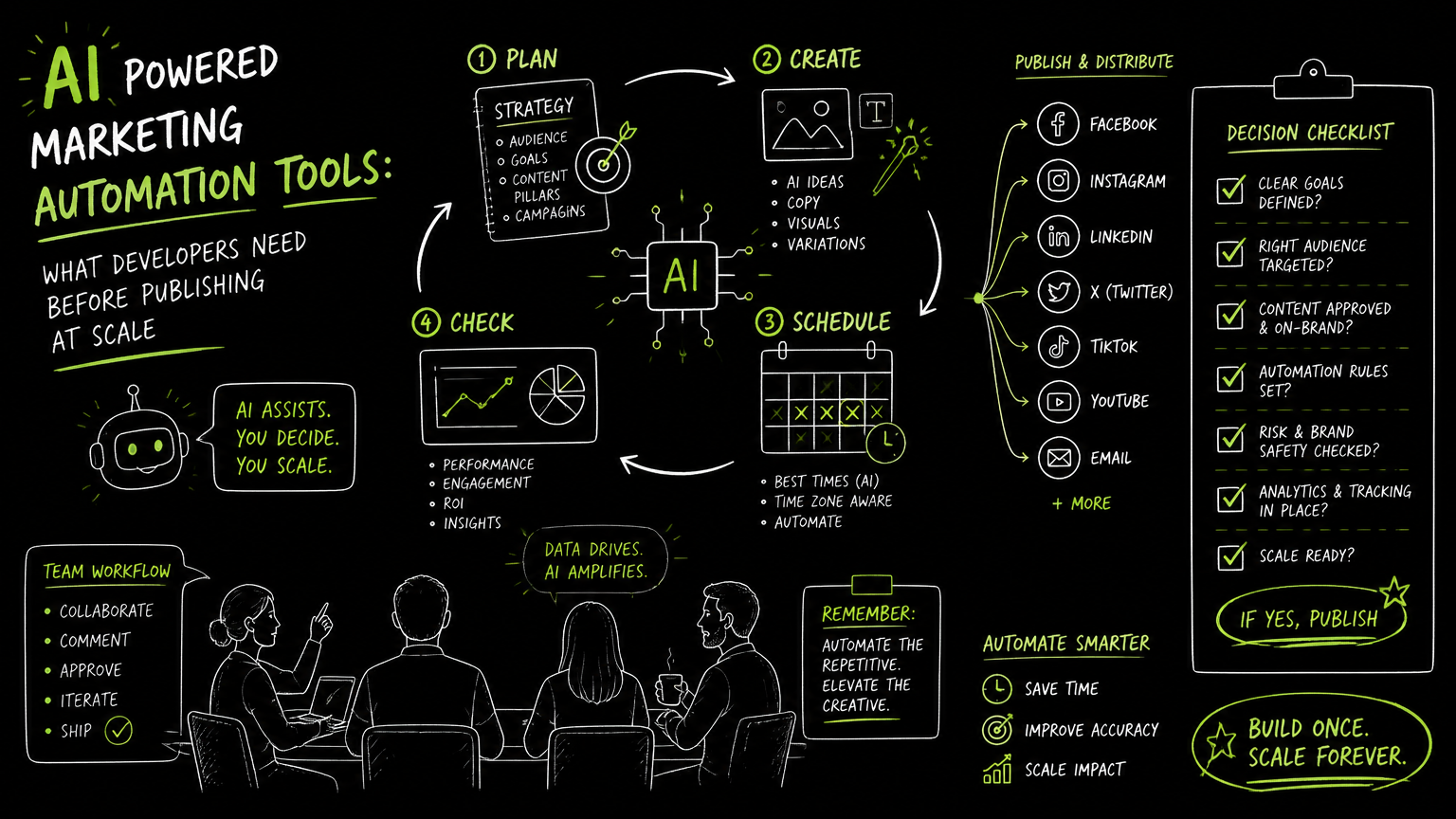
Choosing the right AI marketing platform means balancing advanced features with your brand's unique voice and operational needs
Key Takeaways
- A real platform covers generation, asset matching, scheduling, and multi-channel publishing - anything less is a point tool with an AI label.
- Voice fidelity is the highest-priority evaluation criterion, because generic output costs you trust faster than slow output costs you reach.
- Test with your own last 20 posts, not the vendor's demo prompt; demos are tuned to hide the failure modes.
- Budget for workflow redesign, not just seats - teams that keep old approval chains get automation speed with manual bottlenecks.
- Write down your disclosure, data-retention, and human-review rules before rollout, not after your first embarrassing post.
What an AI-Powered Marketing Automation Platform Actually Does
Automation without judgment just ships mediocrity faster. That's the the reality behind most AI marketing tool purchases. Teams buy a platform expecting transformation, then discover it only accelerates existing weak strategy. The numbers back this up: nearly half of marketers are stuck in neutral or struggling with their effectiveness, and only 12% call themselves highly effective (CMI, 2026). A real automation platform is different from a writing assistant that drafts copy on request. It orchestrates decisions across channels, timing, and audience segments, learning from outcomes rather than just executing prompts.
A writing tool produces content; a platform decides what content should exist, when, and for whom. Most vendors blur this distinction deliberately, because "AI-powered" sells better than "we help you draft faster." Buyers who understand the difference stop paying platform prices for glorified autocomplete, and start evaluating whether a tool actually closes the strategy-to-execution gap that's keeping so many teams average.
Automation platform vs. AI writing tool
A writing tool waits for input and returns text. A platform ingests performance data, adjusts targeting, and triggers the next action without a human re-prompting it every step.
That distinction determines whether AI compounds effort or just multiplies output.
Where the category sits in 2026
Marketing automation has absorbed AI faster than almost any software category, with a significant majority of organizations now using AI for copywriting and content planning (report on AI adoption in marketing statistics, 2025). Adoption alone hasn't fixed effectiveness gaps.
The Five Capabilities That Separate a Platform From a Point Tool
Coverage beats cleverness when evaluating marketing platforms, because the tools that actually save time are the ones that plan, write, design, and publish across every channel a brand runs - not just the one with the flashiest AI demo. A point tool does one thing well and leaves everything else - asset creation, scheduling, multi-brand permissions - for someone to stitch together by hand, which is exactly where content pipelines fail. A significant majority of organizations already use AI for tasks like copywriting and content planning (BuzzHive Marketing, 2025), yet adoption alone says nothing about whether that output ships without a rewrite or whether it covers the channels a brand actually needs, which is why the five capabilities below work as a practical scorecard for any live vendor demo, not just another checklist to skim.
| Capability | What good looks like | Red flag | Why it matters |
|---|---|---|---|
| Voice replication | Trained on your existing site and past posts | One "tone" dropdown with five presets | Determines whether output ships or gets rewritten |
| Channel coverage | Blog, X, LinkedIn, Facebook, Instagram, Threads, Reddit, landing pages | Social-only with a blog "coming soon" | Every gap becomes another subscription |
| Asset matching | Visuals generated or paired automatically per post | Manual upload for every asset | Image selection is a hidden time sink |
| Scheduling | Native publishing plus weekly planning | Export to CSV, publish elsewhere | Handoffs are where calendars die |
| Multi-brand controls | Brand switching plus role-based access | One workspace, one voice profile | Agencies and multi-product founders need separation |
Run any vendor through all five rows before signing a contract.
Miss one, and the gap doesn't disappear - it just resurfaces later as an extra tool, a rewrite queue, or a calendar nobody owns.
Voice Fidelity: The Criterion Most Buyers Skip
Generic output erodes trust faster than silence does. Readers can tell within a sentence or two when copy came from a generic prompt template rather than real brand context. That recognition is exactly why online mentions of the word "slop" jumped over 200% in 2025, as audiences got sharper at spotting AI-flavored text (Creative Ghost, 2025). Most buyers evaluating a content platform check integrations, dashboards, and reporting depth.
Few pressure-test whether the tool can sound like the brand across dozens of posts. That oversight matters more than any feature checklist, because voice inconsistency compounds. One off-tone post is forgivable. A pattern of generic phrasing across a content calendar reads as outsourced, hollow, and forgettable to the exact audience a brand spent years building.
How fine-tuned voice models differ from prompt templates
Prompt templates fake voice with adjectives like "friendly" or "bold" stuffed into instructions. Fine-tuned models learn actual sentence rhythm, vocabulary, and structure from a brand's own archive.
Templates drift after a few outputs. Fine-tuned voice holds steady across hundreds of posts.
A three-post test for voice accuracy
Before buying, run this quick gut check on any shortlisted platform.
- Blind read: Mix three AI drafts with three human ones and see if a teammate can tell them apart
- Idiom check: Confirm the output uses phrases your brand actually says, not generic filler
- Repeat-topic test: Generate three posts on the same subject and check for repeated sentence patterns
- Editor time: Track how many minutes it takes to make each draft publish-ready
Platform vs. Stitched-Together Stack: Real Cost Comparison
Tool sprawl taxes attention more than budget. A five-tool stack rarely costs more per month than a single platform subscription. The real bill shows up in switching costs: re-uploading briefs, re-training tone in a new tool, chasing down which tool broke after an update. A significant majority of organizations now use AI for copywriting and marketing planning, but stitching separate apps together multiplies the places drift and silent breakage can creep in. Consolidated platforms trade some flexibility for a single login, one trained voice profile, and one place to review before anything publishes. Multi-tool stacks trade that simplicity for best-in-class components glued together with automation someone has to maintain. That maintenance is invisible until a Zapier step fails and a week of scheduled posts silently stops going out. The right choice depends less on sticker price and more on who owns the glue holding the stack together.
| Dimension | Consolidated platform | Multi-tool stack |
|---|---|---|
| Monthly tools to manage | One subscription and one login | Writer, scheduler, image tool, analytics, plus glue automation |
| Voice consistency | One trained profile across all channels | Re-prompted per tool, drifts constantly |
| Time to publish a week of content | Plan once, generate, review, schedule | Copy-paste between four surfaces |
| Failure mode | Vendor lock-in if voice quality drops | Silent breakage when one voice changes |
| Best fit | Solo founders and teams under 50 | Teams with a dedicated marketing ops owner |
Neither column is universally cheaper.
The stack that wins is the one your team can actually keep running every single week.
How to Run a 14-Day Evaluation Before You Commit
Trial design decides whether demos survive contact. Most platform trials fail because teams test features instead of outcomes, comparing a slick demo against gut feel rather than against their current workflow's real edit time and cost. A proper trial forces the tool to prove itself on your voice, your weak channels, and your actual publishing cadence
not a canned onboarding flow built to impress. This matters more now: only 12% of marketers call their content highly effective, so another tool that just adds noise won't move that number. The 14-day structure below gives you pass/fail gates at each stage, so you stop the trial early if it fails rather than riding out a full month on hope.
- Days 1-2: Feed the platform your site and last 20 posts, then generate five pieces without editing prompts.
- Day 3: Score each output on voice, factual accuracy, and ship-readiness using a 1-5 scale.
- Days 4-7: Publish only pieces scoring 4 or higher, and track edit time per piece.
- Days 8-11: Test the weak channel
usually long-form blog or Reddit
where generic tools break down. - Days 12-13: Run a multi-brand or client-account test if you manage more than one voice.
- Day 14: Calculate cost per shipped piece, including editing minutes, against your current stack.
Ethics, Data Handling, and Disclosure You Should Demand
Policy written after publishing is damage control. Real governance happens before content goes live, when vendor contracts and internal habits are still negotiable. Most teams skip this step because it feels like legal overhead rather than marketing work. That gap is exactly where reputational damage starts, and it compounds fast once a platform is embedded in daily workflows. The fix isn't a lengthy ethics charter; it's a short list of concrete questions and rules applied consistently. Ask vendors directly, then hold your own team to matching standards. Treat this as a pre-purchase checklist, not a post-crisis memo.
- Model isolation: Ask whether your brand content trains shared models or stays isolated to your account.
- Data retention: Confirm retention and deletion timelines in writing before uploading customer material.
- Sourcing rule: Require human sourcing for statistics, pricing, and customer results at minimum.
- Disclosure stance: Decide your AI-disclosure policy per channel and apply it consistently, not case by case.
- Named reviewer: Keep a named human accountable for every scheduled post, even fully automated ones.
Upskilling Your Team So the Platform Earns Its Price
Tools amplify judgment; they never manufacture it. A platform can draft, schedule, and optimize at scale, but it cannot decide which story matters or spot a tone mismatch before it embarrasses the brand. Nearly half of marketers admit they're stuck in neutral or struggling with effectiveness (CMI's B2B Content and Marketing Trends: Insights for 2026 report, 2026), and buying software rarely fixes that on its own. Meanwhile burnout has climbed 11 points in a single year, a sign teams are being asked to operate machines rather than think (Annual AI sentiment survey, 2026). The fix isn't more tooling; it's retraining people to interrogate outputs instead of approving them by default.
Editor, not operator: redefining the marketing role
Marketers who thrive treat AI drafts as raw material, not finished work.
They edit for accuracy, voice, and brand fit before anything ships.
The weekly review ritual that prevents drift
A short weekly session catching tone slips, factual errors, and stale messaging keeps quality steady.
Skip it, and automation quietly drifts off-brand.
Where AI Marketing Automation Still Falls Short
Reporting numbers differs from explaining them. Most platforms excel at surfacing what happened last week, and struggle to say why it happened or what to do next.
Most teams are still at the descriptive stage, able to report results but not reliably explain them (LatentView, 2026). That gap matters more than any feature checklist. A dashboard full of charts can still leave a marketer guessing about root cause, and automation compounds the guesswork by acting on flawed assumptions at scale. Effectiveness data backs this up: only 12% of marketers call themselves highly effective, meaning they exceeded goals over the past year (CMI, 2026). Tools alone don't close that gap. Judgment, context, and a willingness to question the output still do the heavy lifting automation can't replace.
FAQs about ai powered marketing automation platform
What is an AI-powered marketing automation platform?
It's a system that goes beyond drafting copy - it generates content, schedules it, and publishes it across your channels with minimal manual handoffs. That's the key distinction from a standalone AI writing assistant: a writing tool gives you text you still have to move into a calendar, format, and post yourself, while a true platform closes the loop from idea to live content. When evaluating options, check whether "AI-powered" actually means end-to-end automation or just a chatbot bolted onto an existing dashboard.
How is it different from traditional marketing automation software?
Traditional marketing automation runs on rules-based triggers - if a user clicks this, send that email, tagged with that label. The workflow logic is fixed; only the audience segmentation changes. An AI-powered platform adds a generative layer on top: instead of picking from pre-written templates, it produces new content in response to context, and increasingly it models your specific voice as an input to that generation. In practice, voice modeling is the newest and most differentiating layer - it's what separates a platform that sounds generic from one that sounds like you.
Will AI-generated marketing content hurt my brand voice?
It depends heavily on what the voice model was trained on. A platform trained on generic internet copy or broad industry templates will produce generic-sounding output, no matter how good the underlying model is. One trained on your own past posts, emails, and site copy has a much better shot at sounding authentically like you. Before committing, run a test: feed it a sample of your own historical content and compare the output against a piece you know performed well. If it can't pass that test on a small sample, it won't pass it at scale.
How much should a small team budget for one?
Frame the budget around cost per shipped piece of content, not cost per seat - seat-based pricing can look cheap on paper but balloon once you factor in how many pieces a single seat actually needs to produce and publish each month. Many platforms offer free credit tiers designed for trialing, which let you test voice quality and output volume before committing to a paid plan. Use that trial period to calculate your real per-piece cost, including any editing or revision time, rather than trusting the sticker price alone.
Can one platform handle multiple brands or clients?
The better platforms are built for this, with brand switching that lets you toggle context without logging into separate accounts, plus role-based access so team members or clients only see and edit what they're assigned to. Just as important is whether each brand gets its own separate voice profile - without that, content for one brand can start bleeding tone and phrasing into another, which is a fast way to lose client trust if you're agency-side.
Do I still need a human editor?
Yes. Even a well-trained voice model benefits from a named reviewer attached to every scheduled post - someone accountable for catching tone drift, factual errors, or anything that reads off before it goes live. This matters especially for claims and statistics: AI-generated content can state numbers or facts confidently without a real source behind them, and it's the human editor's job to verify and cite before publishing, not the platform's.
Five Mistakes Founders Make When Buying AI Marketing Automation
- Judging the platform on the vendor's demo prompt: Demos are tuned to look impressive on generic topics. Load your own site and last 20 posts, then judge the first unedited output.
- Buying for output volume instead of ship rate: A tool that generates 50 posts you rewrite is slower than one that generates 10 you publish. Measure cost per shipped piece, including your editing minutes.
- Assembling five point tools and calling it a stack: Every handoff between writer, image tool, and scheduler is a place where voice drifts and calendars stall. Consolidation is a feature, not a compromise.
- Automating the workflow you already had: Speeding up generation while keeping a three-person approval chain just moves the bottleneck. Redesign review before rollout, not after.
- Skipping the data and disclosure conversation: Ask where your brand content lives, whether it trains shared models, and what your public disclosure stance is - before your first automated post goes live.
Sources
- CMI’s B2B Content and Marketing Trends: Insights for 2026 report
- Creative Ghost - Marketing Trends for Small Business
- Report on AI adoption in marketing statistics
- ABI Research - Global Artificial Intelligence Market Size
- Statista Market Insights - Artificial Intelligence Worldwide
- LatentView - Platforms Category Teams Actually Shortlist
- 20+ Best AI Marketing Tools I Tested for Marketers
- DataReportal - Global Digital Insights
- AI Market Size Statistics
- Annual AI sentiment survey (Noam Segal)
About Dana Willow
Author
Senior Marketer sharing 15 years of marketing wisdom through an AI lens. Teaching founders to automate smarter.