

Target Market Selection: How PostKing's Picker Works
PostKing's target market selection lets you pick up to 3 countries for multi-country SEO targeting, or go Global with English-only research.

Dana Willow
Senior Marketer sharing 15 years of marketing wisdom through an AI lens.
Published on August 17, 2026
Updated on October 9, 2026

Choosing a target market decides which country and language your content is built for.
Picking a target market feels like picking a language, until you realize that search volume, competition, and buyer intent shift by country even when everyone speaks the same tongue. PostKing's target market selection settings solve for that gap. This guide walks through multi-country SEO targeting inside PostKing, from the Global fallback to picking up to three countries that share one research language.
I've watched teams launch a German-language blog aimed loosely at "Europe" and then wonder why traffic never showed up in Vienna. The keyword data behind it was built for Germany. Austria runs its own search patterns, its own competitors, and its own difficulty scores, and no amount of shared vocabulary closes that gap.
That's the problem the Target markets picker fixes. It sits near the top of every brand's settings, labeled plainly, and it toggles between two modes: Global and Countries. Each mode changes what the keyword research engine actually does behind the scenes, and getting familiar with both before you launch a brand saves you from re-running research after the fact.
Why Multi-Country SEO Targeting Needs More Than a Language Toggle
Most content tools treat language as the only variable that matters. Write in Spanish, the logic goes, and you've covered every Spanish-speaking market at once.
Search doesn't work that way. Mexico and Spain use different terms for the same product, carry different search volumes, and compete against a different set of sites for the same keyword, which is exactly why multi-country SEO targeting means running country-specific keyword research for each market instead of writing in a language and hoping the numbers line up.
That's the local vs global SEO tradeoff in one line: local data is sharper but narrower, global reach is wider but blind to what's actually happening inside any single country.
PostKing's picker puts that tradeoff in front of you instead of burying it in a settings menu you'd never think to check.
Inside the Target Markets Picker: Global vs Countries Mode
Open a brand's settings and Target markets sits near the top, right alongside the rest of the Native-Language SEO configuration. Two modes: Global and Countries, the two core international SEO settings that drive everything downstream.
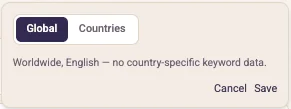
Global mode is the default fallback, and the panel doesn't dress it up. It states plainly: Worldwide, English, no country-specific keyword data. That's an honest tradeoff. Broad reach, English-only writing, and zero per-country search volume or difficulty numbers to plan a keyword strategy against.
Switch to Countries mode and the layout changes. You'll see "Select up to 3 countries (X/3)" with a live count as you check boxes, capping out at three so the research stays focused instead of spread thin across a dozen markets with no real depth in any of them.
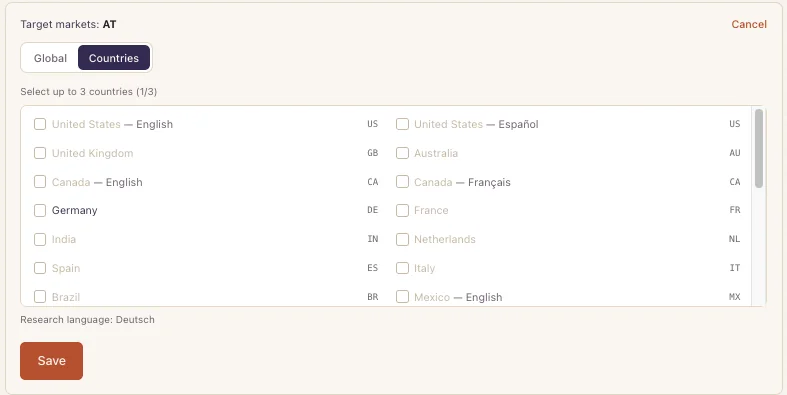
Pick a country and the research engine locks onto that market's actual search terms, volumes, and competition, not a blended average pulled from everywhere at once. Once you've made your selections, the picker shows a Research language line at the bottom, something like Research language: Deutsch, confirming exactly which language the keyword engine is about to run in. That's the core of multi-country SEO targeting inside PostKing: real per-country data instead of one blended global number.
Same Language, Different Country: Why Dialect and Border Both Matter
The country list doesn't group by language first. It groups by country, then language, because the same language reads differently depending on which side of a border it's spoken on.
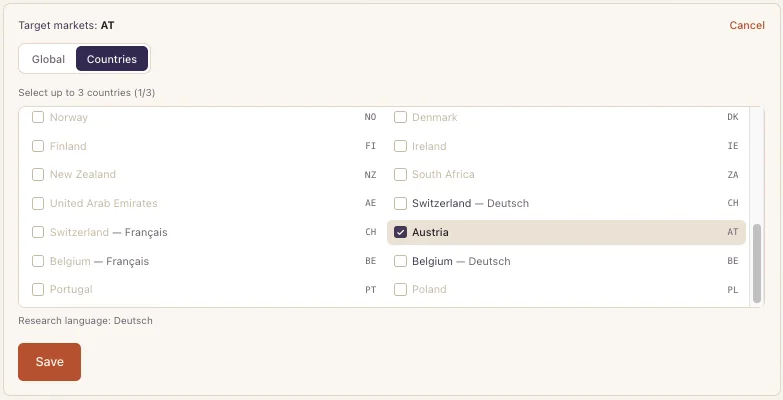
Switzerland, Deutsch and Switzerland, Français sit as two separate entries, both tied to Switzerland (CH) but each running its own language's research. Belgium splits the same way, with Belgium, Français and Belgium, Deutsch listed apart rather than folded into one Belgian market. Canada, English and Canada, Français split by country and language too, and so do United States, English and United States, Español.
Each combination pulls its own keyword data. A phrase that ranks in Zurich won't necessarily rank the same way in Berlin, and treating "German" as one lumped-together bucket throws that difference away entirely.
Practical Examples: Target Market Selection in Action
Say you run a SaaS product selling into German-speaking Europe. You could select Germany, Austria, and Switzerland, Deutsch. All three research in German, so the picker accepts the combination and shows Research language: Deutsch at the bottom, confirming what the keyword engine is about to run on.
Try adding the United States to that same set and the picker stops you. Germany and the US don't share a research language, and PostKing caps a brand at one research language across its up to 3 countries. You'd need a second brand for the US market, complete with its own target market selection and its own content calendar.
That constraint exists for a real reason. Country-specific keyword research runs one language at a time, and mixing English-market data with German-market data inside a single brand would blur both signals together instead of sharpening either one.
Running a global NGO with English, French, and Spanish programs? You're looking at three separate brands, each with its own market set, because English, French, and Spanish count as three different research languages even when the mission and the logo stay identical across all three.
Best Practices for Choosing Local vs Global SEO
Start with revenue geography, not aspiration. If most of your customers sit in two or three countries, target market selection should reflect that reality, not the countries you'd like to break into someday.
Use Global mode for early validation, before you know which country actually converts. It's a reasonable choice when you don't have the data yet to justify narrowing down, and English-only reach beats guessing at three countries you haven't tested.
Switch to Countries mode once you've got a market worth researching properly. The local vs global SEO decision can change as the business grows, and each shift updates the keyword research and the content generation behind it to match the new market set.
Setting Up International SEO Settings for a New Brand
When you create a brand, PostKing asks for a content language first. That choice does double duty: it sets what language the content itself gets written in, and it pre-selects matching default countries inside the Target markets picker before you ever run a keyword search.
Content authoring covers six languages across the product: English, German, French, Spanish, Brazilian Portuguese, and Czech. Pick German as your content language, and the picker defaults toward German-speaking markets; you can still narrow down to just Austria, or widen out to the full Germany-Austria-Switzerland set, before that first research run locks anything in.
These international SEO settings sit upstream of everything else PostKing generates, from country-specific keyword research to the content calendar itself, so getting the market set right before that first run saves a re-run later.
Next Steps: Choose Your Target Markets Before You Publish
Target market selection shapes whether your keyword data reflects Vienna or Berlin, Mexico City or Madrid, and whether your content runs on real search behavior or an English-only average pulled from nowhere in particular.
Get it wrong and you're optimizing for a market that was never yours to begin with. Get it right, and every keyword, every content brief, and every piece of research lines up with where your customers actually search.
If you're setting up a new brand, open the Target markets picker before your first keyword run. Pick Global if you're still validating, or pick up to 3 countries that share one research language if you already know your market. Either way, multi-country SEO targeting in PostKing starts with that single decision, so make it on purpose instead of defaulting past it.
About Dana Willow
Author
Senior Marketer sharing 15 years of marketing wisdom through an AI lens. Teaching founders to automate smarter.