
SEO Automation Software: How to Automate Your SEO Workflow in 2026
SEO automation software explained: what it does, how AI fits in, & a step-by-step workflow to automate keyword research, content, & publishing.

Dana Willow
Senior Marketer sharing 15 years of marketing wisdom through an AI lens.
Published on July 15, 2026
Updated on October 10, 2026
Automate Your SEO Workflow
Key Takeaways
- SEO automation software removes the manual grind from keyword research, briefs, and publishing.
- AI-integrated automation offers advanced insights for better content optimization at scale.
- Sequencing automation (research → cluster → brief → draft → publish) matters more than any single tool.
What Is SEO Automation Software?
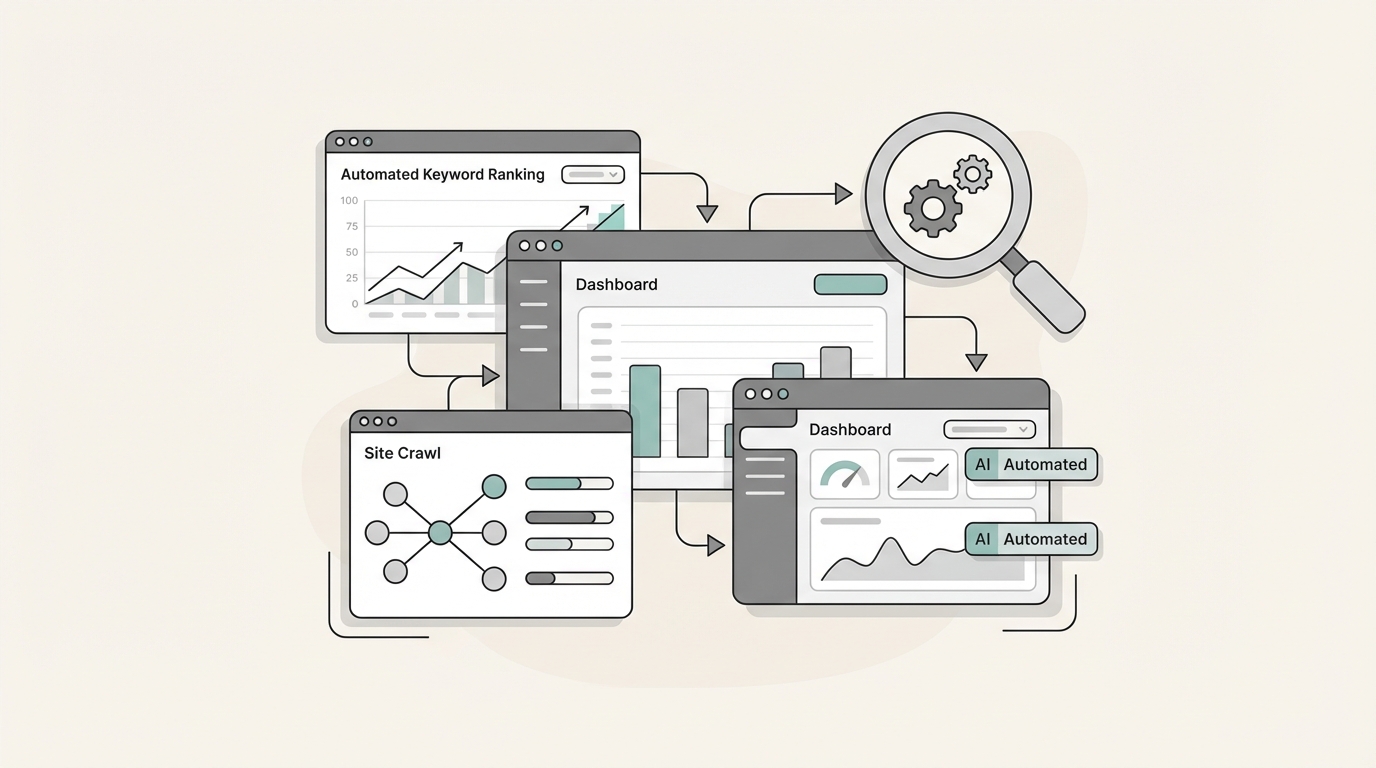
SEO automation software replaces the repetitive, time-consuming tasks that once required hours of manual effort - crawling site errors, tracking keyword rankings, auditing backlinks, and generating optimization reports - so teams can focus on strategy instead of spreadsheets. At heart, this category of tooling connects data sources, runs scheduled checks, and surfaces actionable signals without a human triggering each step. The global SEO software market reflects how seriously businesses take this shift, reaching $96.42 billion in estimated market value (a report, 2026). That figure is not hype - it maps directly to the hours organizations are buying back.
From Manual Checklists to Automated Workflows
Early SEO work ran on manual checklists: open a crawler, export a CSV, paste it into a spreadsheet, repeat weekly. Automation collapsed that loop into a single scheduled workflow. Rank tracking now runs overnight. Technical audits fire on every click. Alerts land in Slack before a ranking drop becomes a traffic crisis.
The difference is speed of response. Manual processes catch problems days after they surface.
Automated workflows catch them in hours - sometimes minutes.
Why Founders and Small Teams Automate SEO First
Small teams face a real constraint: one person cannot monitor hundreds of pages, dozens of keywords, and a competitor network simultaneously. Automation is not a luxury for them - it is the only way to compete.
Marketers typically spend between $100K and $500K annually on organic search (Forrester). Founders who automate early protect that investment by catching issues before they compound into lost rankings.
Categorizing SEO Automation Tools by Function
Five categories of SEO automation worth knowing: keyword research, content briefs, technical audits, rank tracking, and automated publishing each solve a distinct problem in the organic search workflow. Together they form a complete stack that removes the most time-consuming manual tasks from an SEO campaign. The global SEO software market reached an estimated $96.42 billion in 2026, a figure that reflects just how broadly teams now rely on specialized tools to stay competitive. Picking the right category first - rather than grabbing a single all-in-one platform - helps you match the tool to the actual bottleneck in your workflow.
- Keyword Research & Clustering Automation: These tools ingest seed terms, pull search-volume and competition data, and then group related queries into topical clusters automatically. What once took a spreadsheet and hours of manual sorting now runs in minutes, giving writers a clear map of which subtopics belong inside a single piece of content.
- Content Brief & Article Generation: Brief generators analyze top-ranking pages and output structured outlines - headings, recommended word counts, semantic terms, and questions to answer. Some platforms extend further into full draft generation, though human editing remains necessary for accuracy and brand voice.
- Technical SEO Auditors: Crawlers scan every URL on a site and flag issues like broken links, slow Core Web Vitals, missing structured data, and duplicate content. Scheduled crawls catch regressions the moment they appear rather than weeks later during a manual review.
- Rank Tracking & Reporting: These tools monitor keyword positions across search engines, devices, and locations on a daily or near-real-time basis. Automated dashboards and white-label reports replace the tedious process of manually checking rankings and building decks for stakeholders.
- Automated Publishing: Scheduling tools push approved content directly to a CMS, apply meta fields, and trigger social sharing - all without a developer or manual upload.
Speed matters here; faster publication cycles compound into more indexed pages over time.
No single tool dominates every category equally. Most mature SEO stacks combine a flagship platform for research and auditing with lighter point solutions for publishing and reporting. Audit your current workflow gaps before adding new subscriptions.
Leveraging AI in SEO Automation
AI-Powered Automation: From Keyword to Draft in Minutes - modern SEO automation tools now compress what once took days of manual research into a single, structured workflow any marketer can run. The shift matters because speed without accuracy used to be the trade-off. AI changes that equation entirely. Tools trained on search-intent signals can map competitor gaps, suggest semantic clusters, and produce publication-ready outlines before a human writer types a single word. The global SEO software market reached $96.42 billion in 2026, a figure that reflects just how aggressively teams are investing in AI-assisted pipelines to stay competitive.
Automated Content Briefs and Outlines
A content brief used to live in a spreadsheet - keywords in one column, competitors in another, word count at the bottom. AI automation collapses all of that into a single prompt. The tool ingests a target keyword, scans top-ranking pages, and returns a structured outline complete with suggested headings, internal link targets, and questions pulled from "People Also Ask" boxes.
Consider a team launching a new product category. Instead of briefing each writer manually, they feed their primary keyword into an AI brief generator and receive a fully scaffolded outline in under two minutes.
Without automation, that same brief takes a senior SEO strategist the better part of an afternoon.
Predictive Analytics for Better Rankings
Predictive features are where AI earns its premium. Ranking-forecast models analyse historical click data, seasonal patterns, and SERP volatility to tell you which pages are likely to slip - before they do.
That early warning gives content teams time to refresh, relink, or restructure a page rather than scrambling after a traffic drop appears in Google Search Console. Platforms like Semrush Enterprise extend this further by tracking the source domains LLMs rely on, so your brand stays visible inside AI-generated answers, not just traditional blue-link results.
The practical lesson is simple: AI in SEO automation is no longer a nice-to-have feature reserved for enterprise budgets. It is the baseline expectation for any team serious about sustainable organic growth in 2026.
Step-by-Step: Setting Up Your First SEO Automation Workflow
Hands-On: Building an SEO Automation Workflow in Five Steps - once configured, this system researches, drafts, publishes, and tracks content while you focus on strategy. Most marketers delay automation because setup feels overwhelming. It isn't. A lean five-step workflow handles the entire content lifecycle, from raw keyword ideas to live rankings, without requiring a developer or an enterprise budget. The key is sequencing each tool so output from one stage feeds directly into the next, eliminating the manual handoffs that slow most teams down.
Before you begin, pick one platform to anchor your workflow. Tools like Semrush or SE Ranking (rated 4.7 stars on Gartner Peer Insights) handle keyword research, rank tracking, and site audits in a single dashboard. WordPress users can pair that with All in One SEO, trusted by over 3 million website owners, for on-page automation. Now, walk through each step.
- Seed and expand keywords: Enter three to five core topics into your SEO platform's keyword tool. Let it surface hundreds of long-tail variants, filter by intent, and export a prioritized list ranked by difficulty and volume.
- Cluster into topic pillars: Group related keywords by semantic similarity. Each cluster becomes one pillar page plus a ring of supporting posts. This structure signals topical authority to search engines - fast.
- Generate and approve content briefs: Feed your clusters into an AI brief generator. It pulls competing pages, extracts headings, identifies gaps, and outputs a structured brief. Review it. Approve or adjust in under ten minutes per brief.
- Auto-draft and publish articles: Pass approved briefs to an AI writer set to your brand voice. The draft arrives with meta title, description, and internal link placeholders already populated. Human review takes fifteen minutes, then publish directly to your CMS.
- Track rankings and iterate: Connect your platform's rank tracker to the published URLs. Set weekly automated reports. When a page stalls below position five, trigger a refresh brief automatically.
The whole system runs on scheduled triggers once it's live. You review, approve, and refine - the automation handles volume.
Start with one pillar and two supporting posts. Prove the loop works at small scale.
Then expand cluster by cluster, confident that each new topic follows a tested, repeatable path to publication and performance.
Case Studies: Small Business Success Stories
Real Stories, Real Growth: SEO Automation in Practice - small businesses that embraced automated content workflows didn't just save time; they unlocked compounding organic growth that manual processes simply couldn't sustain at scale. The proof isn't in promises - it's in the numbers these owners actually saw. When repetitive SEO tasks move off a founder's plate and onto a reliable automated system, the creative energy freed up tends to flow directly into strategy, customer experience, and product development. That combination is what turns a modest traffic bump into a lasting competitive advantage.
Consider a small e-commerce store selling handmade home goods. Before automation, the owner published two blog posts per month - each one a time-consuming research-and-write session squeezed between order fulfillment. After setting up an automated content production pipeline for keyword clustering, brief generation, and first-draft creation, output climbed to ten pieces per month. The result: a 30% increase in organic traffic within six months, with no additional headcount.
What made the difference wasn't volume alone. Automation enforced consistency - every piece followed the same on-page SEO structure, internal linking logic, and meta-description formula.
Without automation, quality varied wildly depending on how much time the owner had that week.
A local service business - a three-person landscaping company - tells a similar story. They automated Google Business Profile updates, review-request emails, and FAQ page generation from customer questions. Local pack rankings improved within three months. Calls from organic search doubled.
These outcomes aren't outliers. The global SEO software market reached $96.42 billion in 2026 - a figure that reflects millions of businesses investing in exactly these kinds of systems. Small operators are no longer priced out.
- Automated content pipelines: increase publishing frequency without burning out solo founders
- Consistent on-page structure: removes quality variance caused by time pressure
- Local SEO automation: keeps business profiles fresh and review velocity high
- Internal linking rules: spread authority across new pages automatically on publish
- Keyword clustering tools: group topics so one brief covers multiple search intents
- Traffic compounding: each new page builds on existing domain authority, accelerating returns
Lower the Learning Curve
Ease of use separates tools that get adopted from tools that gather dust - and not all SEO automation platforms make it equally easy to get up and running fast. Small business owners rarely have a dedicated SEO team. They need intuitive dashboards, clear guidance, and resources that answer questions before frustration sets in. The difference between a 4.0 and a 4.5 on a usability scale may sound small, but it compounds over weeks of daily use. A tool that clicks immediately saves hours of trial and error - hours better spent on content, outreach, or product.
Google Search Console is the obvious starting point. It's free, authoritative, and backed by official tutorials that walk beginners through every report - and free beats risking a cracked SEO tool. The trade-off is depth - it shows you what's happening but rarely tells you what to do next.
AIOSEO closes that gap with video guides built for WordPress users. Over 3 million website owners use it, which means the community troubleshooting library is enormous. That peer knowledge base quietly reduces onboarding friction.
PostKing matches AIOSEO on ease of use while embedding guidance directly inside the app. You don't leave the platform to learn the platform - a meaningful advantage for solo operators.
| Tool | Ease of Use (Scale of 1-5) | Learning Resources |
|---|---|---|
| Google Search Console | 4.0 | Official Tutorials |
| AIOSEO | 4.5 | Video Guides |
| PostKing | 4.5 | In-app Guides |
A lower learning curve doesn't mean less power. It means faster results - which is exactly what small businesses need when every hour counts.
Common Pitfalls to Avoid When Automating SEO
Avoiding the Pitfalls: Automating SEO Without Losing Quality - automation accelerates results, but only when the foundation is solid. Rushing into automated publishing without a clear strategy often produces content that ranks for nothing, confuses search engines, and dilutes the authority you worked hard to build. The good news is that most automation mistakes follow predictable patterns. Spot them early and you sidestep months of wasted effort. A disciplined setup phase protects every automated workflow that follows.
- Automating publishing before strategy is set: Scheduling content at scale before finalizing target topics, audience intent, and funnel stages is like printing flyers before choosing a venue. Every piece published without strategic grounding competes with itself and rarely earns meaningful rankings. Set your content pillars first, then automate.
- Ignoring keyword cannibalization across automated content: When automation tools generate multiple pages targeting overlapping queries, Google struggles to decide which URL deserves to rank. Cannibalization quietly suppresses all competing pages. Audit your keyword map before each publishing batch and assign unique primary terms to every URL.
- Skipping human review of AI-drafted briefs: AI can draft a brief in seconds - but it cannot verify brand voice, detect factual errors, or flag sensitive topics. A single unchecked brief can spawn an entire content cluster built on a flawed premise. Build a lightweight review checkpoint between brief generation and content production.
- Over-automating too fast: Layering multiple automation tools simultaneously makes it impossible to isolate what is working. Introduce one system at a time, measure its impact, then expand. Incremental rollout keeps quality high and attribution clear.
Automation rewards the methodical.
Rushing it rewards no one.
How to Automate SEO Without Losing Your Brand Voice
Automating SEO without losing your brand voice means letting software handle research and structure while you keep the storytelling, the examples, and the final edit. Bad automation makes you sound like every competitor in your space. These guardrails prevent that.
- Start with research, not writing: Let AI handle keyword clustering and competitor gap analysis. Those tasks benefit from speed. You decide what the insights mean.
- Use AI for structure, not storytelling: Tools are good at suggesting H2s, finding questions to answer, and flagging thin sections. You bring the examples that connect with your audience.
- Write a one-page style guide: List forbidden phrases, required terminology, and tone descriptors. Feed it to every tool you use.
- Run the three-article test: Before you commit to a tool, run three articles through it. If you can't tell which brand wrote what, skip it.
- Audit quarterly: Run AI-assisted content through a readability tool and compare its engagement to your fully manual posts.
A simple weekly rhythm makes this stick. On Monday, AI generates keyword clusters and briefs. On Wednesday, you write the introduction and outline yourself while AI drafts the technical middle sections. On Friday, you review, cut jargon, and add specific customer stories.
One decision rule keeps it honest. If your strategy is "rank for everything," automation creates noise. If it's "own three specific problems your customers search for," automation gives you precision.
Introduction: Building an SEO Workflow That Runs Itself
Your Next Step Toward a Self-Running SEO Workflow - the tools, tactics, and automation frameworks covered in this guide exist for one reason: to give you back the hours that manual SEO quietly drains every week, so your strategy compounds instead of stalls. A well-structured workflow does not merely save time. It creates a system that surfaces opportunities, flags problems, and publishes optimized content without requiring you to supervise every step - turning SEO from a daily grind into a reliable growth engine that runs in the background.
The global SEO software market reached $96.42 billion in 2026 - proof that automation is now the competitive baseline, not an advantage reserved for enterprise teams. Staying manual means falling behind.
Start small. Automate one audit, one reporting loop, one content brief.
Then layer in scheduling, AI-assisted drafts, and performance alerts as your confidence grows.
PostKing is built for exactly this progression - giving solo creators and lean teams the same systematic leverage that large SEO departments pay hundreds of thousands of dollars to maintain. The workflow that runs itself starts with a single rule you set today.
FAQs about seo automation software
What is SEO workflow software?
SEO workflow software is SEO automation software that links each stage of the work into one sequence: keyword research, clustering, briefs, drafts, publishing and rank tracking. Output from one stage feeds the next, which removes manual handoffs. The sequence matters more than any single tool. You still review briefs and drafts before they go live.
What is the best SEO automation software for small teams?
The best SEO automation software for small teams depends on your budget, tech stack, and workflow - but several standout options make it easy to get started without a large team or a large budget. If cost is a primary concern, Google's free ecosystem offers automation-adjacent capabilities through tools like Google Search Console, Google Analytics 4, and Looker Studio, which can be connected to automate basic reporting and performance tracking. For teams running WordPress websites, AIOSEO is a highly popular choice, offering automated on-page optimization suggestions, schema markup generation, XML sitemap management, and technical SEO audits - all without requiring developer input. For teams that want to consolidate their entire SEO workflow into a single dashboard, all-in-one platforms like PostKing deliver end-to-end automation covering keyword research, content brief generation, publishing workflows, and rank tracking. In 2026, the smartest move for small teams is to start with a tool that reduces manual bottlenecks across the most time-consuming tasks - typically content creation and reporting - then scale up as your SEO program grows.
How does AI change SEO automation software?
Artificial intelligence has fundamentally transformed what SEO automation software can accomplish in 2026, moving it far beyond simple rule-based task scheduling into genuinely intelligent optimization. One of the most impactful applications is advanced content suggestions, where AI analyzes top-ranking pages, identifies semantic gaps, and recommends specific topics, headings, and entities your content needs to rank competitively - often in real time as you write. AI also powers predictive ranking insights, allowing platforms to forecast how a piece of content is likely to perform based on current SERP trends, domain authority benchmarks, and historical ranking data, so teams can prioritize the highest-impact work before publishing. Perhaps the biggest time-saver is automated keyword clustering and content brief generation: instead of manually grouping hundreds of keywords by intent and building briefs from scratch, AI-driven tools can instantly cluster related keywords, identify primary and secondary targets, map them to content pillars, and generate content briefs ready for writers. Together, these AI capabilities allow lean SEO teams to operate at a scale that would have required entire departments just a few years ago.
Can SEO automation software replace an agency?
SEO automation software can handle a surprisingly large portion of what a traditional agency does - but it cannot fully replace the strategic and creative value that experienced human professionals bring to the table. On the side of what automation handles exceptionally well, modern platforms excel at content velocity (publishing and optimizing content at scale), technical SEO monitoring (crawling for errors, broken links, and Core Web Vitals issues), rank tracking, competitor analysis, backlink auditing, and performance reporting. These are high-volume, data-intensive tasks where software is faster, more consistent, and significantly cheaper than agency retainers. However, there are several areas that still require human judgment: creating a cohesive long-term SEO strategy consistent with business goals, developing a distinctive editorial voice that resonates with a target audience, making strategic decisions about link-building outreach, making algorithm changes that require contextual interpretation, and building brand authority through thought leadership. The most effective approach in 2026 is a hybrid model - use SEO automation software to eliminate repetitive, time-consuming tasks and free up human strategists (in-house or agency-side) to focus on the high-level thinking that no algorithm can replicate.
Avoid These Common Mistakes with SEO Automation Software
- Automating Before Strategy Is Set: Automation accelerates whatever plan is already in place - a bad plan just fails faster.
- Not Checking for Keyword Cannibalization: Bulk-generating content without cluster review can produce multiple articles competing for the same keyword.
Sources
About Dana Willow
Author
Senior Marketer sharing 15 years of marketing wisdom through an AI lens. Teaching founders to automate smarter.