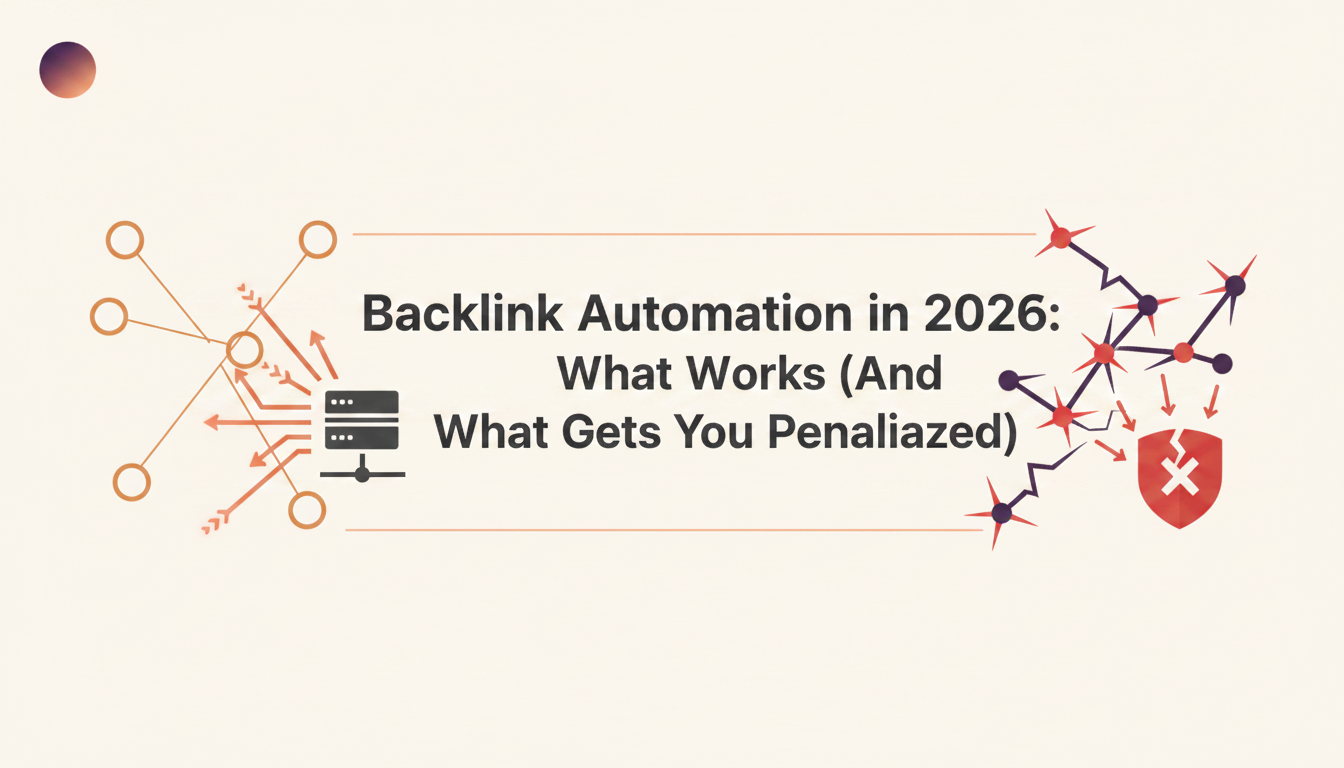
Backlink Automation in 2026: What Works (And What Gets You Penalized)
See which backlink automation tools pass Google's guidelines and which trigger penalties. Get proven strategies for safe, scalable link building in 2026.

Dana Willow
Senior Marketer sharing 15 years of marketing wisdom through an AI lens.
Published on May 22, 2026
Updated on August 26, 2026
What works and what doesnt
Key Takeaways
- Full automation (spammy directories, link farms) triggers Google penalties; semi-automation (prospect research + manual outreach) stays safe
- 80% of consumers rely on zero-click results at least 40% of the time, making backlinks less important than AI-optimized content
- Tools like Semrush AI Backlink Builder and Linkee automate prospecting and email follow-ups without crossing Google's manipulation guidelines
- Nearly 60% of Google searches end without a click in 2024-prioritize content that answers questions directly over pure link volume
- Manual relationship-building still outperforms automation for high-authority placements that AI search engines cite
What Backlink Automation Actually Means in 2026
Backlink automation refers to software that handles repetitive link-building tasks-prospecting sites, finding contact emails, sending outreach messages, and tracking responses-without manual intervention for each step. In 2026, the term covers everything from AI-powered prospect finders (like Linkee and Semrush's AI Backlink Builder) to fully automated spam networks that blast your URL across low-quality directories. The key distinction: legitimate automation speeds up research and follow-up while you control quality and personalization. Black-hat automation submits your link to thousands of irrelevant sites with zero human oversight. Google's algorithms now detect the latter within weeks, triggering manual penalties that can take months to recover from. The rise of AI search has also shifted the value equation-nearly 60% of Google searches end without a click in 2024 (Search Engine Land, 2024), meaning backlinks matter less for traffic and more for authority signals that AI models parse when generating answers.
The Shift from Traffic to Authority Signals
Traditional SEO measured backlink success by referral visits. Today, 80% of consumers rely on "zero-click" results at least 40% of the time (Bain-Dynata Generative AI Consumer Survey, 2024). Links now serve as trust markers for large language models deciding which sources to cite in AI-generated summaries. A high-authority backlink tells ChatGPT, Perplexity, and Google's AI Overviews that your content deserves inclusion-even if users never click through.
This shift rewards editorial links from recognized publications over volume plays. Automated tools that prioritize domain authority and topical relevance align with the new paradigm.
Mass submission services that chase quantity over context become liabilities, diluting your authority profile instead of strengthening it.
Why AI Search Changed the Backlink Game
AI search engines parse link graphs differently than traditional crawlers. They weigh the semantic relationship between linking and linked content, not just PageRank scores. When 34% of marketers report AI search platforms as the first touchpoint for qualified prospects (EMARKETER, 2026), your backlink profile becomes your brand's credential file. Automation tools must now filter prospects by topical alignment and editorial standards-criteria that require human judgment at setup, even if software executes the outreach.
The penalty for getting this wrong has grown steeper. Google's March 2024 core update specifically targeted sites with unnatural link patterns, and recovery timelines stretched beyond six months for many affected domains.
Why Founders Turn to Automated Link Building (And Why Most Regret It)
Founders automate link building because manual outreach consumes 10-15 hours per week-time they'd rather spend on product development, customer support, or revenue-generating activities. The promise is irresistible: set up a tool once, let it run in the background, and wake up to dozens of new backlinks each month. Reality diverges sharply. Most automation tools prioritize quantity over relevance, submitting your SaaS startup to pet-supply directories or outdated link farms that Google flagged years ago. The result: your domain authority stagnates or drops, and you've wasted budget on software that delivers zero SEO benefit. Even worse, aggressive automation can trigger Google's link-spam algorithm, which now uses machine learning to identify unnatural link-velocity patterns. When 80% of consumers rely on zero-click results at least 40% of the time (Bain-Dynata Generative AI Consumer Survey, 2024), a penalty doesn't just hurt rankings-it removes you from AI-generated answers entirely, cutting off the primary discovery channel for 2026.
The Time-Savings Illusion
Automation vendors advertise "set it and forget it" workflows. In practice, you'll spend hours vetting link prospects, disavowing toxic domains, and repairing damage from indiscriminate submissions. Manual review becomes mandatory when tools scrape outdated contact lists or send templated pitches to journalists who've changed beats. The time you save upfront evaporates in cleanup cycles.
How Penalties Compound in the AI Search Era
Google's core updates now penalize link spam faster than ever. A manual action can take six months to lift-six months during which your pages vanish from search results and AI overviews. Only 8% of ChatGPT's citations come from URLs that appear in Google's top 10 (Ahrefs research), so losing traditional rankings also erases your footprint in generative engines. Recovery requires disavowing hundreds of links, submitting reconsideration requests, and rebuilding authority from scratch-a process that costs far more than ethical link building ever would.
The 4 Types of Backlink Automation Tools Explained
Backlink automation tools fall into four categories: full-automation spam networks, semi-automated outreach platforms, AI-powered prospect finders, and monitoring-only dashboards. Full-automation networks-avoid these-submit your URL to thousands of directories without vetting quality or relevance. Think outdated services that promise "500 backlinks in 24 hours." Semi-automated platforms like Pitchbox or BuzzStream handle email sequences and follow-ups but require you to approve each prospect and customize messages. AI-powered finders (Linkee, Semrush AI Backlink Builder) use machine learning to identify high-authority sites in your niche, extract verified contact emails, and draft personalized pitches-you review and send. Monitoring dashboards (Ahrefs, Moz) track your backlink profile and alert you to new links or losses but don't automate outreach.
For beginners, semi-automated outreach and AI finders offer the best risk-reward balance. They save 70% of research time while keeping you in control of quality. Full-automation networks trigger penalties. Monitoring tools alone won't build links-they only report what already exists.
Choose tools that require human approval at every stage. Automation should accelerate research, not replace judgment.
What Google Penalizes vs. What It Tolerates
Google penalizes link schemes that manipulate PageRank-buying links, participating in link exchanges solely for SEO, and using automated programs to create links to your site. The 2026 Spam Policies explicitly call out "large-scale link exchanges" and "automated services or software that create links." However, Google tolerates tools that automate research and communication logistics as long as each link results from a genuine editorial decision by the target site. Translation: software that finds prospects and drafts emails is fine; software that auto-publishes your link without human review crosses the line.
The 2026 Spam Policy Update
The enforcement mechanism has evolved. Google's SpamBrain AI now analyzes link-velocity curves, anchor-text diversity, and co-citation patterns to flag unnatural profiles. A sudden spike of 200 directory links in one week triggers review even if each individual link looks legitimate.
How SpamBrain Detects Automation Patterns
The algorithm watches for temporal clustering-links appearing in batches at regular intervals. It cross-references domain authority with topical relevance. A SaaS startup earning 50 links from pet-grooming blogs in 48 hours raises red flags, regardless of anchor text.
Semi-Automated Link Building: The Middle Ground That Works
Semi-automated link building uses software to handle prospecting, email lookup, and follow-up scheduling while you control targeting, personalization, and final approval. This approach typically cuts manual work by 70-80% without triggering penalties. A typical workflow: your tool (e.g., Linkee) scans your niche for sites that link to competitors, extracts verified emails using APIs, and generates personalized pitch templates based on each site's recent content. You review the prospect list, customize 2-3 sentences per email to reference specific articles, and approve the send. The tool handles follow-ups on a schedule you set (usually 3-5 days apart, max three touches). This method respects Google's guidelines because every link still requires an editor's decision to publish.
Step-by-Step Semi-Automated Workflow
Start by feeding your tool a list of competitor URLs or target keywords. It crawls backlink profiles and filters prospects by domain authority, traffic, and relevance. Next, the software verifies contact emails through multiple databases-bounces waste your sender reputation. You then map each prospect to a pitch angle: broken-link replacement, resource-page addition, or guest-post swap.
Review every draft before sending. Add one sentence about their latest post or a shared connection. Schedule sends across business hours in their time zone. Track opens and replies in a unified dashboard, flagging warm leads for manual follow-up calls.
Why Personalization Still Matters in 2026
AI search platforms reward relationship-driven placements on niche authority sites. Only 8% of ChatGPT's citations come from URLs that appear in Google's top 10 organic results for the same query (Ahrefs research). Generic outreach templates get ignored or marked as spam.
Editors publish links when they see genuine value alignment. A two-sentence custom opener referencing their recent article doubles reply rates and builds the trust that turns one-time placements into recurring partnerships.
Top 5 SEO Software for Beginners Who Want Safe Automation
The best SEO software for beginners balances automation power with guardrails that prevent black-hat mistakes-look for tools with built-in quality filters and manual approval steps. Semrush AI Backlink Builder tops the list: it automates prospect discovery and email drafting but requires you to review every outreach message before sending. Linkee offers similar functionality with a simpler interface and lower price point, ideal for solo founders. Ahrefs includes a Content Explorer that identifies link-worthy pages in your niche; pair it with Hunter.io for email lookup and you've built a semi-automated stack for under $200/month.
BuzzStream handles relationship management and follow-up sequences once you've identified prospects manually. Pitchbox sits at the premium end, offering advanced personalization tokens and CRM tools for teams scaling outreach.
All five tools keep you compliant by design-they automate research and communication logistics without auto-publishing links. You stay in control of every relationship touchpoint while saving 10-15 hours per week on manual tasks.
How to Do-It-Yourself SEO Without Risking Your Domain
DIY link building starts with creating content worth linking to-original research, case studies, or tools-then manually reaching out to sites that have linked to similar resources. Step one: publish a data-driven piece (e.g., "2026 SaaS Pricing Benchmarks" with survey results from 100 companies). Step two: use Ahrefs Content Explorer to find articles that cited similar studies in the past year. Step three: extract author emails using Hunter.io or LinkedIn, then send a personalized note explaining why your new data updates or complements their existing article. Step four: follow up once after five days if no response. This manual process takes 8-10 hours per campaign but yields 15-20% response rates versus 2-3% for automated blasts. It also builds relationships that pay dividends beyond a single link-editors who trust you will cite future content without outreach.
The Link-Worthy Content Formula
Original data beats opinion every time. Survey your customers, analyze public datasets, or compile industry benchmarks that don't exist elsewhere. Format findings as charts, infographics, or interactive calculators. Include a one-sentence note and embed code so publishers can easily reference your work. Tools like Typeform for surveys and Flourish for data visualization cost under $50/month combined.
Outreach Email Template That Converts
Subject: "Updated data for [their article title]"
Body: "Hi [Name], I noticed you cited [old study] in your [date] post on [topic]. We just published 2026 data from [sample size] that shows [key finding]. Would this be useful to add as an update? Here's the link: [URL]. Happy to provide charts or answer questions. Best, [You]"
Personalize the first sentence with a specific detail from their article. Keep the entire message under 80 words. Attach nothing-links only.
Common Backlink Automation Mistakes (And How to Avoid Them)
The biggest automation mistake is prioritizing link volume over relevance-founders celebrate 100 new backlinks without checking if any come from sites their target audience actually reads. Other common errors: using the same email template for every prospect (response rates drop to 1%), ignoring follow-up sequences (70% of positive replies come after the second or third touch), and failing to track which placements drive referral traffic versus just passing PageRank. In 2026, the latter matters less-two-thirds of digital ad spend flows to Google, Meta, and Amazon, and organic traffic from backlinks has declined as AI overviews dominate SERPs. Smart founders now measure backlink success by citation in AI-generated answers, not click-through rates.
To avoid these mistakes: set a minimum Domain Rating threshold (40+) in your automation tool, personalize at least the opening sentence of every email, and use UTM parameters to track which links AI models surface in ChatGPT or Perplexity results. Test whether your backlinks appear in AI citations-only 8% of ChatGPT's citations come from Google's top 10 organic results.
When to Automate and When to Go Manual
Automate prospecting and follow-up logistics when you're targeting 50+ sites per month; go fully manual when pursuing 10-15 high-authority placements that require deep personalization. The tipping point is volume and relationship depth. If you're building links to support a product launch and need broad coverage across industry blogs, semi-automation makes sense-tools like Linkee can handle 200 prospects per week while you focus on customizing pitches for the top 20%. If you're targeting tier-one publications (TechCrunch, Forbes, Wired) or building partnerships with complementary SaaS companies, manual outreach wins every time. These placements require researching the editor's recent articles, understanding their editorial calendar, and often multiple touchpoints over weeks. The ROI justifies the time investment: a single link from a site ChatGPT frequently cites can drive more AI-mediated discovery than 50 mid-tier directory links. For 34% of marketers, AI search platforms are where qualified prospects first hear about their company-prioritize placements that feed those engines.
The 50-Link Threshold Rule
Below 50 monthly targets, manual outreach costs less than tool subscriptions and delivers better response rates. Above that threshold, automation pays for itself through time savings alone. A single marketer can realistically personalize 10-12 pitches per day; beyond that, quality drops and burnout rises. Automation handles the repetitive tasks-finding contact emails, scheduling follow-ups, tracking opens-while you invest human effort where it matters most: crafting the hook, tailoring the value proposition, and building rapport. The sweet spot is hybrid: automate discovery and logistics, personalize the first touch and any reply that shows genuine interest. Track conversion rates by segment; if automated sequences to mid-tier blogs convert above 8%, scale them. If high-authority targets ignore templated pitches, shift those entirely to manual.
High-Authority Targets That Demand Manual Work
Sites with Domain Authority above 70 rarely respond to bulk outreach. Editors at these publications receive hundreds of pitches weekly; yours must demonstrate you've read their work and understand their audience. Start by writing authentically-comment on their LinkedIn posts, share their articles with thoughtful commentary, join communities where they're active. When you pitch, reference a specific piece they published in 2026 and explain how your content extends or challenges that thesis. Offer exclusive data, expert interviews, or a contrarian angle they can't find elsewhere.
Manual outreach to 10 tier-one sites often yields better SEO and referral traffic than automated campaigns to 200 lower-authority blogs. One Forbes byline can position you as a category authority; ChatGPT and Perplexity frequently cite such sources when answering user queries. Budget 2-3 hours per high-authority pitch, including research, drafting, and follow-up. The effort compounds: once you land one placement, editors at similar publications take your next pitch more seriously.
FAQs about backlink automation
Is backlink automation against Google's guidelines?
The answer depends on the type of automation you're using. Full automation-where software automatically publishes backlinks without human oversight-directly violates Google's 2026 Spam Policies on link schemes. These systems create unnatural link patterns that Google's algorithms can easily detect. However, semi-automation is compliant with guidelines. This approach uses tools to automate research, prospect identification, and outreach scheduling, but requires manual approval before any link is published. As long as you're personally vetting each opportunity and ensuring links are editorially placed on relevant, quality sites, you're operating within Google's acceptable practices. The key distinction is that automation should assist your workflow, not replace human judgment in link acquisition.
What's the best automated backlink tool for beginners?
For beginners in 2026, Semrush AI Backlink Builder and Linkee offer the best balance of automation and quality control. Semrush AI Backlink Builder (starting at $129/month) provides AI-powered prospect discovery, email verification to reduce bounce rates, and customizable outreach templates that maintain personalization at scale. It integrates seamlessly with Semrush's existing SEO toolkit, making it ideal if you're already using their platform. Linkee (starting at $79/month) is more budget-friendly and specializes in relationship-building features, including automated follow-up sequences and response tracking. Both tools require manual approval before sending outreach emails, ensuring you maintain control over quality. They also include built-in spam filters to help you avoid low-quality prospects that could harm your domain reputation.
How many backlinks should I build per month?
For new websites in 2026, aim to build 10-20 high-quality backlinks per month during your first six months. This natural pace helps establish authority without triggering Google's SpamBrain algorithm, which actively monitors for unnatural link velocity patterns. As your domain authority grows beyond DA 30, you can scale to 30-50 quality links monthly. The key factor isn't just quantity-it's consistency and quality. A sudden spike from 5 links per month to 100 will almost certainly trigger a manual review or algorithmic penalty. Focus on maintaining steady, organic growth that mirrors how natural editorial links accumulate over time. Sites in competitive niches may build links faster, but always prioritize relevance and editorial value over raw numbers.
Do backlinks still matter in 2026 with AI search?
Yes, backlinks remain critically important in 2026, though their role has evolved with AI-powered search. While approximately 60% of searches now result in zero-click answers through AI overviews and featured snippets, backlinks serve as essential authority signals that determine which sources AI models cite and reference. Google's AI, ChatGPT's SearchGPT, and other AI search engines prioritize content from domains with strong backlink profiles when selecting authoritative sources to quote or recommend. Backlinks may drive less direct referral traffic than in previous years, but they're more important than ever for establishing your site as a trusted source that AI systems will reference. Think of backlinks as credibility votes that tell AI algorithms your content is worth citing-without them, your content may never surface in AI-generated answers, regardless of quality.
Can I automate backlink building without getting penalized?
Yes, you can safely automate portions of backlink building if you follow best practices and maintain human oversight. Use semi-automated tools that require manual approval at key decision points-both before sending outreach emails and before accepting any link placement. To stay penalty-free, follow this checklist: First, verify prospect relevance by manually reviewing each site's niche alignment and audience overlap with yours. Second, customize every outreach email with specific references to the prospect's content-avoid generic templates that scream automation. Third, limit your link velocity to natural growth patterns (10-20 links monthly for new sites). Fourth, diversify your anchor text and link types to avoid patterns. Fifth, regularly audit your backlink profile to disavow any low-quality links that slip through. The safest approach treats automation as a research and workflow assistant, not a hands-off solution.
5 Backlink Automation Mistakes That Tank Your Domain Authority
- Prioritizing Link Volume Over Relevance: Celebrating 100 new backlinks without checking if any come from sites your target audience reads. Google's algorithms now weigh topical relevance heavily-10 links from SaaS blogs outperform 100 from random directories.
- Using Identical Email Templates for Every Prospect: Generic pitches get 1% response rates versus 15-20% for personalized outreach. Automation should handle logistics, not replace the human touch that earns editorial placements.
- Ignoring Follow-Up Sequences: 70% of positive replies come after the second or third email. Founders who send one message and move on leave most opportunities on the table.
- Failing to Track AI Citation Rates: Measuring backlink success by click-through rates misses the 2026 reality-60% of searches are zero-click. Track which links appear in ChatGPT or Perplexity answers instead.
- Sudden Link-Velocity Spikes: Acquiring 200 links in one week triggers SpamBrain review even if each link is legitimate. Natural growth curves (10-20 per month) avoid algorithmic flags.
Sources
- New front door to the internet: Winning in the age of AI search
- FAQ on GEO & AEO: Where AI search & SEO overlap 2026
- Brand building in the era of AI search: A practical guide
- Goodbye clicks, hello AI: Zero-click search redefines marketing
- The Future of Discoverability
- IDC's Black Book
- 4 ways to mitigate the impact of falling traffic on retail websites
- Forget what you know about SEO-here's how to optimize your brand for LLMs
About Dana Willow
Author
Senior Marketer sharing 15 years of marketing wisdom through an AI lens. Teaching founders to automate smarter.