
PostKing v0.2 Is Out: Everything New in This Update
PostKing v0.2 brings carousels, GEO, competitor intelligence, and BrandMind Pro to your content marketing platform. Here's everything that changed.

Dana Willow
Senior Marketer sharing 15 years of marketing wisdom through an AI lens.
Published on July 1, 2026
Updated on September 27, 2026
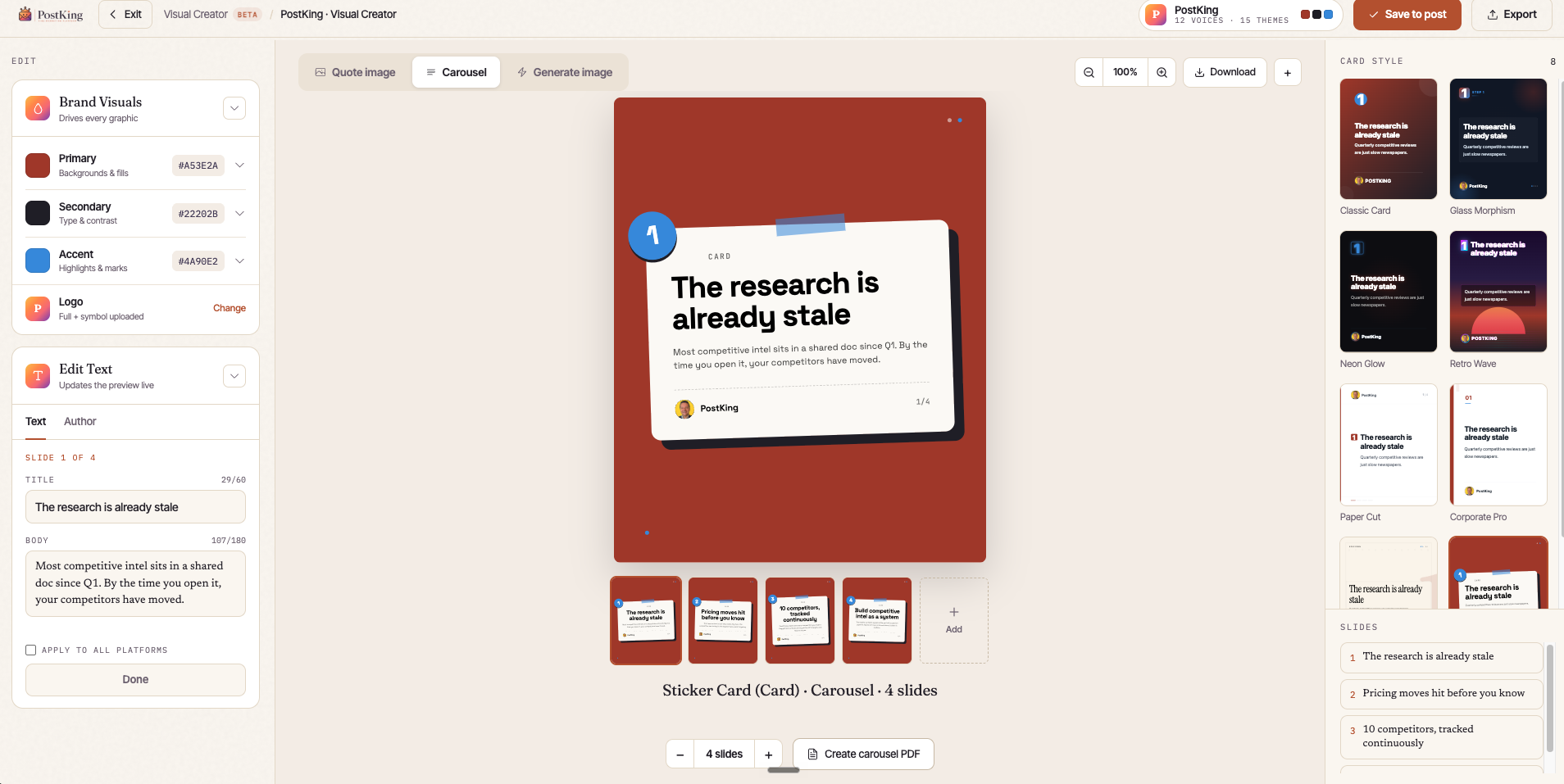
Editing a quote image in the Visual Studio editor with brand colors applied.
When I built PostKing, the problem I kept running into wasn't the writing itself. It was distribution. Getting content out consistently, in the right formats, to the right places, without it sounding like every other founder's copy-paste marketing stack. That's the itch v0.2 scratches.
This is a big release. Probably the biggest since launch. The PostKing v0.2 update ships eight meaningful features: Carousels, Visual Studio, Storylines, GEO optimization, Competitor Intelligence, Brand Truth, BrandMind Pro, and MCP support. Each one exists because someone (usually me, sometimes you) hit a wall that needed a door.
Here's what's in it, how it works, and why it matters for indie founders, small teams, and NGOs who are doing real marketing without a full-time team behind them.
Why Social Media Automation Needed a Rethink
Most social media automation tools treat content like a commodity. You feed them a topic, they spit out text, you schedule it. The brand voice gets sanded down in the process until everything reads like a press release from a company that doesn't actually exist.
The other problem: format diversity. A LinkedIn post isn't a carousel. A carousel isn't a thread. A thread isn't a short-form video script. Tools that claim to "do it all" often mean they do one thing and export it into five boxes. That's not the same thing.
PostKing v0.2 is built around a different assumption: your brand has a specific voice, a specific audience, and a specific competitive position. The automation should serve those things, not flatten them.
Carousels: Swipeable Content, AI Done Right
Carousel posts perform. On LinkedIn and Instagram, they consistently generate higher engagement than static images or plain text, largely because they reward attention with progressive payoff. But building them manually is tedious, and most AI carousel tools produce slides that feel like PowerPoint from 2011.
PostKing v0.2 generates carousel content from your existing blog posts, newsletters, or raw ideas. Each slide gets its own narrative beat, not just a sentence chopped off the paragraph above it. The output respects your brand palette (yes, including your primary and accent colors) and stays within your voice profile.
You can export as structured JSON for tools like Canva or your own design pipeline, or use the built-in Visual Studio to render them directly.
What Makes the Carousel Engine Different
The slides aren't just summarized bullet points. PostKing structures carousels around a hook, a build, and a close, which is the same arc that actually gets people to swipe through to the end. It also flags when a concept is too dense for a single slide and suggests a split, rather than cramming everything into one frame.
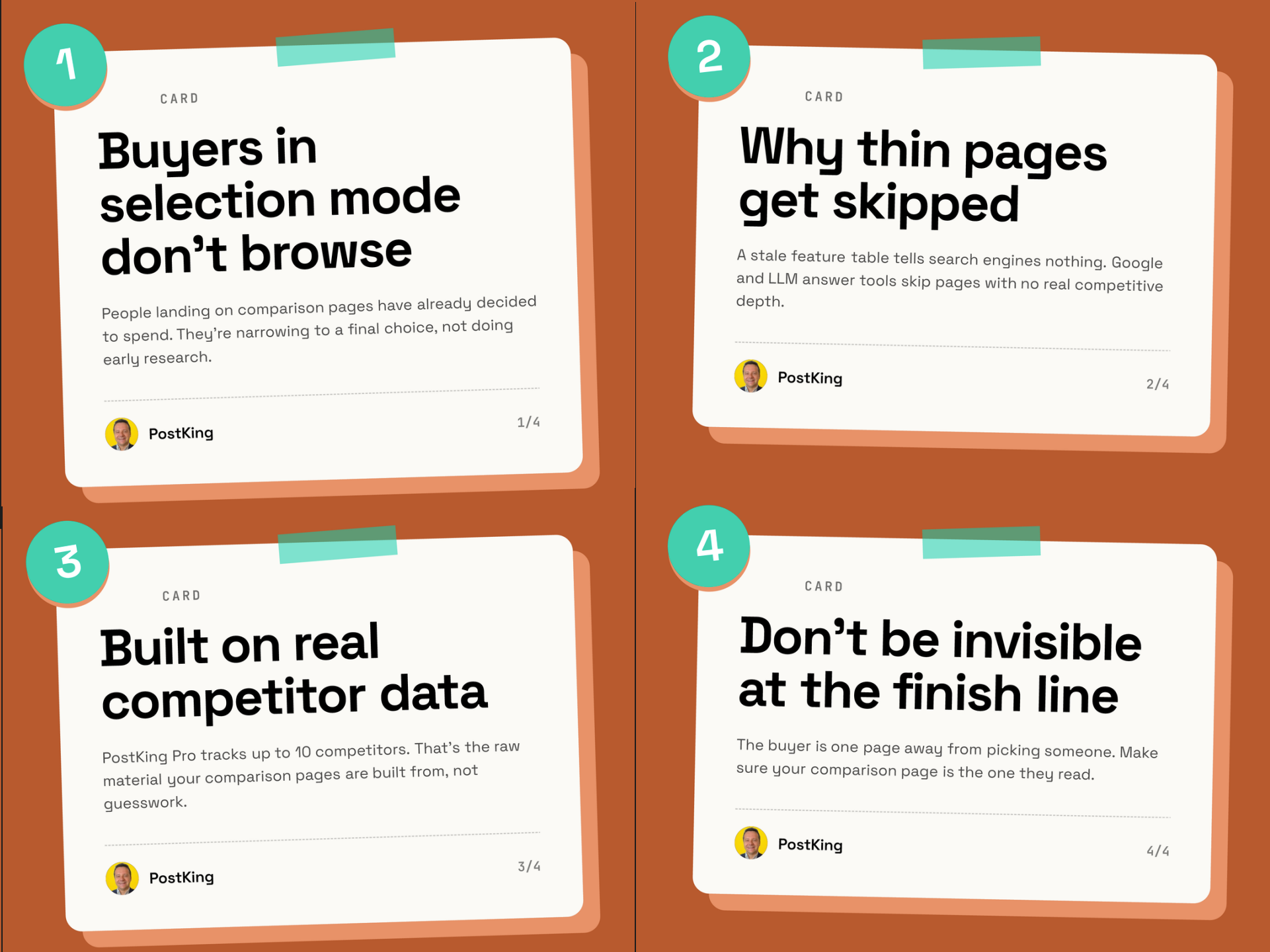 A finished carousel card ready to export.
Visual Studio: Design Without Leaving the Platform
This one came directly from user feedback. People were generating great content, then losing an hour per post trying to make it look presentable in external tools. The Visual Studio is a lightweight, in-platform design layer built specifically for social assets.
It's not Figma. It's not supposed to be. What it is: a fast way to apply your brand identity (fonts, colors, logo, tone) to generated content without starting from scratch every time. Think of it as a compositing layer, not a creation tool.
Templates are anchored to your brand profile, so every asset you produce from the Visual Studio looks like it came from the same place, because it did.
Editing a quote image in the Visual Studio editor with brand colors applied.
Storylines: Sequential Content That Actually Builds Something
One-off posts are fine. A content series that builds audience familiarity over time is better. Storylines is PostKing's take on serialized content: a structured sequence of posts that follow a narrative arc across days or weeks.
You define the story, the arc length, and the destination (newsletter sign-up, product trial, community join, whatever). PostKing maps out the sequence, writes each installment, and schedules them with appropriate spacing so you're not flooding people on day one and going silent for two weeks.
For NGOs and mission-driven brands especially, this is useful. Storytelling is the engine of donor and volunteer engagement, and Storylines gives you a way to run that engine without a full content calendar team.
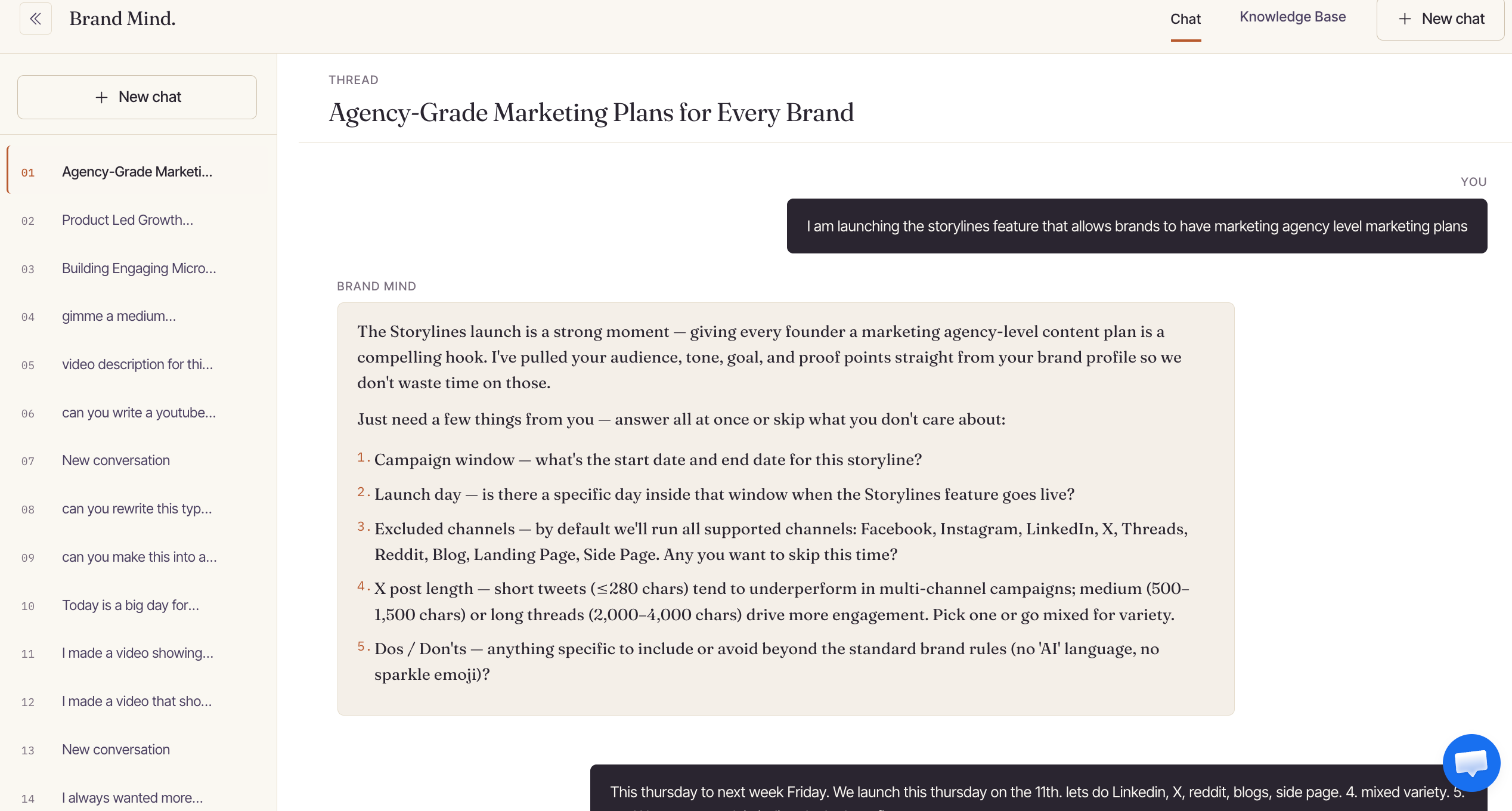 Starting a new storyline in PostKing by describing the campaign in plain language.
GEO: Optimizing for Generative Engine Results
Search is changing faster than most people are adjusting to. Google's AI Overviews, Perplexity, ChatGPT search, and similar generative interfaces are increasingly where people get answers rather than a list of links. GEO (Generative Engine Optimization) is the practice of structuring your content so it gets cited, summarized, or surfaced by these systems.
This is genuinely new territory. Traditional SEO principles still apply, but GEO adds a layer: your content needs to be structured in a way that an AI summarizer can extract clean, attributable answers from it. According to research from Princeton, Georgia Tech, and The Allen Institute for AI (published in their 2024 paper on GEO), content with clear source citations, structured claims, and direct answers performs significantly better in generative search results than long-form prose that buries the point.
PostKing v0.2 ships a full SEO/GEO workspace, not just a tacked-on score. You start by defining competitors and sources, expand into a keyword universe, group those into topic clusters, and generate a brief for each one, tracked individually as ready, approved, or rejected. Every approved brief flows straight into a written article, so you can see the whole path from keyword to published post in one workspace instead of stitching together a spreadsheet and three separate tools.
Why GEO Matters for Small Teams
Large brands have SEO teams that are already adapting to generative search. Indie founders and small SaaS teams typically don't have that resource. The GEO tooling in this PostKing update is built specifically to close that gap without requiring you to become an expert in how language models index and summarize content.
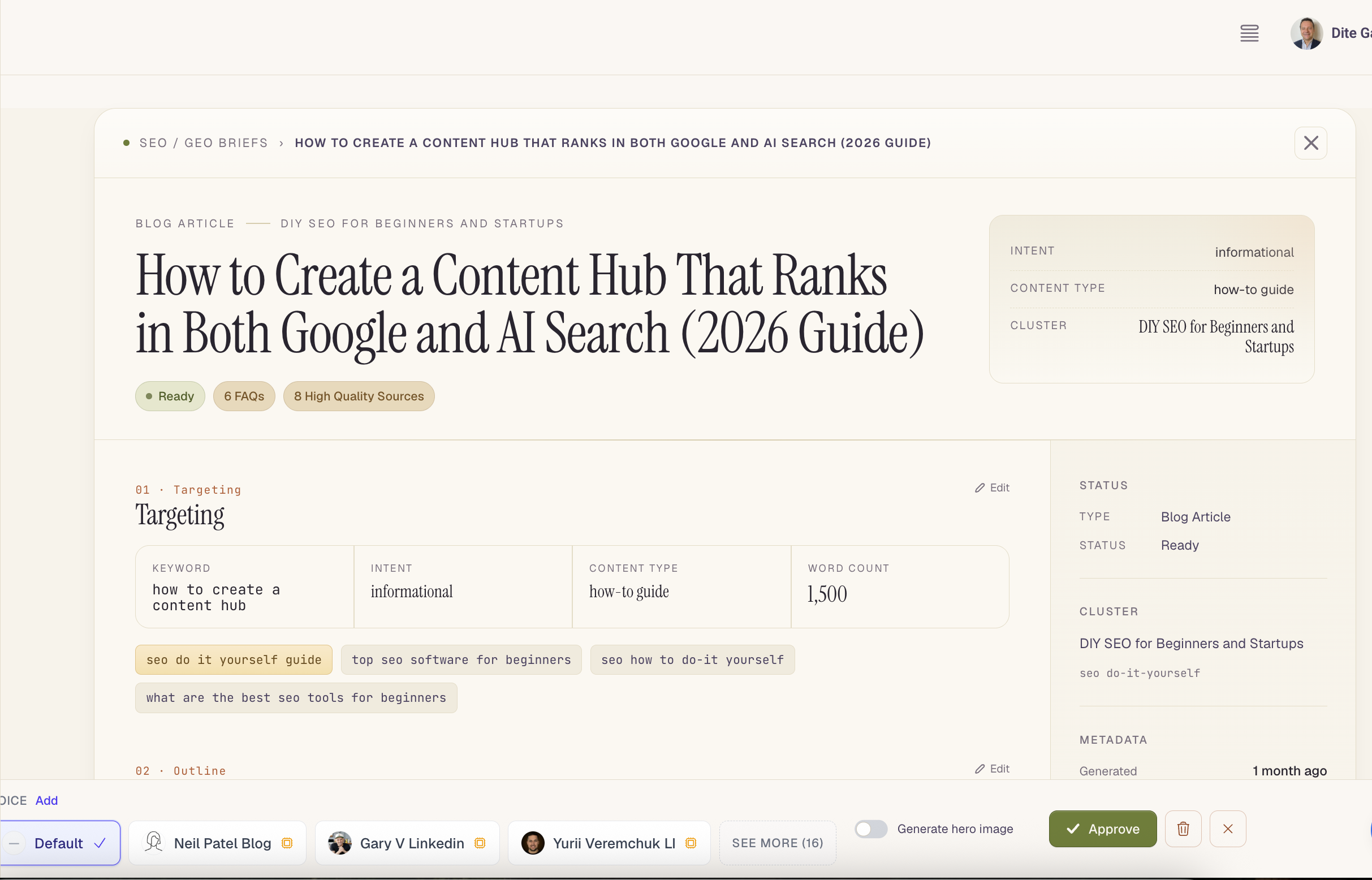 The SEO/GEO workspace showing generated briefs, keywords, and topic clusters.
Competitor Intelligence: Know What You're Up Against
Most competitor research happens in an occasional, vaguely guilty way: you check their site every few months, maybe their LinkedIn, and then forget about it until their new feature announcement shows up in your feed at the worst possible time.
PostKing v0.2's Competitor Intelligence module runs that research continuously. You define your competitors, it tracks their public content output across channels, identifies the themes and formats they're doubling down on, and surfaces patterns you'd miss if you were doing this manually.
The goal isn't to copy them. It's to know where they're concentrating attention so you can make a deliberate choice: go head-to-head with stronger content, or find the gaps they're ignoring.
For SaaS founders especially, competitive positioning is a content strategy problem as much as a product problem. What you publish and how you frame it shapes how potential customers perceive your category position. Having a clear picture of what competitors are saying (and not saying) is useful input for that work.
 Competitor overview with top actionable insights and priority recommendations.
Brand Truth and BrandMind Pro: Your Brand's Memory
This is the part I'm most proud of, because it addresses the thing that breaks most automated content: it sounds like it was written by someone who has never worked at the company.
Brand Truth
Brand Truth is a structured profile that captures what your brand actually stands for, beyond the mission statement. It includes your values, your voice attributes, your audience's real pain points (not the marketing version), your category position, and the specific claims you can credibly make. It's the document that should exist at every company and almost never does.
PostKing builds this profile through a guided intake process. Once it's set, every piece of content generated through the platform is checked against it. If a generated post drifts into language that contradicts your brand position or uses a tone that doesn't match your voice, it gets flagged.
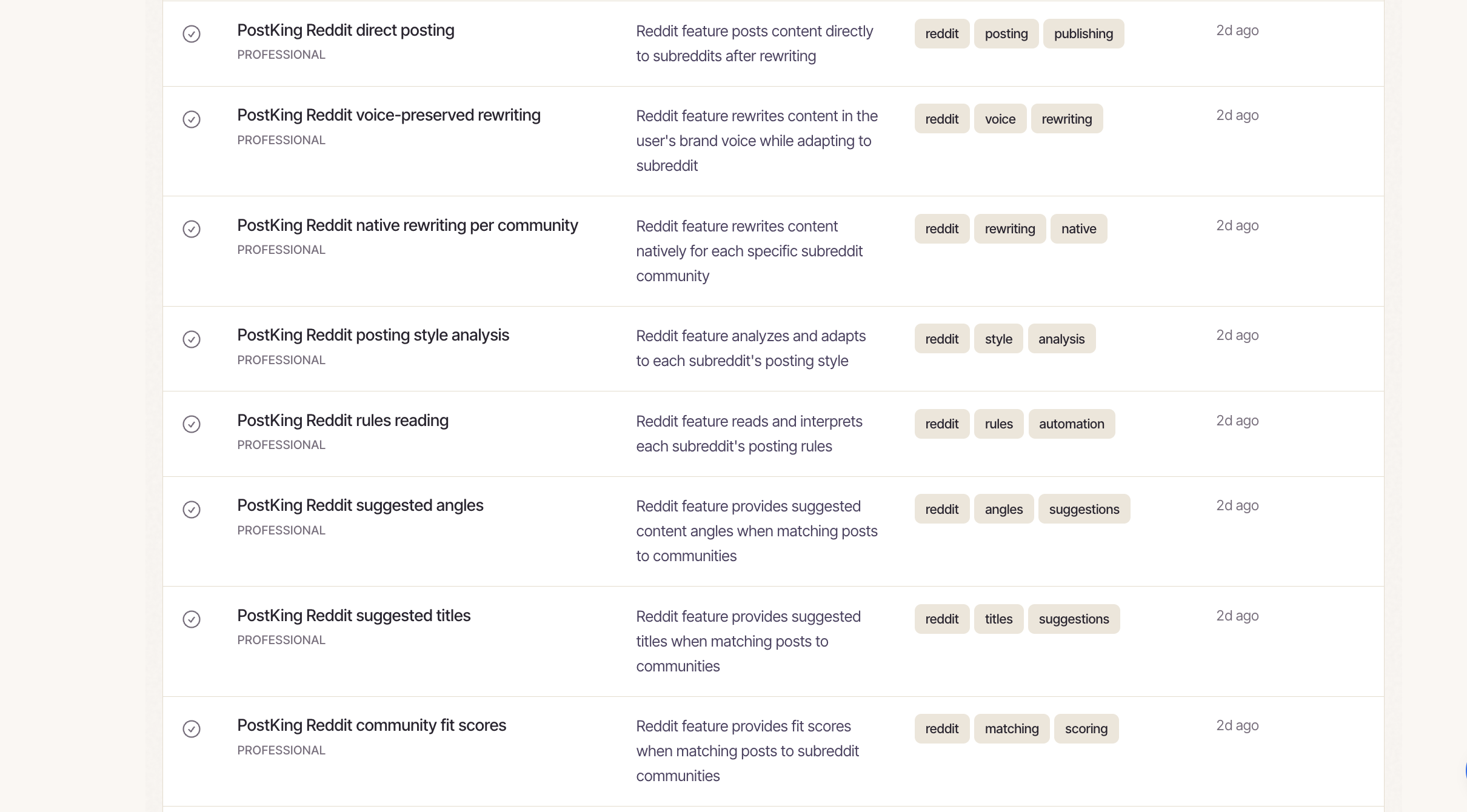 The Brand Truth index storing atomic facts, insights, and negative space for generation.
BrandMind Pro
BrandMind Pro is the deeper layer. Where Brand Truth captures what your brand says, BrandMind Pro captures how it thinks. It's a chat interface that reasons from your brand profile: describe a launch or a campaign in plain language, and BrandMind Pro pulls your audience, tone, goals, and proof points straight from Brand Truth, then asks the handful of clarifying questions that actually matter (timing, channels, format) before generating a plan.
The practical result: content that reads like it came from someone who has actually worked at your company, thought about your category, and developed real opinions over time. That's the difference between automated content that builds trust and automated content that erodes it.
This is particularly important for NGOs and mission-driven organizations, where brand voice isn't just a marketing concern; it's directly tied to credibility and donor trust.
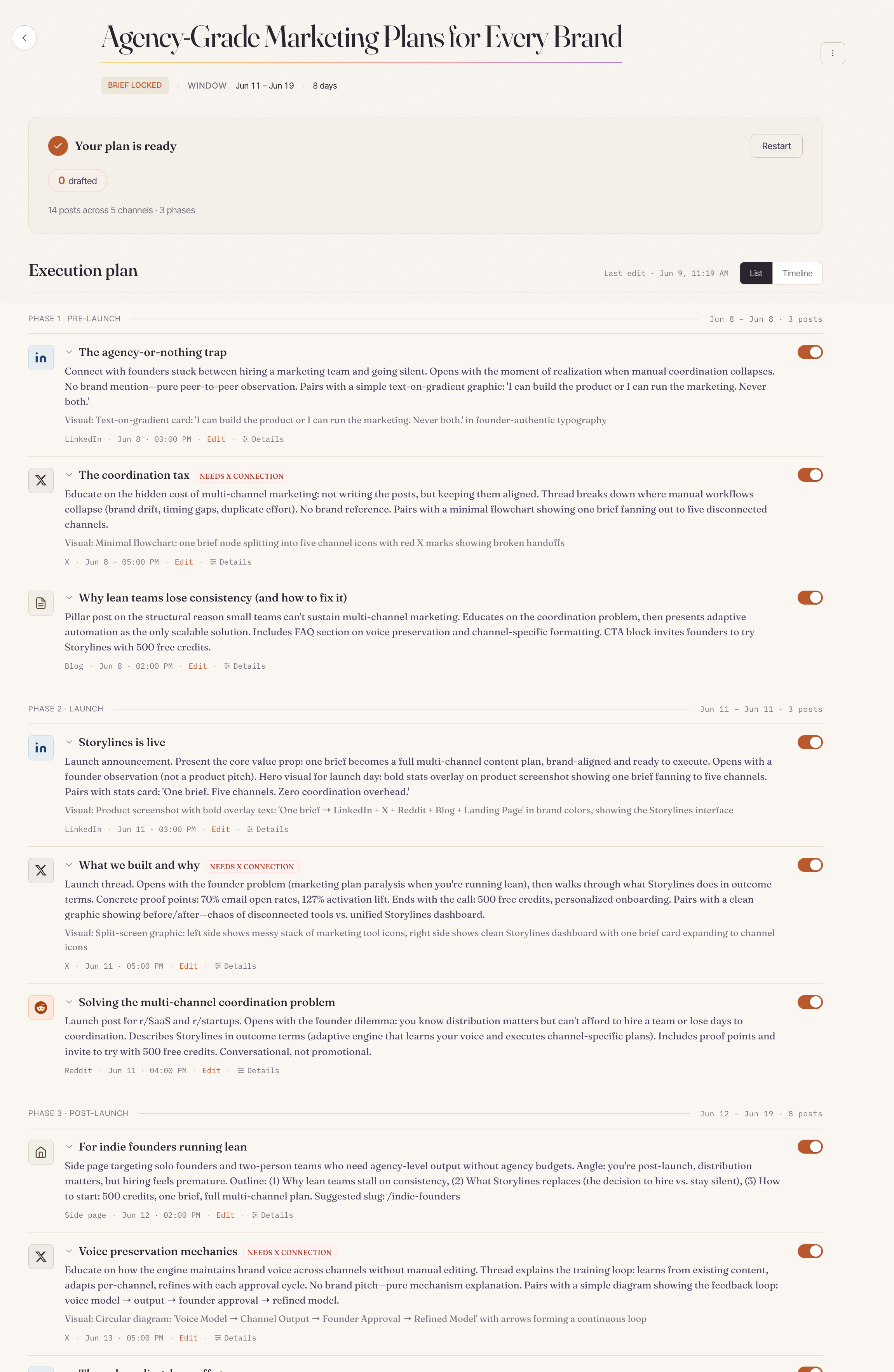 BrandMind Pro chat interface planning a campaign from the brand profile.
MCP: Model Context Protocol Support
This one is more technical, and if you're not running custom integrations you can probably skip it for now. But if you are, it matters a lot.
MCP (Model Context Protocol) is an open standard, developed by Anthropic and increasingly adopted across the AI tooling ecosystem, for connecting AI models to external data sources and tools in a structured, secure way. PostKing v0.2 ships with MCP support, which means you can connect your own data sources, internal knowledge bases, or third-party tools to the PostKing content engine.
The use case for larger SMEs: your content generation can now draw on proprietary data (product documentation, customer research, internal reports) without that data leaving your controlled environment. You get more specific, accurate content without feeding sensitive information into a generic model endpoint. In our own testing, connecting an agent to PostKing's MCP server surfaces 212 callable tools spanning content, publishing, SEO, competitor intelligence, and billing.
For developers building on top of PostKing, MCP also opens the door to custom workflow integrations that weren't possible before.
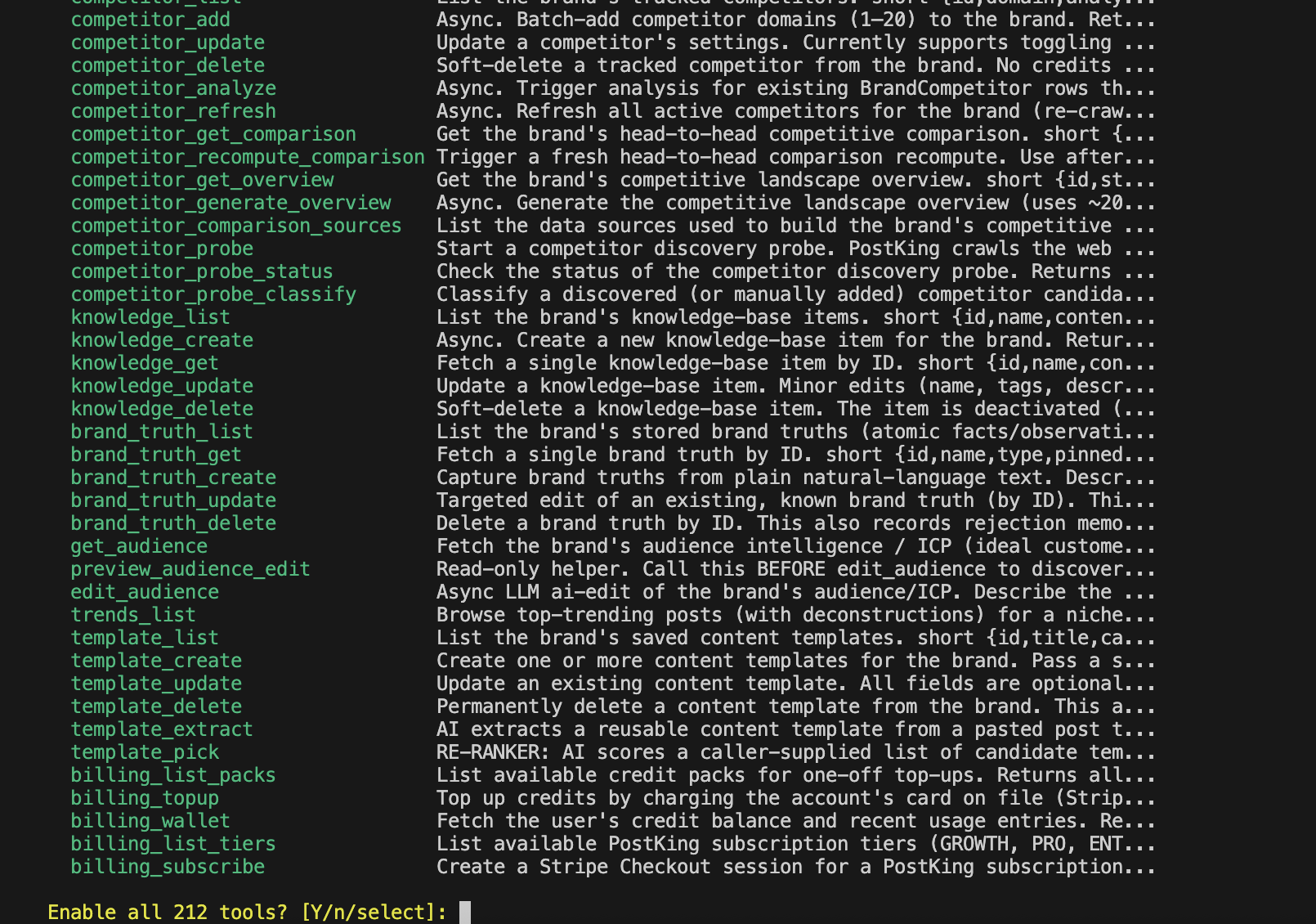 Terminal showing the 212 MCP tools connected to Hermes via PostKing.
Practical Examples: What This Looks Like in Use
Indie SaaS Founder, Solo Team
You're building a project management tool for freelance designers. Your competitors are Notion, Linear, and a handful of niche tools. You set up Brand Truth with your specific positioning (you're the tool for visual thinkers who find text-heavy PM tools exhausting), load your competitors into Competitor Intelligence, and turn on GEO scoring for your blog.
Each week, PostKing generates a carousel from your latest blog post, a LinkedIn Storyline sequence for a product feature launch, and a GEO-optimized article targeting a gap your competitors aren't covering well. The Visual Studio keeps everything on-brand. You spend maybe 2 hours reviewing and approving instead of 12 hours producing.
NGO Communications Team
You have 1 communications person covering 3 programs. Brand Truth captures your organization's voice across all three, which differ in tone (one is youth-facing, one is donor-facing, one is policy-facing). BrandMind Pro holds the reasoning framework for each program's content separately.
Storylines runs a donor engagement series across 6 weeks leading up to your annual campaign. Competitor Intelligence tracks what other organizations in your space are publishing so you're not inadvertently echoing their messaging. GEO optimization means your research and impact reports are more likely to surface when generative search tools answer questions in your issue area.
Best Practices for Getting the Most from PostKing v0.2
A few things I've learned from testing all of this:
Invest time in Brand Truth upfront. The quality of everything else scales with how well your brand profile is built. A rushed 10-minute intake produces mediocre output. A careful 45-minute session produces content that actually sounds like you.
Use Competitor Intelligence as a filter, not a compass. It's useful for knowing the terrain, but your content strategy should come from your audience's needs, not from what your competitors happen to be doing this month.
GEO briefs are a guide, not a grade. A rejected or low-priority brief doesn't mean the topic is bad; it means it's not the highest-leverage thing to write right now. Some content (community posts, social copy) doesn't need GEO structuring at all. Apply the workspace selectively.
With Storylines, resist the urge to front-load everything. The value of a series is in the sustained attention it builds. If you put every insight in the first post, there's no reason to follow the rest. Spread the payoff.
MCP integrations are worth setting up if you have internal documentation that's more than 6 months old and still accurate. Your product documentation, FAQ content, and case study archive are genuinely useful training context for your brand's content engine.
What This PostKing Update Means for Your Content Strategy
The throughline across all 8 features in this release is the same: automation should make you more yourself, not less. The content marketing platform problem has never really been volume. It's been quality at volume, specifically the kind of quality that comes from having a clear point of view and expressing it consistently across formats and channels.
PostKing v0.2 is the most complete version of that idea we've shipped. Carousels and Visual Studio handle the format problem. Storylines handles the continuity problem. GEO handles the discoverability problem. Competitor Intelligence handles the positioning problem. Brand Truth and BrandMind Pro handle the voice problem. MCP handles the data problem.
If you're an indie founder doing your own marketing, a small SaaS team with no dedicated content person, or an NGO communications team stretched across too many programs, this release was built with your specific constraints in mind. The goal is that you spend your time on the decisions that require a human, and PostKing handles the production that doesn't.
You can try everything in v0.2 at postking.app. If something breaks or doesn't make sense, the feedback channel is open. That's how v0.1 became v0.2, and it's how v0.3 will get built.
About Dana Willow
Author
Senior Marketer sharing 15 years of marketing wisdom through an AI lens. Teaching founders to automate smarter.