
The AI That Learns Your Brand So You Don't Repeat It
PostKing 0.2 introduces BrandMind: automated content that actually sounds like you. Here's what changed and why it matters for founders.

Dana Willow
Senior Marketer sharing 15 years of marketing wisdom through an AI lens.
Published on July 7, 2026
Updated on October 10, 2026
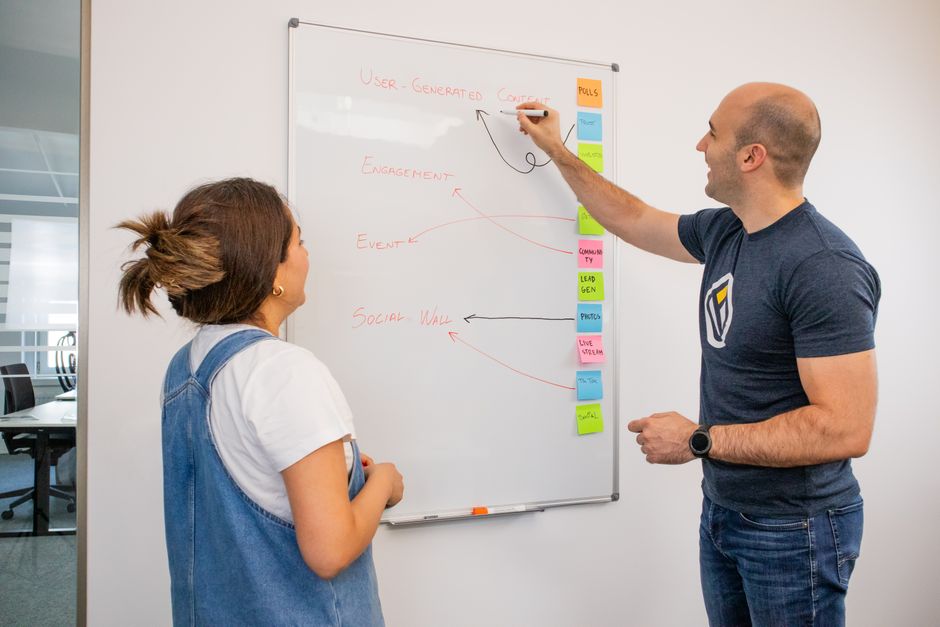
BrandMind remembers your brand so you do not have to explain it in every prompt.
Building PostKing started from a specific frustration. I'd shipped products, had functional landing pages, and still watched them sit quietly in the dark because I couldn't keep up with content. Not for lack of ideas. For lack of hours.
Automation tools existed, sure. But every one I tried produced content that sounded like it was written by a committee that had never met me. Generic phrasing. Off-tone subject lines. Posts that got published but felt like they came from a different company entirely.
PostKing 0.2 is the attempt to fix that specific problem. The centerpiece is BrandMind, a feature set built around one premise: automated content should sound like you wrote it, not like you approved it.
What BrandMind Actually Is
BrandMind is PostKing's brand intelligence layer. Before it writes anything, it builds a working model of how you communicate: your vocabulary patterns, sentence rhythm, the topics you return to, even the things you tend to avoid.
It's less like a content generator and more like a brief you never had to write. The kind of document a good copywriter would ask for on day one, then quietly refer to every time they sat down to work.
1. Voice Profiling
You feed it samples. Blog posts, social content, newsletters, email copy. It reads the pattern, not just the words. Sentence length distribution, formality index, how often you use qualifiers, whether you tend toward declarative statements or exploratory ones. The output is a voice profile that travels with every piece of content PostKing generates for you.
2. Brand Context Memory
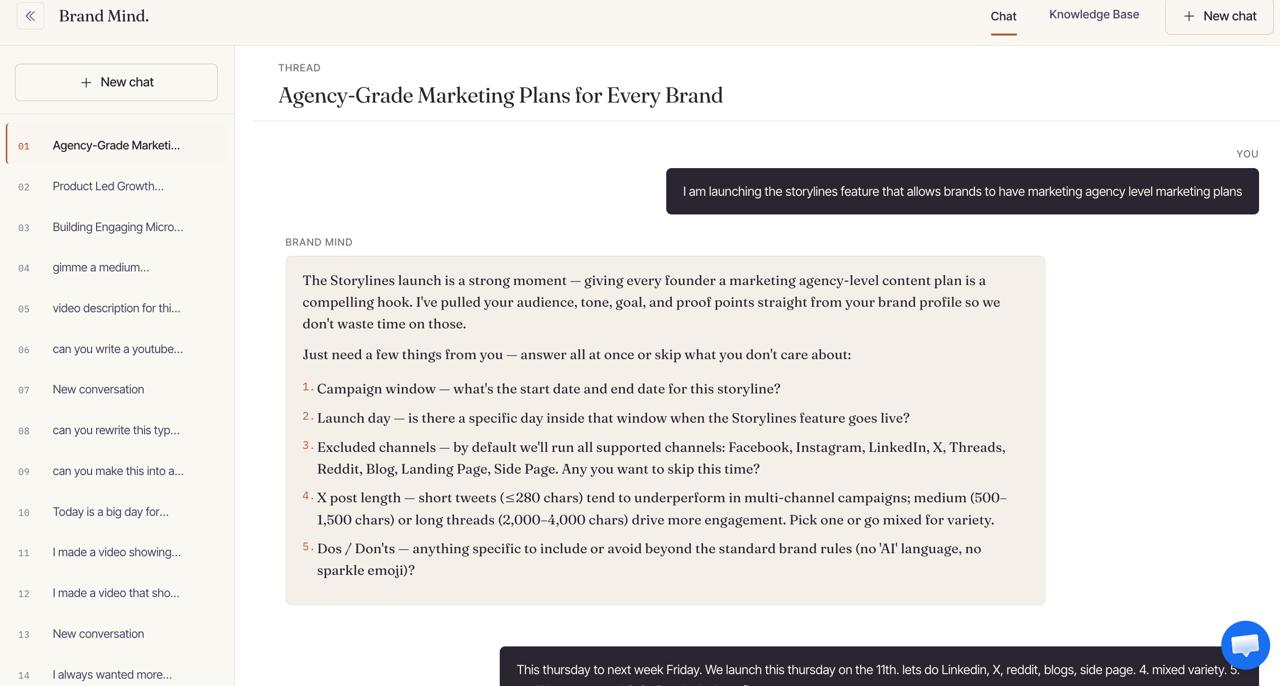
BrandMind keeps a persistent record of your positioning: your audience, your product claims, your tone boundaries. When you've said your product is "for indie founders," it won't start writing content targeted at enterprise procurement teams. That sounds obvious. Every other tool I've used gets it wrong within a few generations.
3. Consistency Scoring
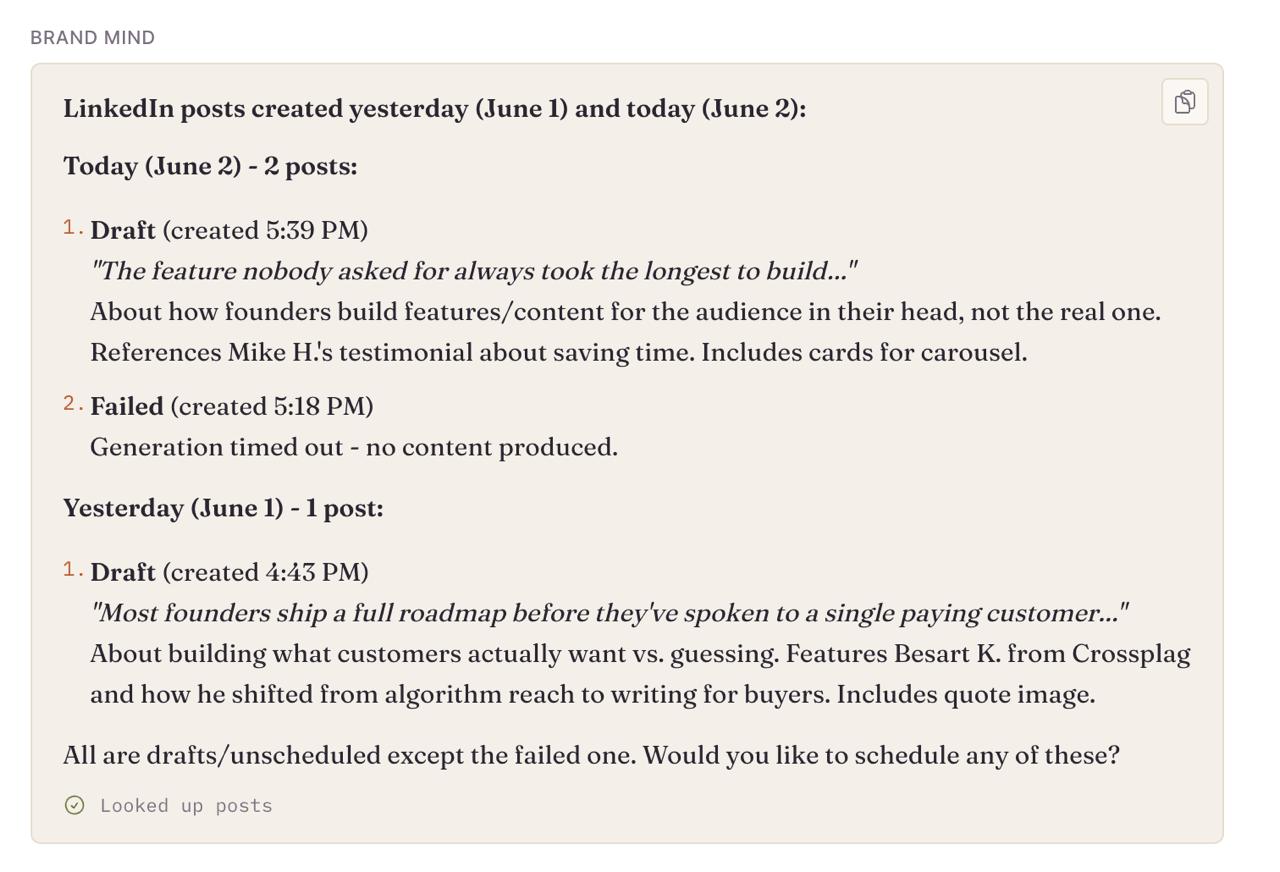
Every piece of generated content gets scored against your voice profile before it surfaces to you. Outputs that fall below a set threshold get flagged or regenerated. You don't review a wall of options. You review content that already passed a filter tuned to your brand.
Why This Approach, and Why Now
Content consistency is a documented problem for small teams. Research from the Content Marketing Institute consistently shows that brand consistency ranks among the top challenges for organizations with fewer than 10 people on marketing, and inconsistent voice is cited as a direct driver of audience trust erosion over time.
For indie founders and small SaaS teams, the math is brutal. You need a steady stream of content to build organic reach. You don't have a content team. You automate or you fall behind. But the tools that automate tend to flatten your voice into something that reads like everyone else's. That's the problem vibe-marketing sets out to solve for bootstrapped founders.
Google's helpful content guidance, updated through 2025, makes the stakes clearer: content demonstrating genuine expertise and original perspective performs better than volume-optimized generic output (Google Search Central, 2025). The algorithm is increasingly able to distinguish between content that reflects a real point of view and content that was assembled to fill space.
BrandMind is built against that pressure. The goal is content that could survive a "did a human write this" read-through by someone who knows your work.
What Changes in Your Workflow
Here's what the 0.2 update looks like in practice.
Setup: The Voice Calibration Session
When you first configure BrandMind, you run a calibration. You paste in 5 to 10 pieces of content you've written yourself. Doesn't have to be polished. A few LinkedIn posts and a couple of email threads will do. PostKing processes them and surfaces a voice profile you can review and adjust.
The voice reads like an editorial brief: dominant tone, average sentence complexity, recurring themes, phrases to favor, phrases to avoid. You can edit it directly. Most people tweak maybe 20% of what it generates on first pass.
Generation: Content That Arrives Pre-filtered
Once calibrated, every content request goes through your voice profile. Ask PostKing to draft a week of LinkedIn posts about your new feature, and what comes back has already been sanded down to match your register. You're editing, not rewriting.
That's the shift worth paying attention to. The time cost of AI-assisted content isn't generation, it's correction. BrandMind tries to move the correction work upstream, into the profile, so you do it once instead of every time.
Iteration: The Profile Updates With You
When you edit generated content, PostKing can read those edits as signals. Over time, the voice profile tightens. The gap between first draft and final shrinks. This is slow, but it compounds. After a few months of use, in our experience, the edit burden on generated content drops meaningfully.
Practical Example: A SaaS Feature Announcement
Say you're shipping a new feature. You need a blog post, 3 social posts, and a short email to your list. Before BrandMind, you'd either write all of it yourself (hours) or generate it with a generic tool and spend almost as long fixing the tone as you would have writing it.
With BrandMind configured, you give PostKing a one-paragraph brief about the feature: what it does, who it helps, why it matters. It generates all 3 formats in your voice, with your usual level of technical detail, without the filler phrases and forced enthusiasm that generic tools pile in.
You still review everything. You should. But you're reviewing for accuracy and nuance, not scrubbing "exciting new features" out of every paragraph.
A Few Things to Know Before You Start
The calibration is only as good as your samples. If you feed BrandMind content you don't love, it'll learn patterns you don't want to keep. Give it your best work, or work that most accurately reflects how you actually want to sound.
Don't expect perfection on week one. The profile improves with use, and the first few generations will probably need heavier editing than later ones. That's normal and expected.
BrandMind works best for founders and teams who already have a clear sense of their voice, even if they haven't documented it. If you're still figuring out your positioning and tone, it's worth settling that first. The tool captures a voice; it doesn't invent one.
For NGOs and mission-driven organizations: the tone calibration handles formal, values-forward communication well. Just make sure your samples reflect your public-facing voice, not your internal reporting language. Those read very differently.
Where This Fits in the PostKing Roadmap
Version 0.2 focuses on getting the voice layer right because everything else depends on it. Scheduling is easy. Distribution is a solved problem. Brand-consistent content at volume, for a team of one or three, isn't solved yet. BrandMind is the attempt at that piece.
Future updates will build on the profile: audience segmentation that adjusts tone by channel, multi-author profiles for teams, and integration hooks for the tools you're already using to manage your content calendar.
For now, 0.2 is worth picking up if you've ever looked at AI-generated content and thought "this is close, but it doesn't sound like us." That gap is exactly what BrandMind is built to close.
If you want to try it, PostKing is available at postking.app. The calibration takes about 15 minutes to set up. After that, you'll have a pretty clear sense of whether it fits how you work.
About Dana Willow
Author
Senior Marketer sharing 15 years of marketing wisdom through an AI lens. Teaching founders to automate smarter.