
PostKing's Guide to Competitor Intelligence and Research
PostKing 0.2 brings competitor intelligence to indie founders. Learn how to research rivals, spot gaps, and build smarter content without the manual grind.

Dana Willow
Senior Marketer sharing 15 years of marketing wisdom through an AI lens.
Published on July 1, 2026
Updated on September 27, 2026

Competitor overview with top actionable insights and priority recommendations in PostKing.
I built PostKing because I kept running into the same wall. Good product, clear value, no idea how to get anyone to notice it. Distribution felt like a separate full-time job, and I didn't have the budget to hire someone to do it well.
One of the things that helped most, before PostKing existed, was studying competitors obsessively. What were they writing about? Where were they posting? What got traction? It was tedious work done in spreadsheets, browser tabs, and late-night copy-paste sessions. PostKing 0.2 is the version where we started automating that part.
What Competitor Intelligence Actually Means Here
The phrase "competitor intelligence" sounds like something from a consulting deck. What it means in practice: knowing what topics your competitors publish, how often they publish, where they distribute, and what kinds of content seem to perform for them.
This isn't about copying. It's about understanding the conversation already happening in your space, so you can enter it with something that actually adds to it rather than repeating it.
PostKing 0.2 introduces structured competitor research workflows that pull this together in one place, instead of forcing you to build the spreadsheet yourself every time.
The Core Features in 0.2
Competitor Content Tracking
You can add competitor domains or social handles, and PostKing will surface what they're publishing. Blog posts, LinkedIn updates, content categories, publishing frequency. Not a firehose, just a structured snapshot you can actually use.
The goal isn't surveillance. It's orientation. When you know a competitor has been publishing three posts a week about onboarding flows, and you haven't touched that topic, that's a signal worth paying attention to.
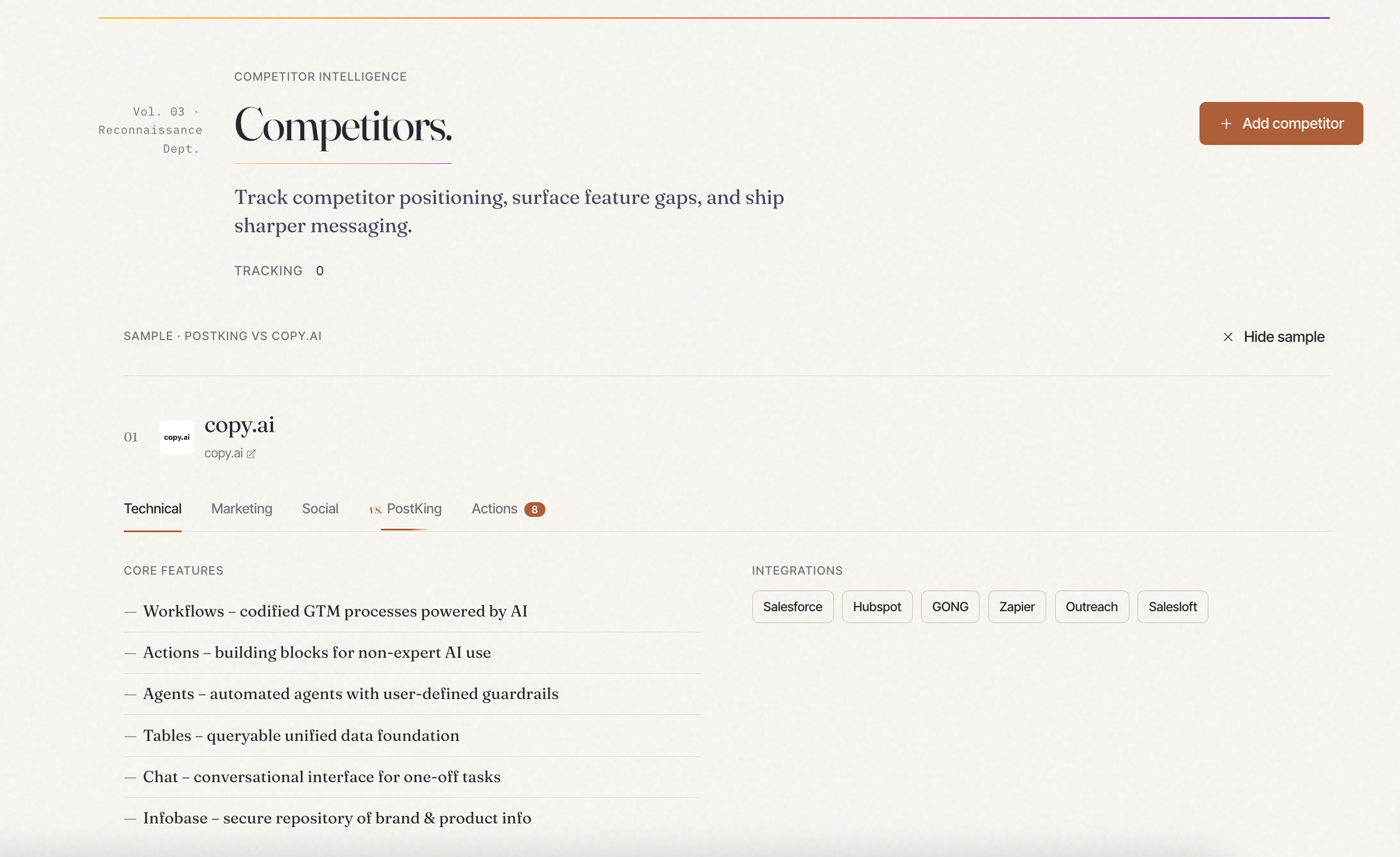 Competitor Intelligence dashboard — track competitors, view sample comparisons, and navigate between technical, marketing, and social views
Topic Gap Analysis
This is the part I find most useful. PostKing 0.2 can compare your published content against a competitor's and surface topics they've covered that you haven't, or angles they've taken that you've approached differently.
Topic gaps are where content strategy gets concrete. Abstract advice like "write about your audience's pain points" is fine but unhelpful if you're staring at a blank document. Seeing a specific topic your competitor has covered three times, that you haven't touched once, gives you somewhere to start.
Research Briefs
When you're ready to write on a topic, PostKing can generate a research brief that pulls in competitor angles, common questions around the topic (based on public search data), and a structural suggestion. Think of it as a starting scaffold, not a finished outline. You still make the calls on voice, angle, and what actually matters to your audience.
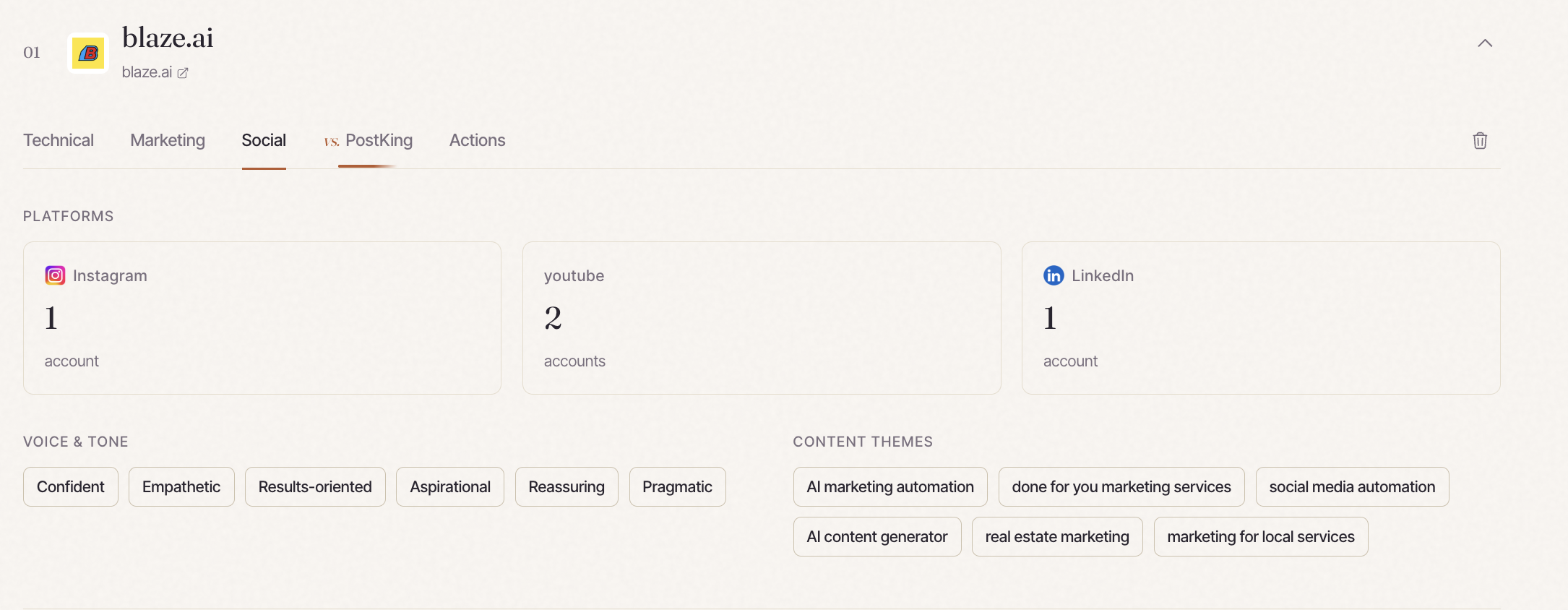 Competitor Social tab — view tracked social platforms, account details, and content themes for any competitor
Why This Matters for Indie Founders Specifically
Larger content teams have people whose job it is to do competitor research. Someone tracks the space, someone else distills it into briefs, a third person writes. That pipeline exists because the work is genuinely valuable.
If you're a solo founder or a team of 3, you don't have that pipeline. You have a finite number of hours, most of them already spoken for. So competitor research either doesn't happen, or it happens in a scattered way that doesn't accumulate into anything useful.
PostKing 0.2 doesn't replace judgment. It compresses the time cost of gathering the raw material, so the judgment you do apply is better informed. According to research from the Content Marketing Institute, organizations that document their content strategy (including competitive analysis) consistently report better content performance than those who wing it. The gap tends to be wide.
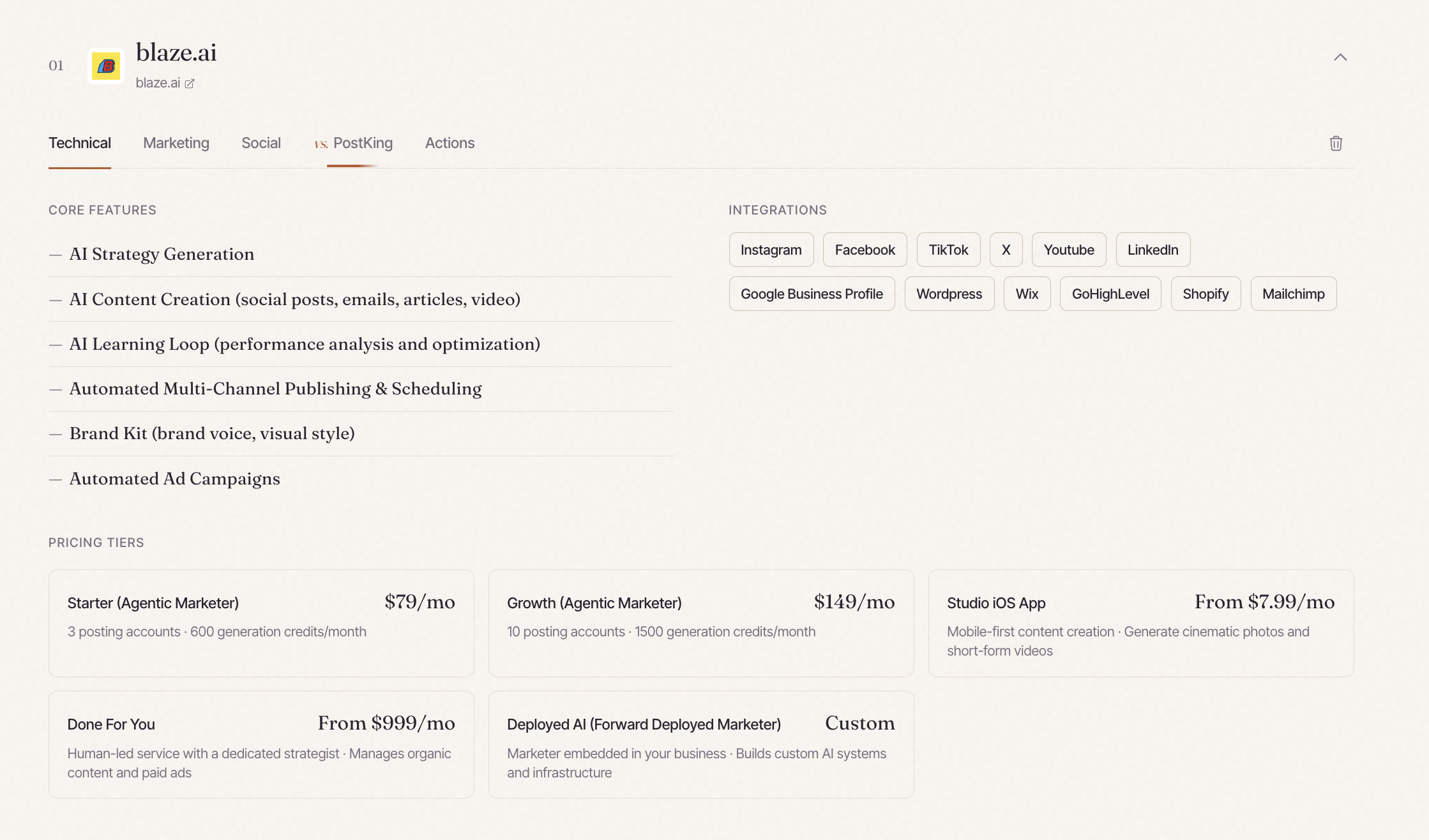 Competitor Technical tab — inspect core features, platform integrations, and product capabilities at a glance
A Practical Walkthrough
Say you run a project management tool targeted at NGOs. You've identified 3 competitors who are active on content. Here's roughly how a research session might look in PostKing 0.2:
First, you add the competitor domains. PostKing surfaces their recent content, grouped by rough topic category. You notice two of them have been writing heavily about grant reporting workflows. You haven't touched that topic.
You open the topic gap view and confirm: grant reporting shows up as a gap for your domain. You flag it for a content brief.
PostKing generates a brief that includes the angles those competitors have taken (both fairly surface-level, neither of them written by someone who clearly understands NGO finance), public questions around the topic pulled from search, and a suggested structure. You read it, disagree with two of the structural suggestions (good, that's the point), and write a much more specific piece based on what you actually know about your users' grant reporting headaches.
That piece is better than whatever you'd have written by staring at a blank document. And it's filling a real gap.
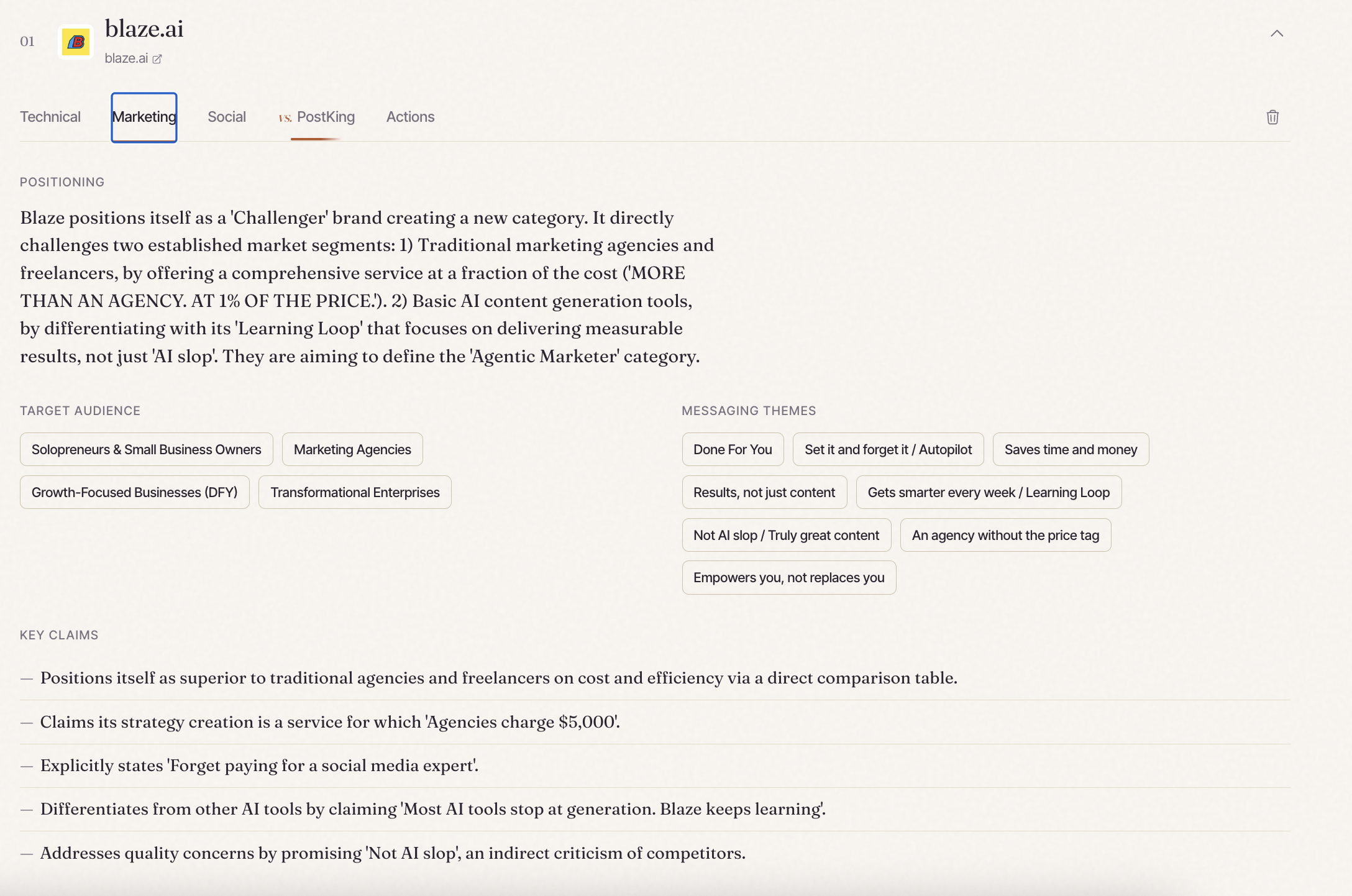 Competitor Marketing tab — surface positioning, target audience, messaging themes, and key claims for competitor analysis
What This Won't Do
Competitor intelligence is an input, not a strategy. If you use it to mechanically mirror what competitors are doing, you'll end up producing content that's a step behind and a degree thinner. The goal is to understand the conversation well enough to say something that moves it forward.
PostKing 0.2 is also still early-stage software. The competitor tracking works well for publicly indexed content. It's less reliable for newsletters, gated content, or platforms with restricted crawling. We're upfront about that.
Best Practices for Getting Value Out of This
Keep your competitor list tight. Tracking 15 competitors generates noise. Tracking 3 to 5 real ones generates signal. Pick the ones your actual prospects mention or compare you to, not the ones that are technically in the same SIC code.
Check the gap analysis on a schedule, not constantly. Monthly is probably right for most teams at this stage. Weekly starts to feel like you're chasing rather than leading.
Use the research brief as a starting point, then throw away the parts that don't fit your voice. A brief that's 60% useful and 40% discarded is still a good brief. It gave you somewhere to push off from.
Cross-reference competitor topics against what your actual users ask. If a competitor is publishing about topic X but none of your users have ever mentioned it, that's worth noting before you invest time writing about it. Search data from tools like Google Search Console (free, first-party) is useful here because it shows what's already pulling people toward your domain. According to Google's own Search Central documentation, understanding existing query patterns is one of the most reliable ways to prioritize content investment.
Where This Fits in the PostKing Roadmap
Version 0.1 was mostly about getting content published consistently without the overhead. Scheduling, formatting, basic distribution. Useful, but fairly mechanical.
0.2 adds the research layer. The idea is that consistent publishing only compounds if what you're publishing is pointed at real opportunities. Competitor intelligence is one input for finding those opportunities. We'll be adding more over time, including audience signal tracking and content performance feedback loops, but research felt like the right second layer to build.
If you're already using PostKing, the competitor features are available now in the dashboard. If you're new, the research tools are part of the core workflow from the start.
Getting Started
Start small. Add 3 competitors, run the gap analysis once, pick one topic to write about this week. See if the brief saves you time and improves the piece. That's the test.
The point of all this tooling is to make good content work sustainable for people who don't have a content team. One well-researched piece that fills a real gap beats five generic posts that disappear into the feed.
If you have feedback on the competitor features, I read every message. The tool is getting better because people tell us where it falls short.
About Dana Willow
Author
Senior Marketer sharing 15 years of marketing wisdom through an AI lens. Teaching founders to automate smarter.