Automated Social Media Posting: A Practical Guide
Boost your small business online with automated social media posting. Learn tools, strategies, and avoid pitfalls to grow your audience today!

Dana Willow
Senior Marketer sharing 15 years of marketing wisdom through an AI lens.
Published on July 16, 2026
Updated on October 9, 2026

Automated posting keeps your channels active while you get on with other work.
Key Takeaways
- Automated social media posting increases efficiency and engagement for SMBs.
- Choosing the right tool is important based on specific business needs and budget.
- Even on a limited budget, SMBs can effectively implement automation strategies.
Introduction to Automated Social Media Posting
Half of Organizations Adopted Marketing Automation in the Last 4 Years Alone - and the gap between early movers and late adopters is widening fast. Scheduling posts, syncing campaigns, and responding to audiences manually once felt manageable. It no longer is. Demand Spring "Marketing Automation Platform Insights" found that nearly 50% of organizations started using an automation platform for the first time within a four-year window - a signal that the shift is happening now, not later. Small businesses that delay risk spending hours on repetitive publishing tasks while competitors let tools handle the queue automatically.
Automated social media posting means scheduling, publishing, and recycling content without manual effort each time. It frees your team to focus on strategy, not logistics.
65% of SMEs still hesitate due to perceived cost and complexity - yet the tools available in 2026 are simpler and more affordable than ever (Marketing Automation Software Market Size to Hit USD 36.97 Billion by 2035).
The following sections break down exactly which tools suit small businesses and how to put them to work.
Top Tools for Small Businesses Compared
Finding the Perfect Fit for Your SMB means looking beyond price tags and flashy feature lists - the right tool should match your team size, content volume, and growth ambitions without overwhelming your workflow or budget. Small businesses rarely need enterprise complexity. What they need is a reliable, intuitive platform that saves hours each week, keeps posting consistent, and surfaces insights they can actually act on. 63% of businesses using marketing automation report increased engagement within the first six months - proof that picking the right tool pays off fast.
The three tools below represent the strongest options for SMBs right now. Each targets a distinct stage of business growth. Compare them carefully before committing.
| Tool | Key Features | Pricing (Basic Plan) | Suitable For |
|---|---|---|---|
| Planable | AI Content Generation, Cross-Platform Scheduling | $29/month | Growing Teams |
| RecurPost | Customizable Posting, Engagement Analytics | $19/month | Solopreneurs & Small Teams |
| ContentStudio | Content Suggestions, Bulk Scheduling | $49/month | Established SMBs |
Which Tool Wins at Each Stage?
RecurPost suits lean operations the best. At $19/month, it delivers customizable posting cycles and solid analytics - ideal when one person manages everything.
Planable steps up for teams producing higher content volumes. Its AI generation feature cuts drafting time sharply.
ContentStudio handles bulk scheduling with content discovery built in, making it the natural upgrade for SMBs ready to scale.
- Budget-first pick: RecurPost keeps costs low while covering core scheduling needs
- Collaboration-first pick: Planable shines when more than one person touches content
- Scale-first pick: ContentStudio supports growing libraries and multi-channel campaigns
- AI-assisted writing: Planable's built-in generation reduces blank-page friction
- Analytics depth: RecurPost surfaces engagement trends without complex dashboards
- Content discovery: ContentStudio suggests relevant third-party content to fill gaps
No single tool wins universally. Match the platform to where your business stands today - not where you hope to be in three years.
Success Stories: Real SMBs, Real Results
From $70 to $270,000: The Power of Automation. A local electrician turned a tiny ad budget into a quarter-million-dollar pipeline - not through luck, but through a simple system that responded to leads and followed up automatically. According to a r/smallbusiness user experience, the electrician generated a $270,000 pipeline from just $70 in ad spend by automating lead responses and follow-up sequences. Speed and consistency beat budget almost every time.
What made it work? The automation replied to every inquiry within seconds - day or night. No lead slipped through the cracks while the owner was on a job site.
"I wasn't doing anything fancy. I just stopped letting leads go cold." - r/smallbusiness community member
This isn't an outlier. Small service businesses - plumbers, cleaners, consultants - see the same pattern repeatedly.
Manual follow-up is inconsistent and forgettable; automated follow-up is relentless and scalable.
The takeaway is simple: automation amplifies whatever budget you already have. A modest spend becomes meaningful revenue when every lead gets a timely, professional response.
Getting Started on a Budget: A Step-by-Step Guide
Automate Without Breaking the Bank - smart SMBs start lean, prove results on one channel, then expand only after they see real returns from a tool that costs nothing upfront. The good news is that free tiers and trial versions now cover most core automation needs, from scheduled posts to basic lead follow-up sequences. Salesmate reports that 63% of businesses using marketing automation see increased engagement within the first six months - proof that early wins are achievable before you spend a dollar on a paid plan. You do not need a big budget to start; you need a clear focus and a willingness to test one thing at a time.
-
Assess Your Current Social Media Presence
Before touching any tool, audit where you actually stand. List every active profile, note your posting frequency, and identify which platform drives the most inbound inquiries.
This baseline shapes everything that follows.
Without it, you risk automating the wrong channel entirely. -
Choose Free or Trial Versions of Automation Tools
Most leading platforms offer generous free tiers. Buffer, Mailchimp, and HubSpot Starter all let you automate basic tasks - scheduling, welcome emails, and basic CRM - at zero cost.
Run each tool for 30 days before committing to a paid plan. Track one metric per tool so the comparison stays honest.
-
Focus on One Platform to Start
Spreading attention across five networks at launch dilutes results and makes reporting confusing. Pick the platform where your customers already spend time.
Master that single channel first.
Expansion is far easier once you have a repeatable system in place and data to back your next move.
- Free audit tools: Google Analytics, native platform Insights, and Ubersuggest's free tier cover most baseline needs.
- Trial stacking: Start overlapping trials so evaluation windows align before any billing begins.
- One KPI rule: Track only one primary metric per tool during the trial period to keep decisions clear.
- Content batching: Write and schedule a week of posts in one sitting - most free schedulers allow up to 10 queued posts.
Momentum matters more than perfection at this stage. A simple automation for lead responses alone can transform pipeline - real SMB results show how quickly focused follow-up pays off. Build the habit before you build the tech stack.
Common Pitfalls & How to Overcome Them
Avoiding the pitfalls of automation separates businesses that thrive from those that fail - the difference usually comes down to setup, not the software itself. Most small businesses jump in too fast, automating everything at once before understanding what their customers actually need. Start with one workflow, measure it, then expand. That focused approach prevents the overwhelm that causes most early failures.
Over-automation is a real trap. When every touchpoint becomes a triggered email, customers feel processed rather than valued.
The fix is simple: keep high-stakes moments - complaints, renewals, big purchases - human-handled, and automate only repetitive low-stakes tasks.
Poor data hygiene quietly kills results. Outdated contact lists, duplicate records, and missing fields feed bad inputs into your automations, producing irrelevant messages. Audit your CRM quarterly and enforce data-entry standards from day one.
Quick-Fix Checklist
- Scope creep: automate one workflow before adding another
- Generic messaging: segment audiences before triggering campaigns
- No testing phase: run A/B tests on every new sequence
- Ignoring analytics: review open rates and conversions weekly
- Skipping onboarding: use vendor tutorials before going live
Note that 43% of marketers cite improving customer experience as automation's top advantage (Statista, 2026) - you only get that gain when the fundamentals are solid.
Conclusion: Automate for Success
Your path to automated success starts here - and every step forward compounds. Marketing automation is no longer optional for small businesses that want to grow. 63% of businesses using automation see increased engagement within six months. The tools exist, the results are proven, and the only real risk is waiting too long to begin.
Start small. Automate one workflow, measure the outcome, then expand. Small wins build the confidence - and the data - to scale further.
PostKing makes this process straightforward. Choose your platform, connect your channels, and let automation do the heavy lifting while you focus on serving your customers.
The businesses winning in 2026 aren't working harder - they're automating smarter. Start today, and let every automated action move your business forward.
What you can automate and what you shouldn't
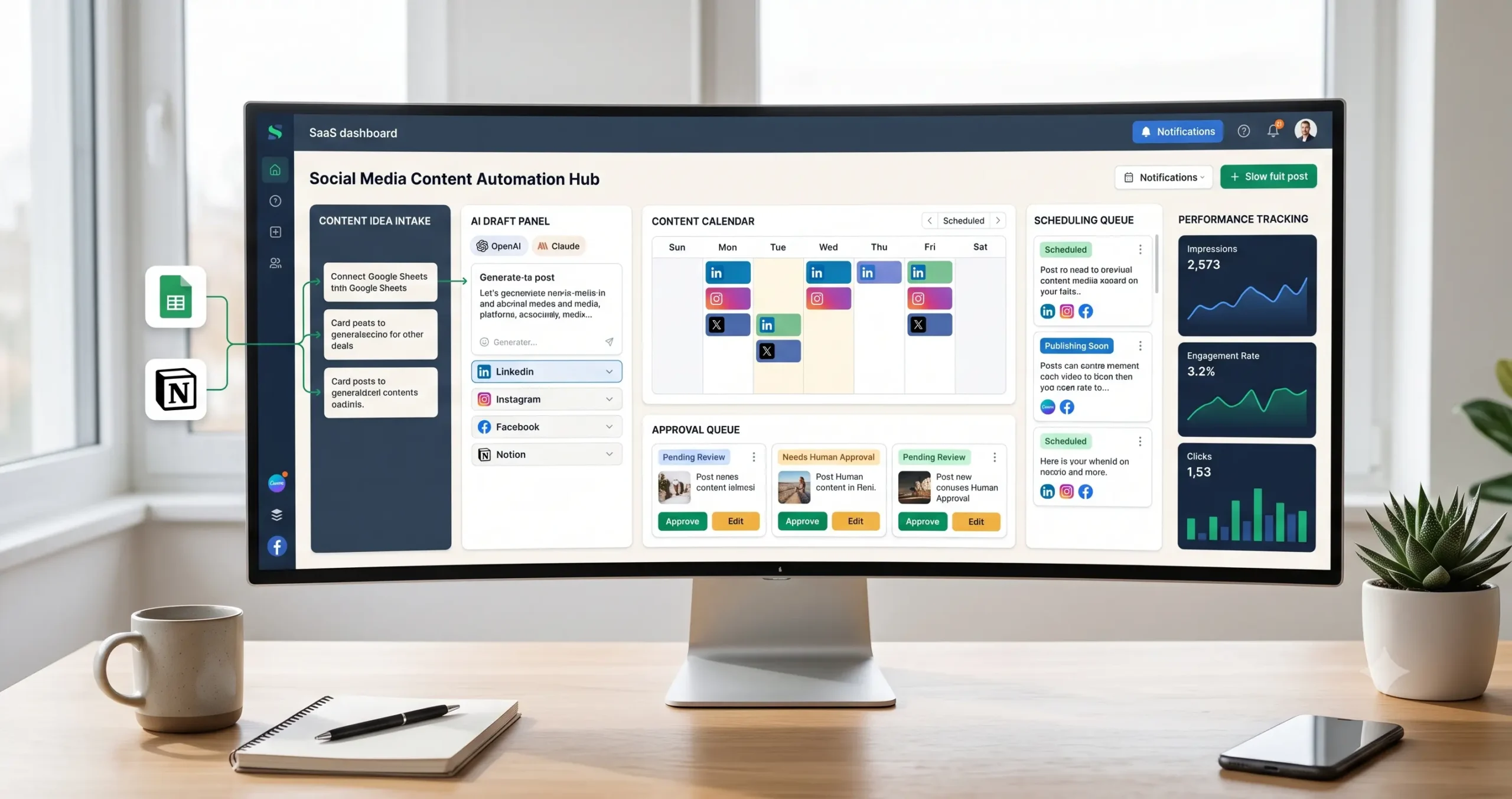
Social media tasks that are repetitive and rule-based, such as scheduling, resizing, routing, alerting and reporting, are safe to automate, while replying to customers and building relationships should stay fully human. The split follows one question: does the task need judgment, empathy or brand voice? If not, software handles it faster and more consistently than any team. If so, automation puts your reputation at risk. One guide to social media automation tips makes the same point: automation should free up time for real engagement, not replace it. The table below goes task by task through a typical social workflow. It shows what is safe, what is only partly safe, and where a person still needs to be involved.
| Task | Automate? | Tool type | Where a human stays involved |
|---|---|---|---|
| Publishing at set times across platforms | Yes | Scheduler | Approving the queue weekly |
| Drafting post copy from existing content | Partly | AI content generation | Reviewing and editing for voice and accuracy |
| Resizing and adapting posts per platform | Yes | AI content generation / scheduler | Spot-checking formatting |
| Pairing visuals with posts | Partly | AI content generation | Rejecting off-brand images |
| Routing comments and DMs to an inbox | Yes | Engagement inbox | Writing the actual replies |
| Replying to customers and complaints | No | None | Fully human, ideally within 24 hours |
| Brand mention and keyword alerts | Yes | Social listening | Deciding whether and how to respond |
| Monthly performance reports | Yes | Analytics / reporting | Interpreting results and next steps |
| Auto-liking, auto-following, auto-commenting | No | None | Avoid entirely (spam risk) |
Notice the pattern. Automation works best on the logistics around a conversation, not the conversation itself. Socialinsider's research on automation tools points to the same divide between scheduling and reporting on one side and engagement on the other.
The "Partly" rows deserve the most care. AI can draft a caption in seconds, but it can also invent a detail or flatten your tone. Treat its output as a first draft, never a final one. Auto-engagement is different. Bots that like, follow or comment on your behalf can trigger platform penalties and cost you trust, so skip them entirely.
Decision table: which tool type to start with
Your biggest challenge decides your first tool. If you struggle with writing time, consider AI content generation. For channel adaptation, look at platform-aware generation. Multi-brand approvals point to role-based platforms, and slow replies suggest an engagement inbox. Reporting pain calls for analytics tools, and disconnected apps call for workflow automation. Buying by feature list usually fails, because a tool that fixes the wrong issue just adds another login. Match the tool to the constraint your audit exposed, then expand only when that constraint stops being the slowest step. Roundups such as Zapier's guide to social media management tools show how many types overlap, so a clear challenge keeps the shortlist short. The table below covers the situations small teams describe most often.
| Your situation | Main bottleneck | Start with | Watch out for |
|---|---|---|---|
| Solo founder posting irregularly | Writing time | AI content generation + scheduler | Generic-sounding drafts |
| Small marketing team, several platforms | Adapting posts per channel | Platform-aware generation + scheduler | Duplicated copy across networks |
| Team managing multiple brands | Switching contexts and approvals | Multi-brand platform with roles | Weak permission controls |
| Growing inbound comments and DMs | Response speed | Engagement inbox | Auto-replies to real complaints |
| Monthly reports eat a day | Data collection | Analytics / reporting | Vanity-metric dashboards |
| Many disconnected apps | Handoffs between tools | Workflow tools (Make, Zapier, n8n) | Fragile, unmonitored automations |
Pick one row, not three. Volunteers at an NGO usually land on the first or second row, since time and consistency are the constraints. Practitioners in Reddit's automation community often warn that stacking automations too early creates more maintenance than it saves. Run your first tool for a month, then re-check the audit.
FAQs about small business owners/marketers
What is the primary benefit of automated social media posting for SMBs?
The primary benefit of automated social media posting for small and medium-sized businesses is a powerful combination of efficiency and increased engagement. On the efficiency side, automation eliminates the need to manually publish content every day, freeing up valuable time that business owners and marketers can redirect toward revenue-generating activities, product development, and customer service. Instead of logging into multiple platforms at different hours, you can batch-create content, schedule it weeks in advance, and let your automation tool handle the rest - including posting at the optimal times for each platform. This consistency also drives increased engagement: when your audience knows your brand shows up regularly with relevant, timely content, they are far more likely to follow, interact, and convert. Automated scheduling tools available in 2026 also use AI-driven insights to identify peak engagement windows, ensuring your posts reach the maximum number of followers precisely when they are most active - boosting likes, shares, comments, and ultimately, sales.
How do I choose the right automation tool for my small business?
Choosing the right social media automation tool for your small business comes down to two key steps: assessing your needs and carefully comparing pricing and features. Start by evaluating your specific situation - how many social media platforms do you manage, how large is your team, and what types of content do you publish most (images, videos, stories, reels)? Identify whether you need basic scheduling, or more advanced capabilities like AI-generated captions, analytics dashboards, inbox management, or team collaboration workflows. Once you have a clear picture of your requirements, move on to comparing tools side by side. In 2026, the market offers a wide range of options from budget-friendly solutions ideal for solopreneurs to more advanced platforms designed for growing marketing teams. Pay close attention to monthly costs versus the number of social profiles and posts allowed, the quality of analytics reporting, ease of use, customer support responsiveness, and compatibility with the platforms you already use. Many tools offer free trials - take advantage of these to test workflows before committing. The right tool should save you time, fit comfortably within your budget, and grow alongside your business without forcing costly upgrades too soon.
Avoid These Common Mistakes in Automated Social Media Posting
- Choosing a Tool Without Assessing Specific Business Needs: Ensuring the tool aligns with your target audience and content strategy.
- Neglecting Content Quality for Automation Speed: Balance efficiency with quality, relevant content.
Sources
- HubSpot State of Marketing Report
- SharpSpring "Investor Presentation Jan 2019"
- 21 Best marketing automation software & tools for 2026
- r/smallbusiness user experience
- Statista
- Forbes
- Socialinsider's research
- Best Tools & Strategies for Social Media Post Automation?, Reddit
- The 10 best social media management tools in 2026, Zapier
About Dana Willow
Author
Senior Marketer sharing 15 years of marketing wisdom through an AI lens. Teaching founders to automate smarter.