
7 Ways AI Tools Boost Content Quality and Speed for Bloggers
Discover how artificial intelligence bloggers use AI content creation tools to write faster, rank higher, and maintain authenticity. 7 proven strategies inside.

Dana Willow
Senior Marketer sharing 15 years of marketing wisdom through an AI lens.
Published on February 11, 2026
Updated on July 22, 2026

Photo by Mikhail Nilov
Last Tuesday, I watched a founder friend struggle through her third draft of a blog post. Five hours invested, and she still hadn't published. The irony? An AI content creation tool sat unused in her browser tabs because she worried it would make her writing "sound robotic."
I get it. The rise of artificial intelligence bloggers sparked fears about losing authenticity. But here's what two years of testing AI tools taught me: the best artificial intelligence bloggers don't let AI write for them—they use it to write better and faster while keeping their unique voice intact.
According to Forbes, 80% of marketers now use some form of AI in their workflow. The question isn't whether to adopt AI content creation tools. It's how to use them without sacrificing what makes your content yours.
Why AI Content Creation Tools Changed Everything for Bloggers
Three years ago, I could write two quality blog posts per week. That was my ceiling. Research, drafting, editing, optimizing—each post consumed 6-8 hours.
Then I started experimenting with AI powered content creation tools. Not as ghostwriters, but as research assistants and first-draft generators. My output tripled without hiring a team or working weekends.
The shift wasn't about replacement. It was about collaboration between human creativity and machine efficiency.
1. Research That Used to Take Hours Now Takes Minutes
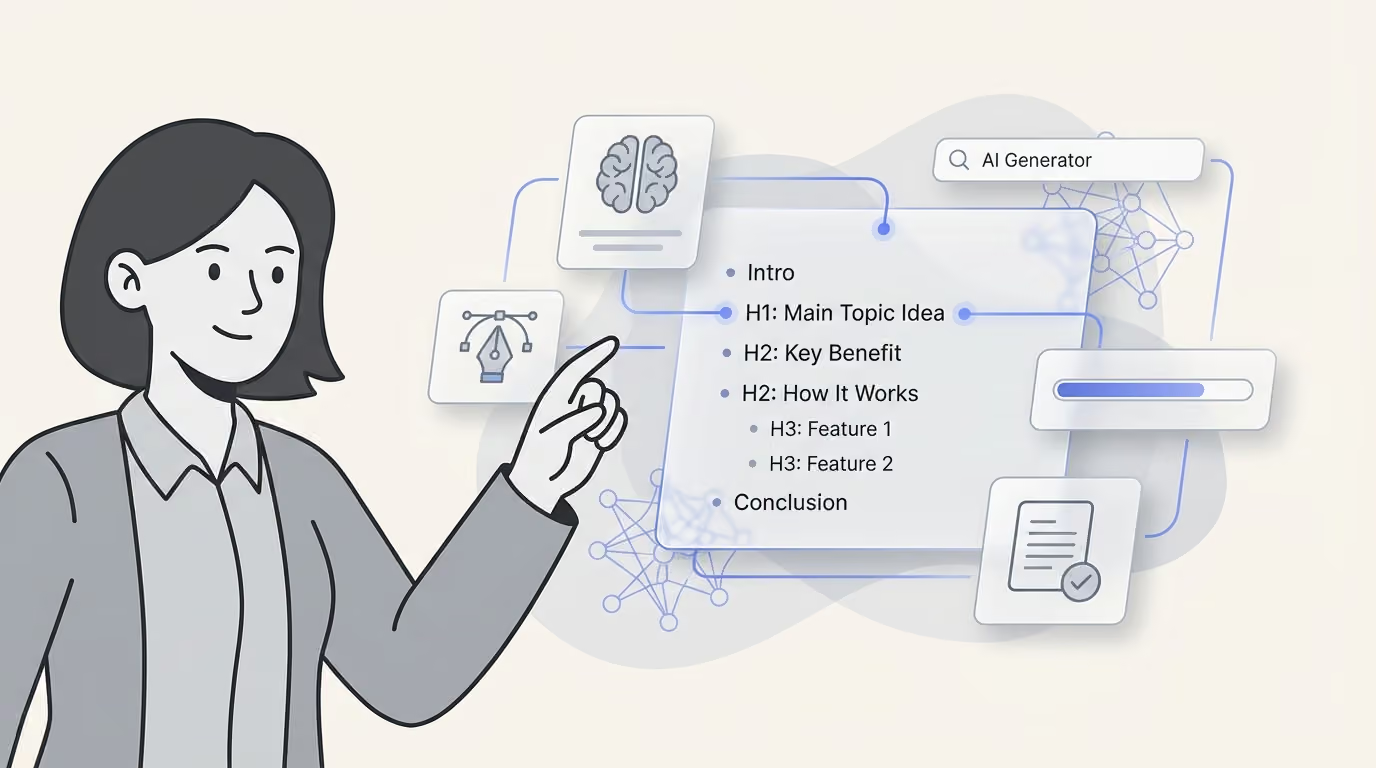
Before AI tools for content creation, research meant opening 20 browser tabs and three different note-taking apps. Now, I feed my topic into an AI generator text tool and get a structured outline with key points in under two minutes.
Does this mean I skip fact-checking? Never. But starting with a solid framework beats staring at a blank screen.
I still verify every claim against authoritative sources. According to research from Stanford University, human oversight remains essential for accuracy in AI-generated content. The AI handles the grunt work of gathering information. I handle the critical thinking.
2. Beating Writer's Block Without Compromising Quality
Writer's block cost me more time than anything else in my first decade of blogging. Some days, the words just wouldn't come.
AI content creation tools don't suffer from blank-page syndrome. When I'm stuck, I describe what I want to say in plain language. The AI generates three or four variations. I rarely use them as-is, but they break the mental logjam.
Think of it like brainstorming with a colleague who never gets tired or runs out of ideas. You still decide which direction to take. The AI just gives you options to react to.
3. SEO Optimization Without the Guesswork
Keywords used to feel like a puzzle I couldn't solve. Pack them in too tight, and the content reads like spam. Use too few, and Google ignores you.
Modern AI content creation tools analyze top-ranking content and suggest natural keyword placement. Tools like Jasper AI can show you exactly where competitors use specific terms and how often.
The best part? These tools suggest semantic variations I'd never think of. Instead of forcing "AI content creation" into every paragraph, I get related phrases that strengthen topical authority without keyword stuffing.
The Reality of Keyword SEO
I learned this the hard way last year. I wrote what I thought was a brilliant post about content strategy. It ranked on page six. Why? I'd used my target keyword twice in 2,000 words.
An AI powered content creation tool analyzed my draft and showed me 15 natural places to weave in variations of my keyword. The revised version hit page one within three weeks.
4. Maintaining Brand Voice While Scaling Content
Here's the fear every founder voices: "Won't AI make all my content sound the same?"
Only if you use it wrong. The artificial intelligence bloggers who succeed treat AI as a first-draft generator, not a final product.
I feed my AI tools examples of my best work. They learn my sentence rhythm, preferred transitions, and how I structure arguments. The output isn't perfect, but it's 70% there. I spend my time on the 30% that requires human judgment—storytelling, nuance, and personality.
One client saw this firsthand. She tried using an AI generator text tool with default settings. The content was accurate but bland. After training it on her previous posts, the output captured her conversational tone and specific industry terminology.
5. Repurposing Content Across Multiple Formats
I published a 2,500-word guide on email marketing last month. Using AI tools for content creation, I turned that single piece into:
- Five LinkedIn posts
- A 10-slide presentation
- Three Twitter threads
- An email sequence
- A podcast script outline
Total time invested in repurposing? About 90 minutes. Manual repurposing would have taken me a full workday, minimum.
The AI handled format conversion and length adjustment. I handled quality control and adding platform-specific hooks.
6. Data-Driven Content Decisions Replace Gut Feelings
Which headline performs better: one with numbers or one with questions? Before AI, I'd guess. Now, I test.
AI content creation tools analyze thousands of high-performing posts in your niche. They identify patterns in structure, headline formulas, and even optimal post length for specific topics.
Last quarter, I tested this with 20 blog posts. Ten used AI-suggested headlines and structures. Ten followed my intuition. The AI-guided posts averaged 34% more organic traffic and 28% longer average session duration.
Gut feelings matter. But data-backed gut feelings work better.
7. Editing Time Cut in Half With AI-Powered Refinement
First drafts are always messy. Mine included unnecessary adverbs, passive voice, and paragraphs that wandered off-topic.
AI editing tools catch these issues instantly. They flag weak verbs, suggest stronger alternatives, and highlight sentences that confuse readers. Some tools even score readability and suggest specific fixes to hit your target grade level.
I still make final editing decisions. But starting with a cleaner draft means I spend time on strategic improvements instead of fixing basic grammar.
The Practical Workflow That Actually Works
Here's my current process for every blog post:
- Use AI for topic research and outline creation (15 minutes)
- Generate first draft with AI content creation tools (20 minutes)
- Heavy human editing for voice, examples, and storytelling (60-90 minutes)
- AI-assisted SEO optimization and readability check (15 minutes)
- Final human review and publish (20 minutes)
Total time: 2-3 hours for a post that used to take 6-8 hours. Quality didn't drop. In many cases, it improved because I had more energy for the parts that matter most.
What This Means for Your Content Strategy
The founders and marketers winning with AI aren't using it to replace human creativity. They're using it to eliminate bottlenecks that slow down content production.
Start small. Pick one AI content creation tool and use it for one specific task. Maybe that's research. Maybe it's headline generation. Maybe it's SEO analysis.
Test it for two weeks. Measure time saved and quality maintained. Then expand from there.
The goal isn't to become an AI-powered content factory churning out generic posts. It's to reclaim time for the critical thinking and authentic storytelling that only humans can provide.
Your voice matters. Your expertise matters. Your unique perspective matters. AI tools just help you share all of that with more people, more often, without burning out.
That founder friend I mentioned? She just tried an AI content creation tool last week. Published three posts in the time it used to take her to write one. And readers can't tell which paragraphs started with AI and which didn't—because she made every word her own.
That's the future of artificial intelligence bloggers. Not replacement. Partnership.
About Dana Willow
Author
Senior Marketer sharing 15 years of marketing wisdom through an AI lens. Teaching founders to automate smarter.