
How to Create a Topical Map for SEO (Without Hiring an Agency)
Build topical authority without an agency. See how to create an SEO topical map that ranks in AI search, plus a free template to start today.

Dana Willow
Senior Marketer sharing 15 years of marketing wisdom through an AI lens.
Published on May 22, 2026
Updated on September 27, 2026
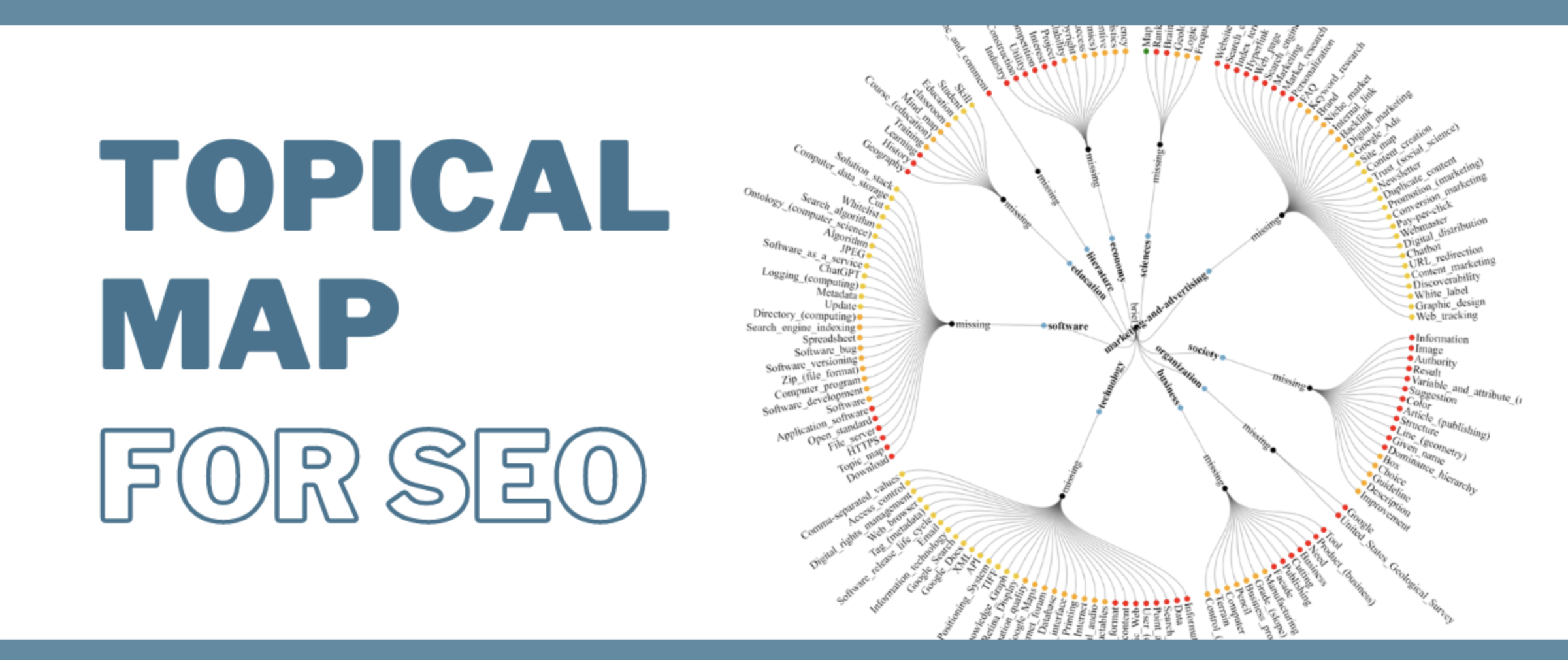
Photo by SEO Topical Map Diagram
Key Takeaways
- Topical maps help you build authority by organizing content around a core subject, not just individual keywords
- Nearly 60% of Google searches end without a click in 2024, making topical authority essential for AI-powered search visibility
- You can create an effective topical map using free tools like Google Search Console, Ahrefs Webmaster Tools, and keyword research platforms
- Organizing content by search intent (informational, commercial, transactional) ensures your map aligns with how users actually search
- AI search engines parse 10x more sources than humans, so broad topical coverage increases your chances of being cited
What Is a Topical Map (And Why It Matters in 2026)
A topical map is a visual blueprint that organizes all your content around a central subject, showing how pillar pages, subtopics, and supporting articles connect to build authority in your niche. Unlike traditional keyword-focused SEO, topical mapping treats your website as a single resource on a specific domain. Instead of chasing individual keywords, you create clusters of related content that signal expertise to both Google and AI search engines like ChatGPT, Perplexity, and Gemini. This approach matters more than ever because nearly 60% of Google searches end without a click in 2024, and 80% of consumers rely on zero-click results at least 40% of the time (Bain-Dynata Generative AI Consumer Survey, 2024). When users get answers directly from AI overviews or chatbots, your brand needs to be the source those systems cite-and topical authority is how you earn that visibility.
Why Traditional Keyword SEO Isn't Enough Anymore
Keyword-driven strategies assume users click through to your site. That model is breaking down. About 50 percent of Google searches already have AI summaries, a figure expected to rise to more than 75 percent by 2028 (trend analysis).
AI engines pull answers from multiple sources in seconds. If your content covers only narrow keywords, you won't appear in those synthesized responses.
Topical depth wins over keyword density.
How AI Search Engines Evaluate Topical Authority
Generative AI platforms scan an order of magnitude more sources than humans (Andrew Yan, CEO of GXO startup AthenaHQ). They reward sites that answer related questions comprehensively, not just the exact query.
Only 8% of ChatGPT's citations come from URLs that appear in Google's top 10 organic results for the same query (Ahrefs research). Traditional rankings don't guarantee AI visibility.
Topical maps guarantee your content covers the full semantic landscape AI models expect.
Step 1: Identify Your Core Topic and Niche
Your core topic is the single subject your business is known for-the area where you want to be recognized as the go-to authority, not a generalist covering everything. For a SaaS founder building a project management tool, your core topic might be "agile project management for remote teams" rather than the overly broad "project management." For an NGO focused on clean water, it could be "community-led water sanitation in rural areas" instead of just "water access." The narrower your focus, the faster you build authority. Start by asking: What problem does my product or service solve? What do my customers search for before they find me? What questions do I answer repeatedly in sales calls or support tickets? Write down 3-5 phrases that describe your expertise, then choose the one that best matches both your business goals and actual search demand.
How to Validate Your Core Topic With Search Data
Open Google and type your candidate topic. Look at autocomplete suggestions-they reveal what real people search. Scroll to "People also ask" and "Related searches" at the bottom of the results page. These free signals show whether your topic has active demand.
Check if competitors already rank for your phrase. If the first page is dominated by household names, your topic may be too competitive. If results are thin or off-topic, demand may be too low. Aim for a middle ground: enough searches to matter, few enough strong players that you can break in.
Use Google Trends to compare two or three candidate topics. Rising interest beats flat or declining curves. Filter by your target geography and the past 12 months to see 2026 momentum.
Avoiding Topics That Are Too Broad or Too Narrow
"Marketing" is too broad; "email subject lines for B2B SaaS selling to healthcare CFOs" is too narrow. The sweet spot sits between them: specific enough that you can own it, broad enough to support dozens of subtopics.
A topic is too broad if you can't list 20 related questions your audience asks. It's too narrow if you struggle to name 10. Test your choice by sketching a quick mind map: write your core topic in the center, then branch out with subtopics. If branches come easily, you've found the right scope.
Remember that 34% of marketers report AI search platforms as the first touchpoint for qualified prospects (EMARKETER). A well-defined core topic helps AI engines understand-and cite-your expertise.
Step 2: Research Subtopics Using Free SEO Tools
Once you've defined your core topic, you need to find every related subtopic your audience cares about-and free tools like Google Search Console, Ahrefs Webmaster Tools, and AnswerThePublic make this surprisingly easy. Start with Google Search Console if you already have a website with some traffic. Go to the Performance report and filter queries by your core topic keyword. You'll see every variation people used to find you, revealing gaps in your current content. Next, create a free Ahrefs Webmaster Tools account and run a site audit. The "Top Pages" report shows which existing pages get traffic, while the "Keywords" section suggests related terms you're not ranking for yet. For brand-new sites, use AnswerThePublic or AlsoAsked to generate question-based subtopics. Type your core topic and export the results-these questions represent real user intent and often become your H2 headings or supporting articles.
Using Google's "People Also Ask" for Subtopic Ideas
Open an incognito browser window and search your core topic. Scroll to the "People Also Ask" (PAA) box. Click each question to expand it-Google dynamically loads more related questions below. Copy 10-15 questions into a spreadsheet. These queries reflect what real users want to know right now in 2026. Group similar questions together. Each cluster becomes a potential section in your content hub or a standalone article. PAA questions also reveal semantic relationships Google recognizes, helping you build topical authority.
How to Organize Subtopics Into Logical Clusters
Dump all your subtopics-from Search Console, PAA, and AnswerThePublic-into a single document. Look for patterns: informational questions, comparison queries, how-to requests, and product-specific terms. Create four buckets: Awareness (what/why), Consideration (how/comparison), Decision (best/reviews), and Support (troubleshooting). Assign each subtopic to one bucket. Within each bucket, rank subtopics by search volume or user priority. This structure mirrors the buyer experience and ensures your content hub answers every question at every stage.
Step 3: Organize Topics by Search Intent
Not all subtopics serve the same purpose-some educate, some compare options, and some drive conversions. Organizing your map by search intent ensures you create the right content for each stage of the buyer funnel. Search intent falls into three main categories. Informational intent covers "how to," "what is," and "why" queries-these are top-of-funnel topics that build awareness and authority. Commercial intent includes "best," "vs," "review," and "alternative" searches-middle-of-funnel content that helps prospects evaluate options. Transactional intent targets "buy," "pricing," "demo," and "sign up" terms-bottom-of-funnel pages designed to convert.
For example, if your core topic is "email marketing automation," an informational subtopic might be "how to segment email lists." A commercial one could be "Mailchimp vs ActiveCampaign." A transactional page would be "email automation software pricing."
Label each subtopic in your map with its intent so you can prioritize creation based on business goals. This structure helps you allocate resources strategically and ensures coverage across the entire funnel.
Step 4: Map Pillar Pages and Supporting Content
A topical map follows a hub-and-spoke model: one main pillar page covers your core topic at a high level, while multiple supporting articles dig deep into specific subtopics and link back to the pillar. Your pillar page should be a 2,000-3,000 word guide that introduces your core topic, outlines key concepts, and links to every supporting article. Think of it as a table of contents for your expertise. Supporting articles (also called cluster content) are 1,000-1,500 word posts that cover individual subtopics in detail. Each supporting article should link back to the pillar page and to related cluster content, creating a web of internal links that signals topical depth to search engines. For instance, a pillar page on "content marketing for SaaS" might link to supporting articles like "how to write SaaS case studies," "best content distribution channels for B2B," and "measuring content ROI with free tools." Use a simple spreadsheet or free tool like Whimsical to visualize these connections before you start writing.
How Many Supporting Articles Does a Pillar Need?
Aim for 8-15 supporting articles per pillar page. Fewer than eight leaves gaps in topical coverage. More than fifteen can dilute focus and make internal linking unwieldy.
Quality beats quantity. A pillar with ten well-researched, 1,200-word articles will outperform one with twenty thin posts. Each supporting article should answer a distinct question or solve a specific problem within your broader topic.
Start with your highest-volume subtopics first. Publish three to five supporting articles, then add the pillar page. This approach lets you test which angles work before committing to a full cluster.
Internal Linking Best Practices for Topical Maps
Every supporting article must link to the pillar page at least once-ideally in the introduction and conclusion. Use descriptive anchor text that includes your target keyword, not generic phrases like "read more" or "click here."
Cross-link related supporting articles within the same cluster. If one post covers "email drip campaigns" and another discusses "lead scoring," link them where relevant. This horizontal linking reinforces topical relationships.
Avoid orphan pages. Every piece of content should be reachable within three clicks from your homepage. Use breadcrumb navigation and footer links to increase discoverability.
Step 5: Validate Your Map Against AI Search Behavior
Traditional SEO metrics like keyword difficulty and search volume don't tell you whether AI search engines will cite your content-you need to validate your map against how LLMs actually surface information. Start by testing your core topic and subtopics in ChatGPT, Perplexity, and Google's AI Overviews. Ask the same questions your audience would ask and note which sources get cited. Only 8% of ChatGPT's citations come from URLs that appear in Google's top 10 organic results for the same query, so traditional SERP analysis isn't enough. Look for patterns: Are AI engines citing forums like Reddit, community wikis, or niche blogs over brand websites? If so, your content needs to adopt a more conversational, question-answering format. Check whether your existing pages appear in AI citations-if they don't, your topical coverage likely has gaps. Use this feedback to refine your map, adding subtopics that address questions AI engines are answering but your content isn't.
Why AI Search Engines Prefer Certain Content Formats
AI models prioritize clarity and directness. They favor content that answers questions in the first 100 words, uses structured data, and breaks complex ideas into scannable sections. Tables, bulleted lists, and definition-style openers perform well because LLMs can extract and reformat them easily.
Conversational tone matters more in 2026 than ever. AI engines train on dialogue, so content written as if answering a real person's question gets cited more often. Avoid jargon-heavy introductions.
Lead with the answer, then explain the nuance.
Tracking Your Brand's Visibility in AI Overviews
Set up a monitoring routine. Query your core topics weekly in ChatGPT, Perplexity, and Google AI Overviews. Document which competitors appear and which subtopics trigger citations. If your brand never surfaces, your topical authority is invisible to AI.
Track citation frequency by content type. Do how-to guides get cited more than thought leadership? Does your FAQ page appear but not your product pages? This tells you where to double down. Adjust your map based on what AI engines reward, not what traditional analytics suggest.
Common Mistakes When Building Topical Maps
Most founders sabotage their topical maps by chasing too many topics at once, creating shallow content, or ignoring internal linking-mistakes that dilute authority instead of building it. The biggest mistake is trying to cover multiple core topics simultaneously. If you're a SaaS founder, you might be tempted to create maps for "project management," "team collaboration," and "productivity tools" all at once. This spreads your content too thin and confuses search engines about your primary expertise. Pick one core topic, exhaust it with 15-20 supporting articles, then expand. Another common error is publishing 500-word "thin" content that doesn't fully answer the subtopic. AI search engines parse an order of magnitude more sources than humans, so surface-level posts won't get cited. Aim for deep coverage-if a subtopic deserves its own article, give it 1,000+ words. Lastly, many founders forget to interlink their cluster content, treating each article as standalone. Without internal links, search engines can't understand the topical relationships you've built.
How PostKing Automates Topical Content Creation
Building a topical map is straightforward-executing it consistently while running a business is the hard part. PostKing generates your entire content cluster in your brand voice, eliminating the bottleneck between strategy and publication. Once you've created your topical map, PostKing analyzes your existing content to replicate your brand voice, then generates pillar pages and supporting articles that match your tone, audience, and messaging. Unlike generic AI tools that produce corporate slop, PostKing's voice analysis ensures every piece sounds like you wrote it.
The platform automatically handles internal linking between cluster content, pairs articles with brand-specific visuals, and schedules publication across your blog and social channels. For 34% of marketers, AI search platforms are where qualified prospects first hear about their company-PostKing ensures your topical content is optimized for both traditional search and AI citations.
You focus on strategy and business growth. PostKing handles the execution that turns your topical map into published authority.
FAQs about how to create a topical map seo
How long does it take to build topical authority with a content map?
Building topical authority typically takes 3-6 months of consistent publishing to show measurable results in traditional search engines. You'll want to aim for 1-2 high-quality articles per week to maintain momentum. Interestingly, AI search visibility can happen faster-often within 4-8 weeks-if your content directly answers common queries that AI models prioritize. The key insight here is that depth matters significantly more than speed. Publishing 15 deep, well-researched articles on one core topic will outperform 50 shallow posts scattered across multiple topics. Focus on thoroughly covering your primary subject before expanding to adjacent areas, as this concentrated approach signals genuine expertise to both traditional search algorithms and AI language models in 2026.
Do I need to hire an SEO agency to create a topical map?
No, topical mapping is absolutely a DIY-friendly process that you can accomplish with free tools. Google Search Console, Ahrefs Webmaster Tools, and basic spreadsheet software provide everything you need to research topics, identify content gaps, and organize your strategy. While SEO agencies can certainly accelerate execution and bring specialized expertise, they're not necessary for developing an effective topical map strategy. The real challenge isn't creating the map-it's consistently producing the content to fill it. This is where solutions like PostKing offer a middle ground: you maintain control over strategy and direction as the founder, while automation handles the time-consuming content creation and publishing process. This approach gives you agency-level output without the agency price tag or loss of creative control.
Can I use AI tools to generate topical map content?
Yes, but with important caveats about quality and differentiation. The concern about "AI slop" is legitimate-generic AI tools often produce content that sounds identical across brands, using the same corporate phrases and lacking distinctive personality. This sameness hurts your ability to stand out and build genuine audience connection. The smart approach is using AI for research, topic ideation, and outline creation, while ensuring your brand voice remains intact in the final content. Generic ChatGPT or Claude outputs won't differentiate your brand. The solution is using AI systems that analyze your existing content first to understand and replicate your authentic voice, rather than imposing generic corporate language. This voice-preservation approach lets you scale content production in 2026 without sacrificing the unique perspective that makes your brand memorable.
How do I know if my topical map is working?
Track these specific metrics to measure topical map success: First, monitor organic traffic growth to your pillar and cluster pages in Google Analytics, looking for steady increases over 60-90 days. Second, track keyword rankings for both core topics and subtopic terms in Google Search Console-you should see gradual improvements across multiple related keywords, not just one or two. Third, check for brand mentions in AI overviews by manually testing relevant queries in ChatGPT, Perplexity, and other AI search tools to see how often your content gets cited. Fourth, measure engagement metrics like time on page and scroll depth to validate that your content genuinely satisfies user intent. While AI search visibility is harder to quantify than traditional SEO, you can approximate it by regularly testing queries related to your topics and noting citation frequency. Expect to see traditional search results within 3-6 months and AI citations potentially sooner if your content directly answers common questions.
Should I update my topical map as my business evolves?
Absolutely-your topical map should be a living document that evolves alongside your business, audience needs, and search trends. Plan quarterly reviews to assess what's working and what needs adjustment. During these reviews, add new subtopics that reflect emerging customer questions, retire or refresh outdated content that no longer serves your audience, and adjust your strategy based on how AI search behavior is changing. In 2026, AI models update frequently, so staying current matters more than ever. That said, resist the temptation to constantly pivot to new topics. Expanding one core topic fully before adding new primary topics maintains your authority better than spreading yourself thin. Think of it as building vertical depth before horizontal breadth-dominate one subject completely, then strategically expand to adjacent areas where your established expertise provides natural credibility.
3 Topical Map Mistakes That Kill Your Authority
- Spreading Across Multiple Core Topics Too Soon: Trying to build authority in 'project management,' 'team collaboration,' and 'productivity' simultaneously dilutes your expertise signals. Search engines and AI tools can't determine your primary focus, so you rank poorly for everything. Exhaust one core topic with 15-20 supporting articles before expanding to a second.
- Publishing Thin Content That Doesn't Fully Answer Subtopics: 500-word surface-level posts won't get cited by AI search engines that parse 10x more sources than humans. If a subtopic deserves its own article, commit to 1,000+ words of full coverage. Shallow content wastes your topical map's potential and trains algorithms to ignore your site.
- Ignoring Internal Links Between Cluster Content: Publishing pillar and supporting articles without interlinking them breaks the topical relationship structure. Search engines rely on internal links to understand content hierarchy and subject connections. Every supporting article should link back to the pillar page and to 2-3 related cluster posts.
Sources
- New front door to the internet: Winning in the age of AI search
- FAQ on GEO & AEO: Where AI search & SEO overlap 2026
- Brand building in the era of AI search: A practical guide
- Goodbye clicks, hello AI: Zero-click search redefines marketing
- The Future of Discoverability
- IDC's Black Book
- 4 ways to mitigate the impact of falling traffic on retail websites
- Forget what you know about SEO: Here's how to optimize your brand for LLMs
About Dana Willow
Author
Senior Marketer sharing 15 years of marketing wisdom through an AI lens. Teaching founders to automate smarter.